
Dragonfly Doji: Bullish Reversal Candlestick at the Bottom
⚡ Key Takeaways
- The dragonfly doji is a single-candle pattern where the open, high, and close are all at or very near the same price, producing a long lower shadow and virtually no upper shadow.
- The pattern signals that sellers pushed prices significantly lower during the session but buyers reclaimed all lost ground by the close — a sign of strong buying pressure.
- Dragonfly dojis are most meaningful at the bottom of a downtrend, where they can signal a potential bullish reversal, but they require confirmation from the next candle.
- The length of the lower shadow matters — a longer shadow indicates more aggressive selling that was fully rejected, which represents a stronger potential reversal signal.
- The dragonfly doji differs from a hammer primarily in body size: the dragonfly has virtually no real body (open equals close), while the hammer has a small but visible body.
What Is a Dragonfly Doji?
The dragonfly doji is a candlestick pattern that forms when a security's open, high, and close are all at or near the same price, while the low is significantly below these three levels. The result is a candle that looks like a capital "T" — a thin horizontal line at the top (the body) with a long vertical line extending downward (the lower shadow).
During the session that forms a dragonfly doji, sellers initially dominated, driving the price sharply lower. However, by the close, buyers had stepped in with enough force to push the price all the way back to the opening level. The entire decline was reclaimed. This complete rejection of lower prices — captured in the long lower shadow — is what gives the dragonfly doji its significance.
The dragonfly doji is one of several doji variations, each defined by the relationship between the body and the shadows. While the standard doji has both upper and lower shadows (signaling general indecision), the dragonfly doji's one-directional shadow communicates a more specific message: sellers tried and failed.
Anatomy of the Dragonfly Doji
Open, Close, and High
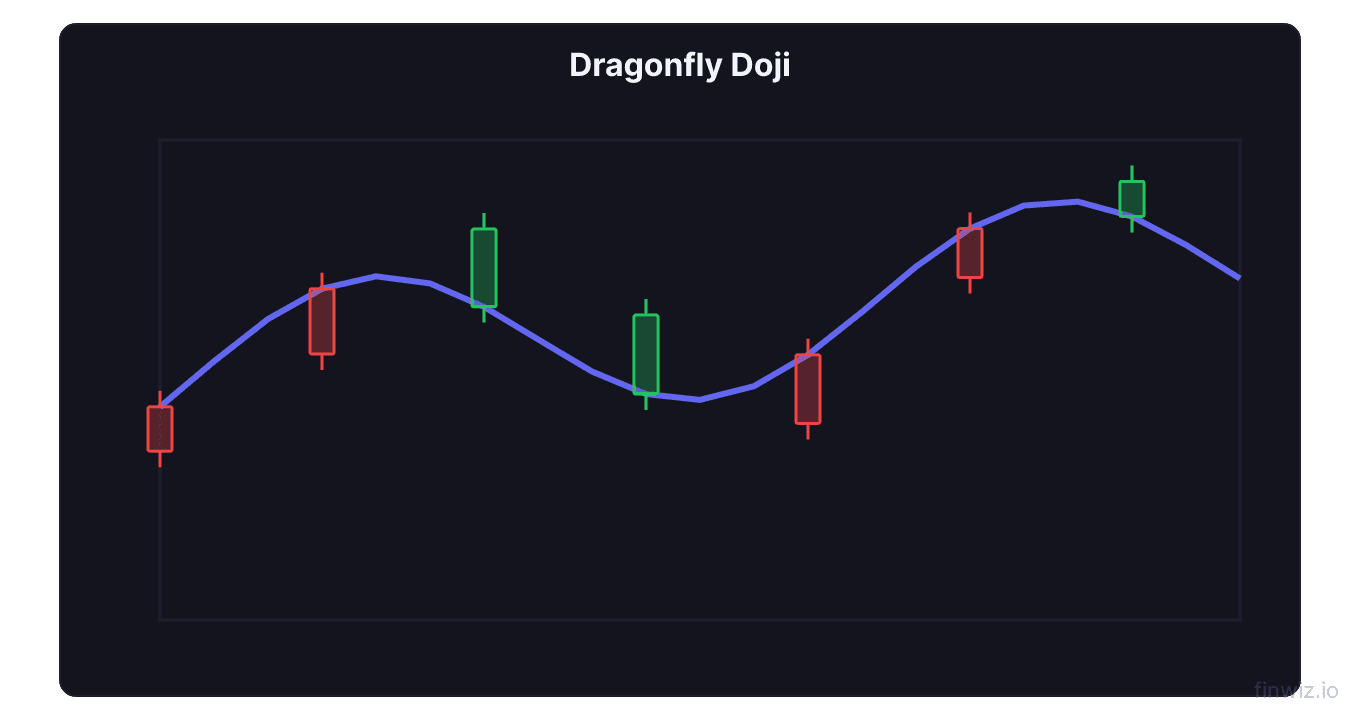
In a textbook dragonfly doji, the open, close, and high are all at exactly the same price. In practice, a small tolerance is acceptable — the open and close should be within a fraction of a percent of each other, and the high should be at or very near the same level. There should be no meaningful upper shadow.
The absence of an upper shadow means that buyers did not push the price above the opening level. Combined with the fact that the close returned to the open, this tells us the session was a contest between sellers (who pushed down) and buyers (who pushed back) — but not a contest where buyers pushed higher.
Lower Shadow
The lower shadow is the defining feature. It extends from the body down to the session low and should be at least two to three times the height of any body that exists. The longer the lower shadow, the more dramatic the intra-session selloff and recovery, and the more significant the signal.
A dragonfly doji with a lower shadow equal to 5% of the stock's price is a far more meaningful signal than one with a 1% shadow. The magnitude of the shadow reflects the intensity of the battle between buyers and sellers.
Body Size
The ideal dragonfly doji has no real body — the open and close are at exactly the same price. However, a tiny body (less than 5-10% of the candle's total range from high to low) is still generally classified as a dragonfly doji. If the body becomes too large, the pattern transitions into a hammer candlestick, which has similar but not identical implications.
Pro Tip
The Psychology Behind the Dragonfly Doji
Understanding the session dynamics behind the dragonfly doji explains why it is a potential reversal signal.
At the open, the stock begins trading at a certain price. Bears are in control from the previous downtrend, and the expectation is for continued selling.
During the session, sellers push the price sharply lower. The decline may represent panic selling, stop-loss triggers cascading, or aggressive short selling. At some point during this decline, the price reaches a level where buyers perceive value.
At the turning point, demand overwhelms supply. New buyers enter, short sellers begin covering, and the price starts climbing back toward the open. The buying continues throughout the remainder of the session.
At the close, the price has returned to exactly where it started. Every seller who sold during the decline is now underwater if they held. Every buyer who purchased during the dip is immediately profitable. The psychological message is clear: the market rejected the lower prices with conviction.
This rejection is particularly powerful at the bottom of a downtrend because it suggests that the selling pressure that has been driving the stock lower has been exhausted. The bears gave it their best shot during the session, pushed the price to new intra-session lows, and lost all their progress by the close.
Where the Dragonfly Doji Is Most Significant
Bottom of a Downtrend
The dragonfly doji carries the most weight when it appears at the end of a sustained downtrend. After multiple sessions of declining prices, the dragonfly doji signals that sellers are losing control and buyers are finding a floor. This is the classic reversal setup.
Look for dragonfly dojis that form:
- At established support levels
- At Fibonacci retracement levels
- At round-number psychological price levels ($50, $100, etc.)
- Near moving average support (50-day, 200-day)
- At Bollinger Band lower boundary
The more support factors converging at the dragonfly doji's level, the stronger the potential reversal signal.
Top of an Uptrend
A dragonfly doji at the top of an uptrend is less common and more ambiguous. It still shows that sellers pushed the price down significantly during the session and buyers recovered — but in the context of an uptrend, the aggressive selling itself is unusual and may warn of upcoming weakness, even though the buyers recovered this time.
Within a Range
A dragonfly doji in the middle of a trading range carries minimal significance. It is noise within a broader consolidation and should not be traded in isolation.
Confirmation Requirements
The dragonfly doji alone is a warning signal, not a trade signal. It must be confirmed by the subsequent candle or candles before acting on it.
Bullish Confirmation
The strongest confirmation is a bullish candle following the dragonfly doji that closes above the doji's high. This shows that the buying pressure signaled by the dragonfly doji has carried over into the next session, with buyers not only defending the doji's low but pushing meaningfully higher.
Ideal confirmation characteristics:
- The confirmation candle is a strong bullish candle (large body, small upper shadow)
- The confirmation candle closes above the dragonfly doji's open/close level
- Volume on the confirmation candle is above average
- No bearish reversal pattern immediately follows
Failed Dragonfly Doji
If the candle following the dragonfly doji is bearish and closes below the doji's low, the pattern has failed. The sellers have reasserted control, and the brief recovery during the doji session was just a temporary bounce. A failed dragonfly doji at the bottom of a downtrend suggests the downtrend will continue.
Trading the Dragonfly Doji
Entry
Enter long after the confirmation candle closes above the dragonfly doji's high. Use a limit order to buy on a pullback to the doji's close level if you want a better entry price, or use a market order if you want immediate execution and are willing to accept the higher price.
Stop Loss
Place your stop loss below the dragonfly doji's low — the bottom of the lower shadow. This level represents the point of maximum buyer rejection during the doji session. If price breaks below it, the reversal thesis is invalidated.
The distance from entry to stop loss can be significant because the dragonfly doji's lower shadow may be long. Use position sizing to ensure this wide stop does not expose you to excessive dollar risk.
Price Target
Set your profit target using one or more of these methods:
- Next resistance level: Identify the nearest overhead resistance from prior price action
- Risk-reward ratio: Set the target at 2:1 or 3:1 the distance of the stop loss
- Moving average target: Target a declining moving average above as the first resistance level
- Fibonacci extension: Use Fibonacci extensions projected from the doji's low
Dragonfly Doji vs. Hammer
The dragonfly doji and the hammer candlestick are often confused because they share similar shapes and implications. Both appear at the bottom of downtrends and signal potential bullish reversals. The distinction lies in the body.
| Feature | Dragonfly Doji | Hammer |
|---|---|---|
| Body | Virtually nonexistent (open = close) | Small but visible |
| Lower shadow | Long (2-3x body or more) | Long (2-3x body) |
| Upper shadow | None or negligible | None or very small |
| Signal | Bullish reversal (with confirmation) | Bullish reversal (with confirmation) |
| Indecision level | Extreme | High |
| Frequency | Less common | More common |
Both patterns tell the same story: sellers pushed lower and buyers recovered. The dragonfly doji tells this story in a more extreme way because the recovery was complete — no ground was lost at all. The hammer tells a similar but slightly weaker version because the close is slightly above or below the open, leaving a small body.
In practical trading, many traders group these patterns together and analyze them identically.
Dragonfly Doji vs. Gravestone Doji
The dragonfly doji and the gravestone doji are opposite patterns — mirror images of each other.
| Feature | Dragonfly Doji | Gravestone Doji |
|---|---|---|
| Shape | T-shaped (shadow below) | Inverted T-shaped (shadow above) |
| Shadow location | Long lower shadow | Long upper shadow |
| Body location | At the top of the range | At the bottom of the range |
| Reversal signal | Bullish (at bottom of downtrend) | Bearish (at top of uptrend) |
| Psychology | Sellers failed | Buyers failed |
The gravestone doji forms when the open, low, and close are all at the same price, with a long upper shadow. It shows that buyers pushed prices higher during the session but sellers reclaimed all gains by the close. At the top of an uptrend, the gravestone doji warns of a potential bearish reversal — the exact opposite of the dragonfly doji's bullish signal.
Both the dragonfly and gravestone dojis are specialized forms of the standard doji, which has both upper and lower shadows and signals more general indecision without a directional bias.
Volume and the Dragonfly Doji
Volume provides important context for dragonfly doji signals.
High-volume dragonfly doji. A dragonfly doji formed on above-average volume is a stronger signal because it indicates that the selling pressure (and subsequent recovery) involved significant participation. Many traders were involved in both the decline and the recovery, making the rejection of lower prices more meaningful.
Low-volume dragonfly doji. A dragonfly doji on light volume may simply reflect thin trading conditions rather than a genuine battle between buyers and sellers. Low-volume dragonfly dojis in quiet markets (holidays, summer sessions) should be viewed with skepticism.
Use OBV or the accumulation/distribution line to confirm whether the volume pattern supports accumulation (buying) at the doji's level.
Combining with Indicators
RSI divergence. If the RSI shows bullish divergence (price making lower lows while RSI makes higher lows) and a dragonfly doji forms, the reversal signal is significantly strengthened.
Bollinger Band touch. A dragonfly doji forming at or below the lower Bollinger Band combines statistical extremity with candlestick-based evidence of buyer rejection of lower prices.
MACD histogram. If the MACD histogram is becoming less negative (shrinking bars) when the dragonfly doji forms, momentum is shifting in favor of the reversal.
Moving average proximity. A dragonfly doji forming at the 50-day or 200-day moving average adds moving average support to the candlestick signal, increasing the probability of a bounce.
Frequently Asked Questions
Is the dragonfly doji always bullish?
The dragonfly doji is most commonly interpreted as bullish, especially when it appears at the bottom of a downtrend. However, context matters. At the top of an uptrend, a dragonfly doji can be a warning sign that sellers are becoming active, even though buyers recovered during the session. Always consider the surrounding trend and wait for confirmation.
How rare is the dragonfly doji?
The dragonfly doji is less common than the standard doji because it requires all three values (open, high, close) to converge at the same price with only a lower shadow. On daily charts of actively traded stocks, you might see a dragonfly doji a few times per year on any given stock. Its relative rarity adds to its significance.
Can a dragonfly doji appear on any timeframe?
Yes. Dragonfly dojis form on all timeframes, from 1-minute charts to monthly charts. However, dragonfly dojis on higher timeframes (daily, weekly) carry more weight because they represent more market participants and a longer battle between buyers and sellers. An intraday dragonfly doji on a 5-minute chart is far less significant than one on a daily chart.
What if the dragonfly doji has a very small upper shadow?
A dragonfly doji with a tiny upper shadow is still valid as long as the upper shadow is negligible compared to the lower shadow. Some technicians allow an upper shadow up to 5-10% of the candle's total range. If the upper shadow becomes substantial, the candle is better classified as a standard doji or a spinning top.
Should I trade every dragonfly doji I see?
No. Dragonfly dojis are only tradeable in the right context — primarily at the bottom of downtrends at established support levels with volume confirmation and bullish follow-through. Dragonfly dojis in the middle of ranges or without confirmation should be ignored. Selectivity is essential for profitability with any candlestick pattern.
What is the difference between a dragonfly doji and a pin bar?
A pin bar is a price action concept that includes both hammer-like and shooting-star-like candles. A dragonfly doji is a specific candlestick pattern with precise requirements (open = close = high). All dragonfly dojis could be classified as bullish pin bars, but not all bullish pin bars qualify as dragonfly dojis.
Disclaimer
This is educational content, not financial advice. Trading involves risk, and you should consult a qualified financial advisor before making any investment decisions. Past performance does not guarantee future results.
12 chapters covering charts, indicators, risk management & more. Plus weekly trading insights.