
Limit Order vs Market Order: Key Differences Explained
⚡ Key Takeaways
- Market orders prioritize execution speed; limit orders prioritize price control
- In liquid markets with tight spreads, the difference between market and limit orders is often negligible
- In illiquid or volatile markets, limit orders can save significant money by preventing slippage
- Most experienced traders default to limit orders and only use market orders when immediate execution is critical
- The choice depends on the specific situation: urgency, liquidity, and the width of the bid-ask spread
Limit Order vs. Market Order: When to Use Each
Choosing between a limit order and a market order is one of the most common decisions traders face. The choice comes down to a simple trade-off: speed vs. price.
A market order says: "Execute now at whatever price is available." A limit order says: "Execute only at my price or better."
Both have valid use cases, and understanding when to use each will improve your execution and protect your capital.
The Core Trade-Off: Speed vs. Price
| Attribute | Market Order | Limit Order |
|---|---|---|
| Speed | Immediate | May take time or not fill |
| Price certainty | None | Full control |
| Execution certainty | Guaranteed | Not guaranteed |
| Slippage | Possible | None |
| Complexity | Simple | Slightly more complex |
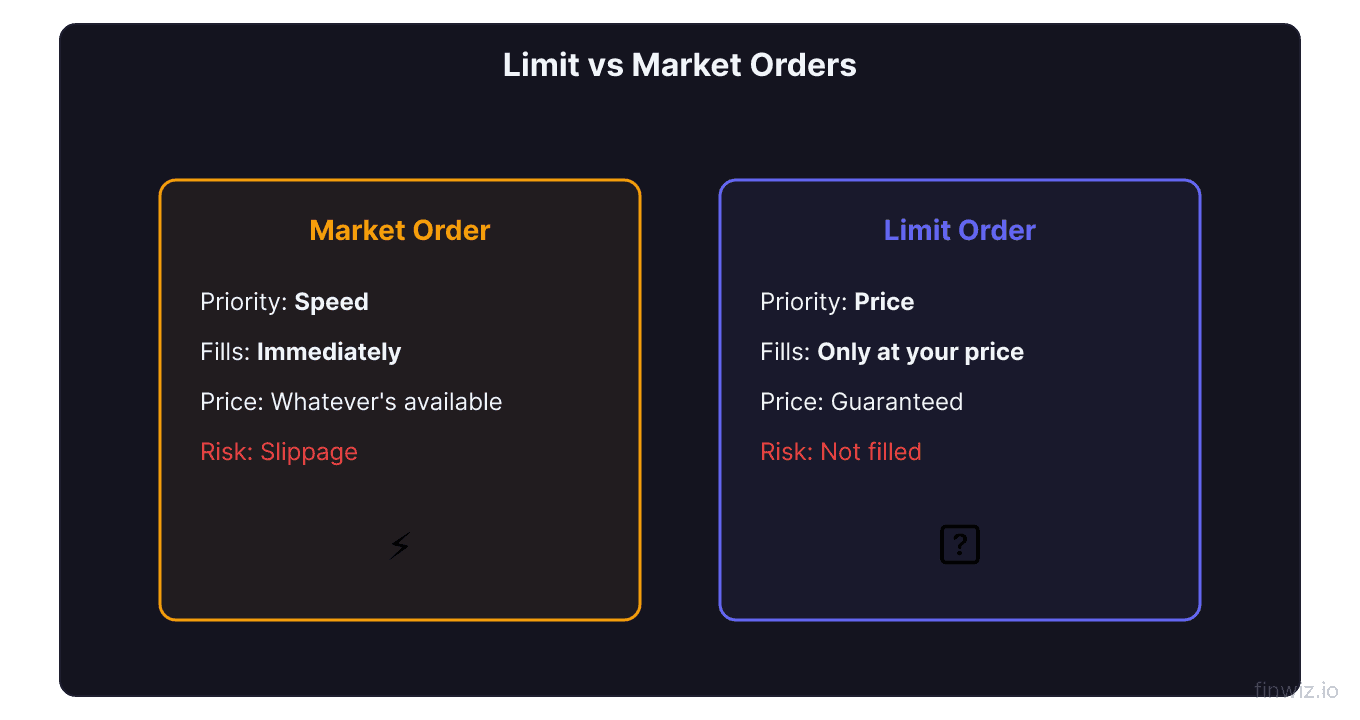
In theory, you should always use limit orders because they give you better price control. In practice, there are situations where the speed of a market order is worth the potential cost.
When Market Orders Make Sense
Fast-Moving Breakouts
When a stock is breaking out on heavy volume and you need to enter immediately, a market order ensures you participate. Placing a limit order a few cents above the current price risks the stock running away while your order sits unfilled.
Exiting Losing Trades
When you need to exit a losing position at your stop level, a market order guarantees you get out. This is why most stop-loss orders convert to market orders when triggered: the priority is exiting, not getting the perfect price.
Highly Liquid Markets
In stocks and ETFs with extremely high volume and penny-wide bid-ask spreads, the cost difference between a market order and a limit order is trivial. A market order to buy SPY will typically fill within a penny of the quoted price.
Small Positions
If you are buying or selling a small number of shares relative to the stock's daily volume, the market impact of your order is negligible. A market order for 100 shares of a stock trading 10 million shares per day will have virtually no slippage.
When Limit Orders Make Sense
Planned Entries at Specific Levels
When your trading plan calls for buying at a specific support level or selling at a specific resistance level, a limit order ensures you get your desired price. This is the standard approach for swing trading entries and exits.
Illiquid Stocks
For stocks with low volume or wide bid-ask spreads, limit orders are essential. A market order on a stock with a $0.50 spread means you start the trade with $0.50 per share working against you. Over multiple trades, this cost compounds significantly.
Options Trading
Options almost always have wider spreads than their underlying stocks. Market orders on options can cost you $0.10 to $0.50 or more per contract in unfavorable fills. Always use limit orders for options. Set your limit between the bid and ask (the mid-price) as a starting point.
Large Orders
If your order represents a meaningful percentage of the stock's typical volume, a market order can move the price against you. Limit orders cap your cost and prevent you from filling across multiple unfavorable price levels.
Pre-Market and After-Hours
Liquidity during extended hours is significantly lower. Market orders during these sessions can fill at prices far from the regular session quotes. Many brokers require limit orders during extended hours for this reason.
Pro Tip
The Marketable Limit Order: Best of Both Worlds
A marketable limit order is a limit order set at or slightly beyond the current best price, ensuring immediate execution while still providing a price ceiling.
How It Works
If a stock has an ask of $50.00 and you place a buy limit at $50.10, your order will fill immediately at $50.00 (or wherever the best offer is, up to $50.10). You get market-order speed with a $0.10 safety net against unexpected price jumps.
This technique is especially useful during volatile moments when you want quick execution but want to avoid paying an extreme price on a sudden spike.
Cost Comparison Across Scenarios
| Scenario | Market Order Cost | Limit Order Cost |
|---|---|---|
| Liquid large-cap (1-cent spread) | ~$0.01/share | $0.00 (but may not fill) |
| Mid-cap (5-cent spread) | ~$0.05/share | $0.00 |
| Small-cap (25-cent spread) | ~$0.25/share | $0.00 |
| Fast-moving breakout | $0.05-0.50/share | $0.00 (but may miss trade) |
| Low liquidity/OTC | $0.50+/share | $0.00 |
| After-hours | Highly variable | $0.00 |
Over hundreds of trades, the cost of consistently using market orders on stocks with meaningful spreads can represent a significant drag on performance. This is why experienced traders default to limit orders.
Psychological Considerations
Market orders are emotionally satisfying because they execute immediately. You see the trade happen. This feels decisive and confident.
Limit orders can be emotionally frustrating because the stock might come within pennies of your price and then reverse without filling you. Missing a profitable trade because your limit was too aggressive is one of the most irritating experiences in trading.
Managing this frustration is part of trading discipline. The times your limit order protects you from overpaying or from entering a bad trade at a poor price more than compensate for the times you miss an entry by a few pennies.
Decision Framework
Use this quick framework to decide:
- Is the bid-ask spread 2 cents or less? Market order is fine.
- Is the bid-ask spread wider than 2 cents? Use a limit order.
- Am I exiting a losing trade at my stop level? Market order (via stop-loss).
- Am I entering a planned setup at a specific level? Limit order.
- Is this an emergency exit? Market order.
- Am I trading options? Always limit order.
- Is it pre-market or after-hours? Always limit order.
Frequently Asked Questions
Do I save money using limit orders?
Over time, yes. Each limit order may only save you a few cents per share, but across hundreds of trades, this adds up to a meaningful improvement in your average fill prices. The savings are most significant on stocks with wider bid-ask spreads.
What if my limit order never fills?
If your limit order does not fill, you miss the trade. This is the cost of price control. You can mitigate this by setting your limit slightly above the current ask (for buys) or slightly below the current bid (for sells) to increase fill probability while still maintaining some price protection.
Should day traders use market orders or limit orders?
Most successful day traders use limit orders for entries and stop-loss orders (market-type) for exits. Some use marketable limit orders for quick entries during fast moves. The choice depends on how liquid the stocks they trade are and how time-sensitive the entry is.
Can I switch between order types mid-trade?
Yes. You can enter a trade with a limit order and place a market order to exit (or vice versa). You can also modify or cancel pending orders at any time before they fill. Your entry order type does not affect your exit options.
Is there a commission difference between market and limit orders?
With most modern brokers, no. Commission-free brokers charge the same (nothing) for both order types. Even brokers that charge commissions typically charge the same rate regardless of order type.
Disclaimer
This is educational content, not financial advice. Trading involves risk, and you should consult a qualified financial advisor before making any investment decisions. Past performance does not guarantee future results.
Additional Considerations
Order Types and Trading Platforms
Different brokerage platforms offer varying levels of order type functionality. When choosing a broker, verify that it supports the order types your trading plan requires. Key features to confirm include:
- Support for bracket orders and OCO (One-Cancels-Other) logic
- Trailing stop functionality with both percentage and dollar-based options
- Stop-limit orders with customizable buffer distances
- Extended hours order capability
- Mobile app support for all order types (not just market and limit)
- Conditional orders that trigger based on price, time, or other criteria
Many beginning traders start with a broker that offers limited order types and later realize they need more sophisticated tools. Consider your future needs when choosing a platform, not just your current requirements.
Order Type Selection by Market Condition
The optimal order type varies with market conditions:
During normal volatility, limit orders are the default choice for entries and profit targets. They provide price control with reasonable fill probability.
During high volatility, consider using wider limit prices or market orders for urgent exits. Spreads widen during volatility, making tight limit orders less likely to fill when you need them most.
During pre-market and after-hours sessions, always use limit orders. Market orders in extended hours can fill at prices far from the last regular-session price.
During earnings announcements and major news events, be prepared for rapid price changes that can affect all order types. Stop-loss orders may fill with significant slippage, and stop-limit orders may not fill at all.
Building an Order Type Workflow
Develop a consistent workflow for placing orders:
- Analyze the chart and identify your entry, stop, and target levels
- Calculate position size based on your stop distance
- Select the appropriate entry order type (limit for planned levels, stop for breakouts)
- Set your protective stop (stop-loss or stop-limit based on your preference)
- Set your profit target (limit order at your target level)
- Consider a bracket order to automate steps 3-5 as a single package
- Review all order details before submitting
This systematic approach ensures you never enter a trade without complete risk management in place.
12 chapters covering charts, indicators, risk management & more. Plus weekly trading insights.