
Order Fills: How Trade Execution Works
⚡ Key Takeaways
- An order fill is the completion of a buy or sell order — it means your order has been matched with a counterparty and shares have changed hands at a specific price
- Full fills execute your entire order at once, while partial fills execute only a portion, leaving the rest open — partial fills are common with limit orders on less liquid stocks
- The NBBO (National Best Bid and Offer) is the tightest available spread across all exchanges and sets the baseline for execution quality — your broker is legally required to match or beat it
- Order routing determines which exchange or market maker handles your trade, and different routing paths produce different fill quality, speed, and price improvement
- Execution quality varies significantly across brokers — factors like price improvement, fill rate, and speed can save or cost active traders thousands of dollars annually
What Is an Order Fill?
An order fill occurs when your buy or sell order is matched with a counterparty and executed. When you submit an order to buy 100 shares of AAPL, that order is not complete until someone on the other side agrees to sell you those shares at a mutually acceptable price. The fill is the moment that match happens.
Every fill has three core attributes: price (what you paid or received per share), quantity (how many shares executed), and time (when the execution occurred). These three data points appear on your trade confirmation and determine the actual economics of your trade — not what you intended, but what actually happened.
Understanding fills matters because the gap between what you expect and what you get is real money. A trader who does not understand fill mechanics is flying blind on one of the most fundamental aspects of trading. This is especially true for active traders executing dozens of trades daily, where small differences in fill quality compound into significant annual costs — a concept closely related to slippage.
Full Fills vs. Partial Fills
A full fill means your entire order executed at once. You wanted 500 shares, you got 500 shares. Full fills are the norm when you use market orders on liquid stocks. If you market-buy 500 shares of MSFT during regular hours, the order book has more than enough liquidity to fill you instantly.
A partial fill means only part of your order executed. You wanted 500 shares but only got 200. The remaining 300 shares stay open as a working order until they fill, you cancel, or the order expires. Partial fills happen most often with limit orders when the stock touches your price but does not have enough volume at that level to fill the entire order.
Partial Fill Example:Partial fills create practical problems. If you planned to buy 1,000 shares and set a stop-loss based on that position size, getting only 350 shares changes your risk math. Your commission structure may also charge per execution, meaning five partial fills cost more than one full fill on some brokers. Always check your fill status after placing limit orders on less liquid names.
Pro Tip
The NBBO: Your Execution Quality Benchmark
The NBBO (National Best Bid and Offer) is the tightest bid-ask spread available across all U.S. stock exchanges at any given moment. If NYSE has AAPL bid at $192.48 and Nasdaq has AAPL offered at $192.49, the NBBO is $192.48 × $192.49 — a one-cent spread.
SEC regulations require brokers to fill customer orders at the NBBO or better. This is called the Order Protection Rule (Rule 611 of Regulation NMS). Your broker cannot fill your buy order at $192.55 when the national best offer is $192.49. This rule exists to ensure that retail investors get fair execution regardless of which broker they use.
However, "at the NBBO or better" leaves room for significant variation. Some brokers consistently achieve price improvement — filling your order at a price better than the NBBO. If the NBBO ask is $192.49 and your broker fills you at $192.485, that half-cent improvement saves you $0.50 on a 100-share order. Across thousands of trades, price improvement adds up.
Brokers publish their execution quality statistics quarterly as required by SEC Rule 605 and Rule 606 reports. These reports show average price improvement, fill rates, and execution speed. Reviewing these reports is one of the most overlooked steps in choosing a broker.
How Order Routing Affects Your Fills
Order routing is the process by which your order travels from your broker to the venue where it gets executed. The route your order takes directly impacts fill quality.
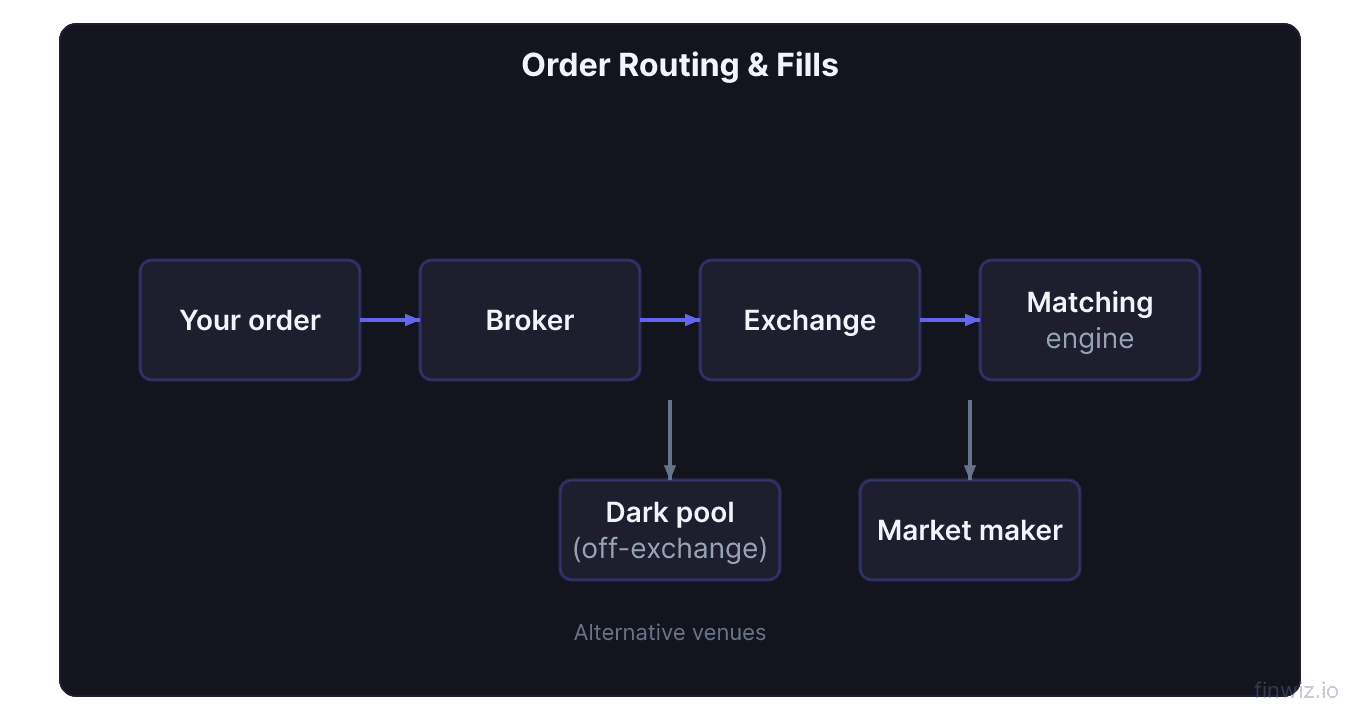
When you press "buy" on your trading platform, your order goes to your broker's system. The broker then decides where to send it: directly to an exchange (NYSE, Nasdaq, CBOE), to an electronic communication network (ECN), or to a market maker (like Citadel Securities or Virtu Financial).
Many retail brokers engage in payment for order flow (PFOF) — they route your orders to market makers who pay the broker for the privilege of filling your trades. The market maker profits from the bid-ask spread and the information value of seeing retail order flow. In exchange, market makers typically offer price improvement relative to the NBBO.
The debate over whether PFOF helps or hurts retail traders is ongoing. Proponents argue that market makers provide better prices than exchanges for small orders. Critics argue that the practice creates conflicts of interest and that retail traders would get even better fills on transparent exchanges.
Order Routing Comparison (hypothetical 100-share AAPL buy, NBBO ask = $192.49):Pro Tip
What Affects Execution Quality
Several factors beyond order type and routing influence how your fills turn out.
Time of day has a major impact. The first and last 30 minutes of the trading day have the highest volume and tightest spreads on most stocks, but also the fastest price movements. Midday (11:30 AM - 2:00 PM ET) typically has lower volume and potentially wider effective spreads on smaller names.
Stock liquidity is fundamental. SPY fills 80+ million shares daily with a $0.01 spread. A small-cap biotech trading 100,000 shares daily might have a $0.05-$0.15 spread. The difference in fill quality between these two names is enormous.
Order size relative to available liquidity matters. An order for 100 shares of AMZN fills instantly at the best price. An order for 50,000 shares needs to work through multiple price levels, creating market impact that worsens your average fill price. Institutional traders use algorithms specifically designed to minimize this impact by spreading large orders across time and venues.
Market conditions play a role too. During calm markets, fills are predictable and tight. During volatile events — earnings, Fed announcements, geopolitical shocks — spreads widen, liquidity thins, and fill quality deteriorates for everyone.
Frequently Asked Questions
Why did my limit order not fill even though the stock hit my price?
Your limit buy order at $50.00 requires a seller willing to sell at $50.00 or less. If the stock briefly touches $50.00 but only a handful of shares trade there before bouncing, those shares may fill other orders that arrived before yours (price-time priority). Your order was in the queue but did not reach the front before the price moved away. This is more common on less liquid stocks and during fast-moving markets.
Do partial fills cost more in commissions?
It depends on your broker. Some brokers charge per trade (one commission regardless of how many partial fills make up the execution). Others charge per execution or per share. If your broker charges per execution, five partial fills on the same order could cost five times as much as a single full fill. Check your broker's fee schedule — this is an often-overlooked cost for limit order users.
How can I check my broker's execution quality?
Every broker is required to publish quarterly Rule 605 and Rule 606 reports. Rule 605 shows execution quality metrics (price improvement, fill rates, speed). Rule 606 shows where orders are routed (which market makers and exchanges). These reports are typically available on the broker's website under "disclosures" or "regulatory." Compare multiple brokers to see who consistently delivers better fills.
Related Articles
12 chapters covering charts, indicators, risk management & more. Plus weekly trading insights.