
GTC Orders: Good 'Til Cancelled & Other Time-in-Force Types
⚡ Key Takeaways
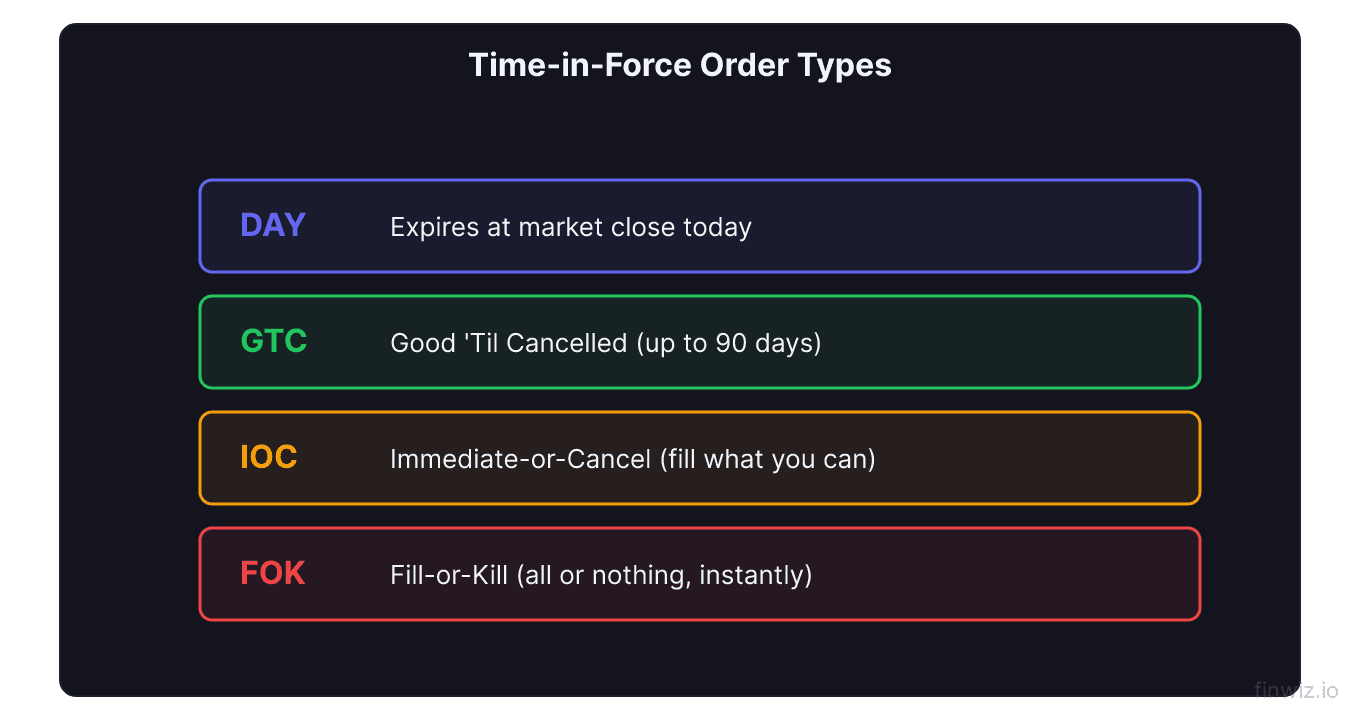
- A GTC (good til cancelled) order remains active until it is either filled or manually cancelled, typically with a broker-imposed maximum of 60 to 180 days
- A day order automatically expires at the end of the regular trading session (4:00 PM ET) if not filled — this is the default setting at most brokerages
- IOC (immediate or cancel) orders demand instant execution — any unfilled portion is immediately cancelled
- FOK (fill or kill) orders require the entire order quantity to be filled immediately or the order is cancelled completely
- Choosing the right time-in-force (TIF) setting ensures your orders behave the way you intend and prevents unwanted fills on forgotten orders
What Is a GTC Order?
A GTC order — short for good til cancelled — is a time-in-force instruction that keeps your order active in the market until it is either executed or you manually cancel it. Unlike day orders that expire when the trading session ends, GTC orders persist across multiple trading sessions, patiently waiting for the market to reach your specified price.
If you want to buy shares of Tesla at $200 but the current price is $245, a GTC limit buy at $200 will sit on the order book day after day, week after week, waiting for the price to drop to your target. You set it and walk away, knowing the order will execute automatically whenever the market reaches your price — even if that happens three weeks from now while you are on vacation.
GTC orders are ideal for patient, disciplined investors who have identified specific price levels for entries and exits but do not want to manually re-enter orders every day. They are particularly useful for setting profit targets on existing positions and establishing limit buys at support levels you expect the stock to revisit.
How Day Orders Work
A day order is the default time-in-force setting at most brokerages. It remains active only during the current regular trading session — from 9:30 AM to 4:00 PM Eastern Time. If the order is not filled by the close of trading, it is automatically cancelled and you must re-enter it the next day if you still want it.
Day orders are the most commonly used TIF setting and serve the vast majority of trading scenarios. They align with the natural rhythm of active traders who evaluate positions and set orders each morning as part of their trading routine.
Key characteristics of day orders:
- Automatically expire at 4:00 PM ET (or at the end of the extended session if you specifically selected extended hours)
- Must be re-entered each trading day
- No risk of forgotten orders filling weeks later on changed analysis
- Default setting — you must actively change to GTC or another TIF if you want different behavior
- Particularly appropriate for day trading strategies where positions are not held overnight
Pro Tip
If you use day orders and trade around key technical levels, consider setting up alerts or a watchlist to remind you to re-enter orders each morning. Missing a re-entry because you forgot to place the order again can mean missing a trade you planned and analyzed. Some platforms allow you to save order templates that pre-fill price, quantity, and other parameters for quick re-entry.
GTC vs. Day Orders: When to Use Each
The choice between GTC and day orders depends on your trading style, time horizon, and how actively you monitor your positions.
| Feature | GTC Order | Day Order |
|---|---|---|
| Duration | Active until filled or cancelled (60-180 days max) | Expires at session close |
| Best for | Swing traders, investors, profit targets | Day traders, active traders |
| Risk | Forgotten orders filling on stale analysis | Missing entries by forgetting to re-enter |
| Maintenance | Set once, review periodically | Must re-enter daily |
| Market conditions | Works well when waiting for specific levels | Preferred in fast-moving, volatile markets |
Use GTC orders when:
- You have a firm price target that will not change based on daily market action
- You are setting profit takes or stop-loss orders on longer-term positions
- You are a swing trader or investor with entries at specific technical or fundamental levels
- You want to avoid the daily administrative task of re-entering orders
Use day orders when:
- You are day trading and all positions should be closed by market close
- Your analysis changes daily based on market conditions
- You are trading around catalysts like earnings reports where the setup is time-sensitive
- You want maximum control over your active orders
GTC Order Duration Limits
While "good til cancelled" implies indefinite duration, brokers impose maximum time limits on GTC orders for practical and regulatory reasons.
Common broker GTC limits:
- Charles Schwab / TD Ameritrade: 180 calendar days
- Fidelity: 180 calendar days
- Interactive Brokers: GTC orders can persist indefinitely but are reviewed periodically
- Robinhood: 90 calendar days
- Webull: 60 calendar days
- E*TRADE: 60 calendar days
When a GTC order reaches its maximum duration, it is automatically cancelled by the broker. You will typically receive a notification, but if you still want the order active, you must re-enter it. Mark your calendar with GTC order expiration dates for any orders you want to maintain.
Immediate or Cancel (IOC) Orders
An IOC (immediate or cancel) order demands execution the moment it reaches the market. Any portion that can be filled immediately is executed, and any remaining unfilled quantity is cancelled instantly — there is no waiting on the order book.
IOC Order Behavior:IOC orders are used by traders who want to test the current depth of the market without leaving a resting order. If there is sufficient liquidity at your price right now, you get filled. If not, you move on rather than advertising your intent on the order book.
Common use cases for IOC orders:
- Algorithmic trading: Algorithms use IOC orders to sweep available liquidity without exposing their full order size
- Testing liquidity: Traders can gauge how much size is available at a price without committing to a standing order
- Time-sensitive trades: When you want to participate at a specific price only if it is available right now
- Avoiding information leakage: Large resting orders reveal trading intent to other market participants. IOC orders minimize this exposure
Partial fills are common with IOC orders. If you place an IOC buy for 5,000 shares and only 2,000 are available, you receive 2,000 shares and the remaining 3,000 are cancelled. You can then decide whether to place another order for the remainder.
Fill or Kill (FOK) Orders
A FOK (fill or kill) order is the most demanding TIF instruction. It requires the entire order quantity to be filled immediately — if even one share cannot be filled, the entire order is cancelled. There are no partial fills with FOK orders.
FOK Order Behavior:FOK orders are relatively rare in retail trading but have specific applications:
- Block trades: Institutional investors who need a specific quantity and do not want to manage multiple partial fills
- Portfolio rebalancing: When precise share counts are needed to achieve target allocations
- Hedging: When the hedge only works if the full offsetting position is established
- Options strategies: When all legs of a multi-leg strategy must be filled simultaneously (though multi-leg orders have their own execution logic)
The trade-off is clear: FOK orders are the most likely to go unfilled because the market must have sufficient depth at your price to complete the entire order instantly.
Extended Hours Time-in-Force
Extended hours trading sessions — pre-market (4:00 AM - 9:30 AM ET) and after-hours (4:00 PM - 8:00 PM ET) — have their own TIF considerations.
Most brokers offer specific TIF options for extended hours:
- EXT (Extended hours): The order is active only during the extended session and expires at the end of that session
- GTC+EXT: The order is active during both regular and extended sessions and persists across days until filled or cancelled
- DAY+EXT: Active during the regular session and the extended session on the same day only
Pro Tip
Extended hours orders are almost always required to be limit orders. Brokers do not allow market orders during pre-market or after-hours because liquidity is thin and prices can be far from regular-session levels. If you are trading during extended hours, set your limit price carefully and consider that spreads are typically wider and fills may be at less favorable prices.
When trading during extended hours, pay special attention to which session your order applies to. A day order entered at 8:00 AM ET intended for the pre-market session will expire at 9:30 AM when the regular session opens unless you selected a TIF that covers both sessions. Review your broker's specific extended-hours TIF options in their help documentation.
Other Time-in-Force Options
Beyond the standard TIF types, some brokers and trading platforms offer additional options.
Good Til Date (GTD)
A GTD order lets you specify an exact expiration date rather than using the broker's default GTC maximum. If you want an order to remain active for exactly two weeks, you set the expiration date to two weeks from today. This is useful when your analysis is tied to a specific event — for example, setting an order that expires the day before an earnings announcement.
At the Open (OPG)
An OPG order is designed to participate in the opening auction. It is submitted before the market opens and executes only during the opening cross at 9:30 AM ET. If it cannot be filled during the opening process, it is cancelled. This TIF is used by traders who want to participate at the official opening price.
At the Close (LOC / MOC)
Limit on Close (LOC) and Market on Close (MOC) orders execute during the closing auction. They participate in the 4:00 PM ET closing cross, which determines the official closing price. These are used by index fund managers, institutional traders, and others who need the official closing price for benchmark or NAV calculations.
Good After Time (GAT)
Some platforms support GAT orders that remain inactive until a specified time and then become active. A trader might set an order that becomes active at 10:00 AM, avoiding the volatility of the first 30 minutes while still participating in the rest of the session.
Managing Your Open Orders
Regardless of which TIF type you use, actively managing open orders is critical.
Review open orders daily: Even GTC orders deserve a daily glance. Has the fundamental or technical picture changed? Has news altered your thesis? An order that made sense a week ago may no longer be appropriate.
Set alerts at key levels: Rather than relying solely on standing orders, set price alerts at levels near your GTC orders. When an alert triggers, you can evaluate whether the order still makes sense before it fills.
Cancel before corporate events: If a stock has a pending stock split, merger, or other corporate action, outstanding GTC orders may be cancelled automatically by the broker — but not always. Cancel and re-enter orders around corporate events to avoid confusion.
Know your broker's policies: Different brokers handle GTC orders differently during corporate actions, trading halts, and exchange-wide circuit breakers. Read your broker's order handling documentation to understand how your orders will be treated in unusual circumstances.
Use order alerts and confirmations: Enable email or push notifications for order fills. A GTC order that fills while you are away from your screen should generate an immediate notification so you can adjust any related orders (stops, targets, hedges).
Frequently Asked Questions
What is the most common time-in-force used by retail traders?
Day orders are the most common TIF for retail traders because they are the default setting at most brokerages. GTC is the second most common, primarily used for setting profit targets and limit buy orders at lower prices. IOC and FOK are rarely used by retail traders but are common among institutional and algorithmic traders.
Can I change a GTC order after placing it?
Yes. You can modify the price, quantity, or other parameters of a GTC order at any time while it remains open. The modified order typically resets its position in the order book queue — if there are other orders at the same price, your modified order goes to the back of the line. Some traders cancel and re-enter rather than modify to ensure they understand exactly what the active order looks like.
What happens to my GTC order over a weekend or holiday?
GTC orders remain in the system over weekends and market holidays. They do not expire during non-trading days and will be active when the market reopens. However, if significant news occurs over a weekend, the stock may gap past your order price at Monday's open. Your limit order will fill at the opening price if it is at or better than your limit.
Do GTC orders work in extended hours?
Only if you specifically selected a TIF that includes extended hours (such as GTC+EXT). A standard GTC order without the extended hours modifier is only active during regular trading hours (9:30 AM - 4:00 PM ET). Check your broker's TIF options to ensure your order is active during the sessions you want.
Can I place a GTC market order?
Technically, some brokers allow GTC market orders, but this is generally inadvisable. A GTC market order would execute immediately during the next available session at whatever price is available. Since the price could change significantly between sessions, this combination provides no price protection and no timing benefit. Always pair GTC duration with a limit price to maintain control over your execution price.
Disclaimer
This is educational content, not financial advice. Trading involves risk, and you should consult a qualified financial advisor before making any investment decisions. Past performance does not guarantee future results.
Related Articles
12 chapters covering charts, indicators, risk management & more. Plus weekly trading insights.