
Market Orders: When Speed Matters More Than Price
⚡ Key Takeaways
- A market order executes immediately at the best available price, prioritizing speed over price precision
- Market orders guarantee execution but do not guarantee the exact fill price
- Slippage occurs when the fill price differs from the expected price, especially in fast-moving or illiquid markets
- Market orders are best used when speed of execution is more important than getting the perfect price
- In thin markets with wide bid-ask spreads, market orders can result in significantly worse fills
What Is a Market Order?
A market order is the simplest and most straightforward order type. It instructs your broker to buy or sell a stock immediately at the best available price. There is no price condition; the order fills as soon as it reaches the exchange.
When you click "Buy" or "Sell" on most brokerage platforms, you are typically placing a market order. Speed is the priority. The trade happens now, at whatever price the market offers.
Market orders guarantee execution but do not guarantee the price. This distinction is critical and is the fundamental trade-off between market orders and limit orders.
How Market Orders Execute
When you place a buy market order, it fills at the lowest ask price available. When you place a sell market order, it fills at the highest bid price available.
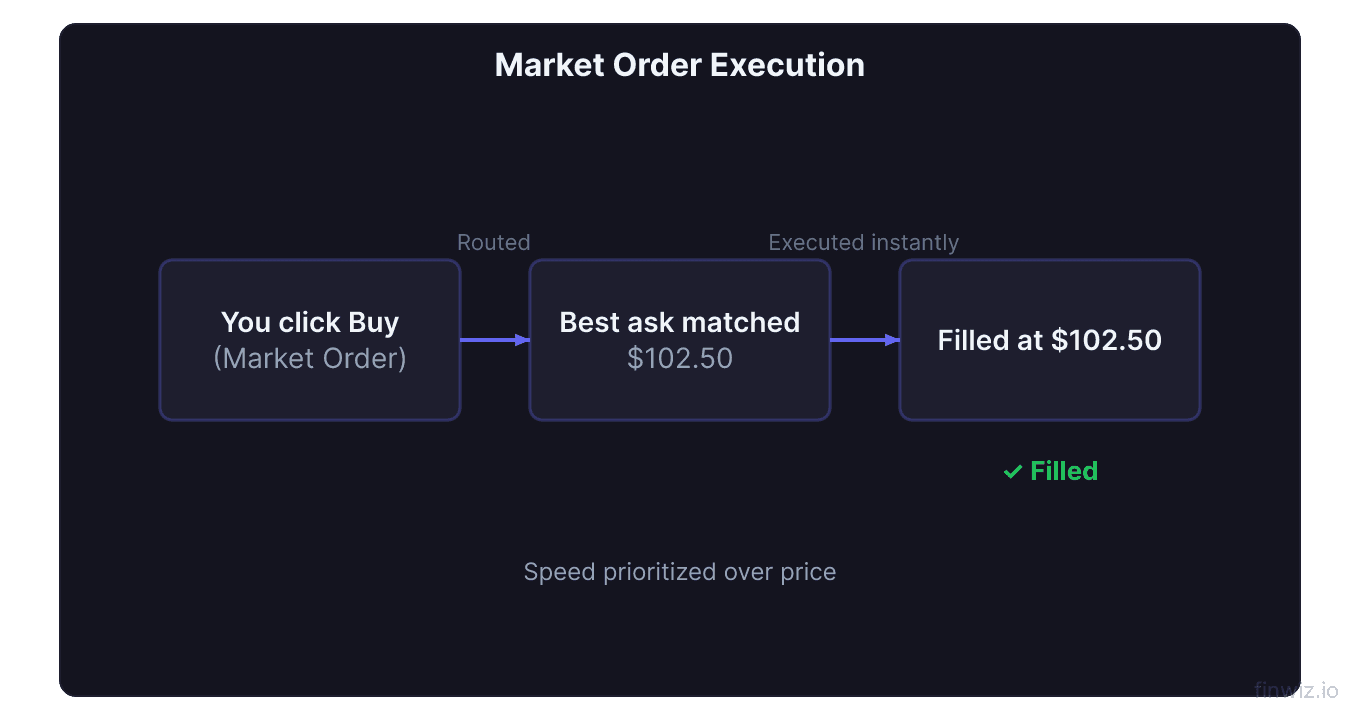
Example: Buying
A stock has a bid of $49.95 and an ask of $50.00. If you place a market buy order for 100 shares, you will pay $50.00 per share (the ask price). Your order fills immediately.
Example: Selling
Using the same stock (bid $49.95, ask $50.00), if you place a market sell order for 100 shares, you receive $49.95 per share (the bid price). Again, the order fills immediately.
The difference between the bid and ask ($0.05 in this example) is the bid-ask spread. You always buy at the ask and sell at the bid with market orders, which means you incur the spread as a cost on every trade.
Understanding Slippage
Slippage is the difference between the expected fill price and the actual fill price. It occurs when the market moves between the time you see a price and the time your order executes.
Why Slippage Happens
- Fast-moving markets: During high volatility, prices change rapidly. By the time your order reaches the exchange, the price has moved.
- Large orders: If you buy more shares than are available at the best ask price, your order fills at progressively worse prices (price impact).
- Thin markets: Stocks with low volume and wide bid-ask spreads have fewer shares available at each price level, increasing the likelihood of slippage.
Example of Slippage
You see a stock at $50.00 and place a market buy order for 1,000 shares. The order book looks like this:
- 200 shares offered at $50.00
- 300 shares offered at $50.05
- 500 shares offered at $50.10
Your 1,000 shares fill across multiple price levels: 200 at $50.00, 300 at $50.05, and 500 at $50.10. Your average fill price is $50.065, not $50.00. You experienced $0.065 in slippage per share, or $65 total.
Pro Tip
When to Use Market Orders
When Speed Matters More Than Price
If you need to exit a losing position immediately because your stop level has been reached, a market order ensures you get out. Waiting for a limit order to fill in a falling market can result in much larger losses.
Highly Liquid Stocks
On stocks that trade millions of shares per day with penny-wide spreads (think large-cap names and major ETFs), the slippage on a market order is minimal. A market order to buy 500 shares of a highly liquid stock will typically fill at or within a penny of the displayed price.
Opening and Closing Positions Quickly
Day traders often use market orders to enter and exit quickly on fast-moving setups. When a stock is breaking out and moving rapidly, placing a limit order risks missing the move entirely while the stock runs away.
Emergency Exits
If a position moves sharply against you and you need to cut losses now, a market order is the safest way to ensure you exit. This is especially true during news events or market crashes where limit orders may not fill.
When NOT to Use Market Orders
Thin, Illiquid Markets
In stocks with daily volume under 100,000 shares or wide bid-ask spreads (more than $0.10), market orders can result in terrible fills. Always use limit orders for illiquid stocks.
Pre-Market and After-Hours
During extended trading hours, liquidity drops dramatically. Market orders during these sessions can fill at prices far from where you expect. Some brokers do not even allow market orders during extended hours for this reason.
Around Major News Events
During earnings announcements, Fed decisions, and other major events, prices can swing wildly in seconds. A market order placed during this chaos may fill at an extreme price. Use limit orders during high-impact events.
Large Orders
If your order represents a significant percentage of the stock's typical volume, a market order will move the price against you as it fills across multiple price levels. Break large orders into smaller pieces or use limit orders to control your fill price.
Market Orders and the Opening Bell
The market open is one of the most dangerous times to use market orders. Overnight order flow creates an opening auction that can result in prices significantly different from the previous close. If you place a market order before the open, it fills at the opening auction price, which may be far from where you expect.
Many experienced traders wait 5-15 minutes after the open before placing any orders to let the initial volatility settle.
Market Orders vs. Limit Orders
| Feature | Market Order | Limit Order |
|---|---|---|
| Speed | Immediate | May take time or not fill |
| Price control | None | Full control |
| Slippage risk | Yes | None |
| Execution certainty | Guaranteed | Not guaranteed |
| Best for | Urgent trades, liquid markets | Planned entries, illiquid markets |
For a comprehensive comparison, see our guide on limit vs. market orders.
Tips for Minimizing Slippage
- Trade liquid stocks: Stick to stocks with high daily volume and tight spreads.
- Avoid market orders at the open: Wait for the first 5-15 minutes of trading.
- Use limit orders when possible: Even setting a limit a few cents above the ask gives you protection against unexpected slippage.
- Check the bid-ask spread before ordering: If the spread is wide, use a limit order.
- Reduce position size: Smaller orders experience less price impact.
Frequently Asked Questions
Is a market order the same as buying at the current price?
Not exactly. A market order fills at the best available price at the time of execution, which may differ from the price you see on your screen. There is always a slight delay between when you see a quote and when your order reaches the exchange. In liquid markets, this difference is negligible. In fast or thin markets, it can be significant.
Can I lose money on a market order due to slippage?
Yes. If you buy with a market order and experience significant slippage, you start the trade with an immediate loss. Similarly, if you sell with a market order at a worse price than expected, your profit is reduced. This is why limit orders are preferred for non-urgent trades.
Why do brokers default to market orders?
Market orders are the simplest to understand and guarantee execution, which makes them beginner-friendly. Brokers default to them because they want the trading experience to be as straightforward as possible. However, experienced traders typically switch to limit orders for most situations.
Do market orders work the same for options?
Market orders on options are riskier than on stocks because options typically have wider bid-ask spreads. A market order on an option with a $0.50 spread immediately costs you $50 per contract in spread. Always use limit orders for options trading.
What is a marketable limit order?
A marketable limit order is a limit order set at or beyond the current ask (for buys) or bid (for sells), ensuring it fills immediately like a market order but with the protection of a price ceiling. For example, setting a buy limit at $50.10 when the ask is $50.00 gives you market-order speed with limit-order protection against a price above $50.10.
Disclaimer
This is educational content, not financial advice. Trading involves risk, and you should consult a qualified financial advisor before making any investment decisions. Past performance does not guarantee future results.
Additional Considerations
Order Types and Trading Platforms
Different brokerage platforms offer varying levels of order type functionality. When choosing a broker, verify that it supports the order types your trading plan requires. Key features to confirm include:
- Support for bracket orders and OCO (One-Cancels-Other) logic
- Trailing stop functionality with both percentage and dollar-based options
- Stop-limit orders with customizable buffer distances
- Extended hours order capability
- Mobile app support for all order types (not just market and limit)
- Conditional orders that trigger based on price, time, or other criteria
Many beginning traders start with a broker that offers limited order types and later realize they need more sophisticated tools. Consider your future needs when choosing a platform, not just your current requirements.
Order Type Selection by Market Condition
The optimal order type varies with market conditions:
During normal volatility, limit orders are the default choice for entries and profit targets. They provide price control with reasonable fill probability.
During high volatility, consider using wider limit prices or market orders for urgent exits. Spreads widen during volatility, making tight limit orders less likely to fill when you need them most.
During pre-market and after-hours sessions, always use limit orders. Market orders in extended hours can fill at prices far from the last regular-session price.
During earnings announcements and major news events, be prepared for rapid price changes that can affect all order types. Stop-loss orders may fill with significant slippage, and stop-limit orders may not fill at all.
Building an Order Type Workflow
Develop a consistent workflow for placing orders:
- Analyze the chart and identify your entry, stop, and target levels
- Calculate position size based on your stop distance
- Select the appropriate entry order type (limit for planned levels, stop for breakouts)
- Set your protective stop (stop-loss or stop-limit based on your preference)
- Set your profit target (limit order at your target level)
- Consider a bracket order to automate steps 3-5 as a single package
- Review all order details before submitting
This systematic approach ensures you never enter a trade without complete risk management in place.
Related Articles
12 chapters covering charts, indicators, risk management & more. Plus weekly trading insights.