
Limit Buy vs Limit Sell: How Limit Orders Work on Both Sides
⚡ Key Takeaways
- A limit buy order sets the maximum price you are willing to pay — it executes only at your limit price or lower
- A limit sell order sets the minimum price you are willing to accept — it executes only at your limit price or higher
- Limit orders provide price control but sacrifice execution certainty — your order may never fill if the market does not reach your price
- Partial fills occur when only some of your shares are executed at the limit price, leaving the remainder as an open order
- Limit orders are essential for trading illiquid stocks, wide bid-ask spreads, and volatile markets where price slippage can be costly
What Are Limit Buy and Limit Sell Orders?
A limit buy order is an instruction to purchase a stock at a specific price or lower, while a limit sell order is an instruction to sell a stock at a specific price or higher. Unlike market orders, which execute immediately at whatever price is available, limit orders give you precise control over the price you pay or receive — at the cost of guaranteed execution.
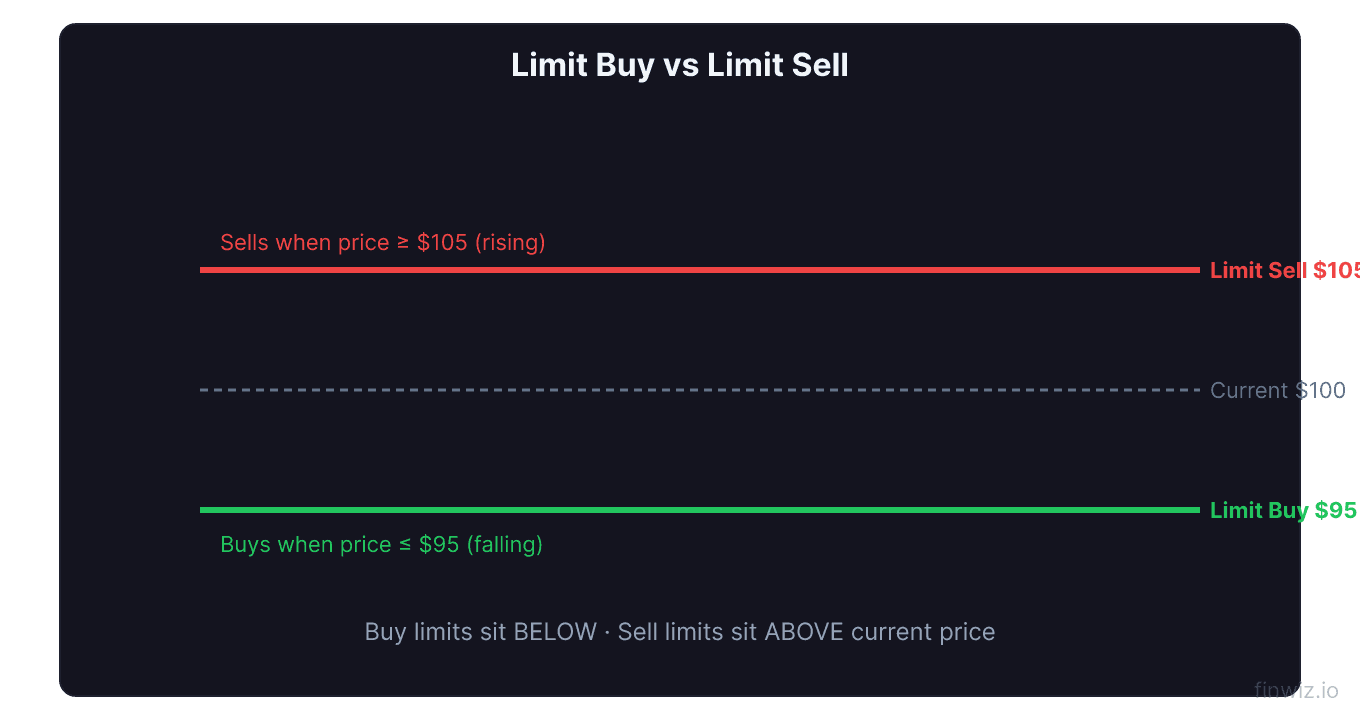
If a stock is trading at $50 and you place a limit buy at $47, your order will only execute if the price drops to $47 or below. If the stock never reaches $47, your order remains unfilled. Conversely, if you own the stock and place a limit sell at $55, it will only execute when the price reaches $55 or above. Both types sit on the order book as resting orders until they are either filled, cancelled, or expire.
Understanding the mechanics and nuances of limit orders is fundamental to effective trading. They are the workhorse order type for disciplined traders who refuse to overpay when buying or undersell when exiting.
How Limit Buy Orders Work
A limit buy order specifies the maximum price you are willing to pay for a stock. Your order enters the order book on the bid side and waits for a seller willing to accept your price.
Limit Buy Execution Rule:There is a common misconception that a limit buy at $148 will fill at exactly $148. In reality, you may get a better price — if the stock gaps down to $146, your order fills at $146, not $148. The limit price is a ceiling, not a target.
When to use limit buy orders:
- Buying pullbacks: Set a limit buy at a support level you have identified, and the order waits patiently for the stock to dip to your target
- IPO and volatile stocks: Prevents you from overpaying during rapid price swings
- Illiquid stocks: Prevents massive slippage that occurs when market orders consume multiple price levels on a thin order book
- Pre-planned entries: Set your order in advance and walk away — useful for traders who cannot watch markets all day
Pro Tip
Place limit buy orders slightly above key support levels rather than exactly at round numbers. Many traders cluster their buy orders at obvious levels like $100, $150, or $200. Placing your order at $100.10 or $150.25 increases the likelihood of getting filled because your order sits ahead of the crowd on the order book.
How Limit Sell Orders Work
A limit sell order specifies the minimum price you are willing to accept when selling your shares. Your order enters the order book on the ask (offer) side and waits for a buyer willing to pay your price.
Limit Sell Execution Rule:Limit sell orders are commonly used for two purposes. First, as profit targets — you identify a price at which you want to take profits and set a limit sell to automate the exit. Second, as a way to sell into strength during volatile rallies when market orders might execute at rapidly changing prices.
Unlike stop-loss orders, which sell when the price falls to a trigger level, limit sell orders sell when the price rises to your target. They are offensive tools (locking in profits) rather than defensive tools (limiting losses).
Limit Buy vs. Limit Sell: Side-by-Side Comparison
Understanding the key differences helps you deploy each order type correctly.
| Feature | Limit Buy | Limit Sell |
|---|---|---|
| Purpose | Buy at or below target price | Sell at or above target price |
| Placement | Below current market price | Above current market price |
| Order book side | Bid side | Ask (offer) side |
| Fills when price | Drops to or below your limit | Rises to or above your limit |
| Risk | Missing the trade if price never drops | Missing the exit if price never rises |
| Common use | Buying pullbacks, entering positions | Taking profits, exiting positions |
Understanding Partial Fills
Partial fills occur when only a portion of your limit order is executed. This happens when there are not enough shares available at your limit price to fill your entire order at once.
Consider this scenario: you place a limit buy for 1,000 shares at $25.00. Only 300 shares are offered at $25.00 or below. Your order fills 300 shares immediately, and the remaining 700 shares stay on the order book as an open order, waiting for additional sellers at $25.00 or lower.
Partial fills are more common with:
- Large orders relative to average trading volume
- Illiquid stocks with thin order books (low-float, small-cap, or penny stocks)
- Limit prices far from the current market where fewer counterparties exist
- Pre-market and after-hours sessions with reduced liquidity
Partial fills can create complications. Some brokers charged commissions per execution in the past, meaning a 1,000-share order filled in four batches incurred four commission charges. While most major brokers now offer commission-free trading, some platforms and asset classes still charge per trade, making partial fills costly.
Pro Tip
If you want to avoid partial fills, consider using a fill or kill (FOK) order, which requires the entire quantity to be filled immediately or the order is cancelled completely. Alternatively, an all-or-none (AON) modifier tells the broker not to accept partial executions. Be aware that these modifiers reduce your chances of execution, particularly in less liquid stocks.
Common Limit Order Mistakes
Even experienced traders make errors with limit orders. Here are the most common pitfalls.
Setting Limits Too Far From the Market
Placing a limit buy 15% below the current price hoping for a dramatic dip usually results in a missed opportunity. While patience is valuable, unrealistic limit prices mean your capital sits idle in cash while the stock trends higher without you. A more balanced approach is setting limits at technically meaningful levels — identified support zones, moving averages, or recent pullback levels — rather than arbitrary deep discounts.
Forgetting About Open Orders
A limit order placed on Monday that was not filled can still execute days or weeks later if you used a GTC (good til cancelled) duration. By the time it fills, your analysis may have changed, or the fundamental situation may be different. Review your open orders regularly, especially before earnings announcements and other catalysts. Many traders have been surprised by forgotten limit orders filling at inopportune times.
Chasing With Adjusted Limits
When a stock rises above your limit buy, resist the temptation to chase by raising your limit price repeatedly. This behavior eliminates the discipline that limit orders are meant to provide. If the stock moved past your target, either wait for a pullback or re-evaluate whether the setup is still valid at a higher price.
Not Accounting for the Bid-Ask Spread
In stocks with wide bid-ask spreads, your limit buy should be placed relative to the ask price (what you would actually pay), not the last traded price. If a stock shows a last price of $10.00 but the ask is $10.25 and the bid is $9.75, a limit buy at $10.00 may not fill quickly because you are placing it between the bid and ask. Understanding the order book context matters.
Limit Orders and Order Book Dynamics
When you place a limit order, it becomes visible on the Level 2 order book (also called the depth of book). Your order joins other resting orders at your price level, forming the aggregate bid (for limit buys) or ask (for limit sells).
Large limit orders can influence other traders' behavior. A 50,000-share limit buy at $100 — visible on the Level 2 screen — can act as a support level because other traders see the large resting buyer and gain confidence that the price is unlikely to fall far below $100. Conversely, large limit sell orders create visible resistance levels.
Sophisticated traders sometimes use limit orders strategically — placing and cancelling large orders to signal intent without actually wanting to trade (a practice called spoofing, which is illegal). Understanding that not all visible limit orders represent genuine trading intent is important for interpreting the order book accurately.
Combining Limit Orders With Other Order Types
Limit orders become even more powerful when combined with other order types to create comprehensive trade management strategies.
Bracket Orders
A bracket order combines an entry order with a preset profit target (limit sell) and stop loss. For example, you might buy 100 shares at market and simultaneously place a limit sell at $55 (profit target) and a stop-loss at $45 (risk management). When either the limit sell or stop-loss triggers, the other is automatically cancelled.
Stop-Limit Orders
A stop-limit order combines a stop trigger with a limit price. When the stop price is reached, a limit order is placed instead of a market order. This prevents the unfavorable executions that can occur with regular stop orders during fast-moving markets, but adds the risk that the limit order may not fill.
Trailing Stop With Limit Sell
You can use a trailing stop for downside protection while simultaneously having a limit sell at your profit target. This "set it and forget it" approach manages both the upside exit and downside risk automatically.
Limit Orders in Different Market Conditions
The effectiveness of limit orders varies with market conditions.
In calm, liquid markets: Limit orders work well. Bid-ask spreads are narrow, and your order is likely to fill near your limit price. The main risk is missing the trade if the stock does not reach your price.
In volatile markets: Limit orders provide crucial protection against slippage. During flash crashes, earnings reactions, and opening-bell volatility, market orders can fill at terrible prices. Limit orders ensure you maintain price discipline.
In illiquid stocks: Limit orders are essential. A market order in a stock trading 10,000 shares per day with a $0.50 bid-ask spread could cost you significant slippage. Limit orders allow you to set a fair price and wait.
During extended hours: Most brokers require limit orders for pre-market and after-hours trading. Market orders are not available because liquidity is too thin and prices could execute far from the last regular-session price.
Frequently Asked Questions
What happens if a stock gaps past my limit price?
If a stock gaps past your limit buy (opens below your limit price), your order fills at the opening price, which may be better than your limit. If a stock gaps past your limit sell (opens above your limit price), your order fills at the opening price — again, potentially better than your target. Limit orders guarantee your worst acceptable price, so gaps in your favor are a benefit.
Can I place a limit buy above the current market price?
Yes, technically, but it would likely fill immediately at the current market price (or close to it), functioning similarly to a market order. This is called a marketable limit order. Some traders use this technique to buy with price protection — they set a limit slightly above the current ask to ensure execution while capping the maximum price at a reasonable level.
How long does a limit order stay active?
This depends on the time-in-force you select. A day order expires at the end of the regular trading session if not filled. A GTC (good til cancelled) order remains active until filled or cancelled by you, though most brokers cap GTC orders at 60-180 days. You can also use IOC (immediate or cancel) or other TIF options.
Do limit orders guarantee execution?
No. Limit orders guarantee your price but not your execution. If the stock never reaches your limit price, your order will never fill. This is the fundamental trade-off versus market orders, which guarantee execution but not price. The choice between limit and market orders depends on whether price control or execution certainty is more important for your specific trade.
Are there fees for limit orders that do not fill?
No. At virtually all brokerages, there is no charge for placing a limit order that goes unfilled. You can place and cancel limit orders throughout the day without incurring costs. The only cost occurs when the order actually executes.
Disclaimer
This is educational content, not financial advice. Trading involves risk, and you should consult a qualified financial advisor before making any investment decisions. Past performance does not guarantee future results.
12 chapters covering charts, indicators, risk management & more. Plus weekly trading insights.