
Bid-Ask Spread: What It Tells You About Liquidity
⚡ Key Takeaways
- The bid price is the highest price a buyer will pay; the ask price is the lowest price a seller will accept
- The bid-ask spread is the difference between these two prices and represents a transaction cost for traders
- Tighter spreads indicate higher liquidity; wider spreads indicate lower liquidity or higher volatility
- Market makers profit from the spread by continuously buying at the bid and selling at the ask
- Always check the spread before trading, especially on less liquid stocks, ETFs, and options
What Is the Bid-Ask Spread?
The bid-ask spread is the difference between the highest price a buyer is willing to pay (bid) and the lowest price a seller is willing to accept (ask) for a stock at any given moment.
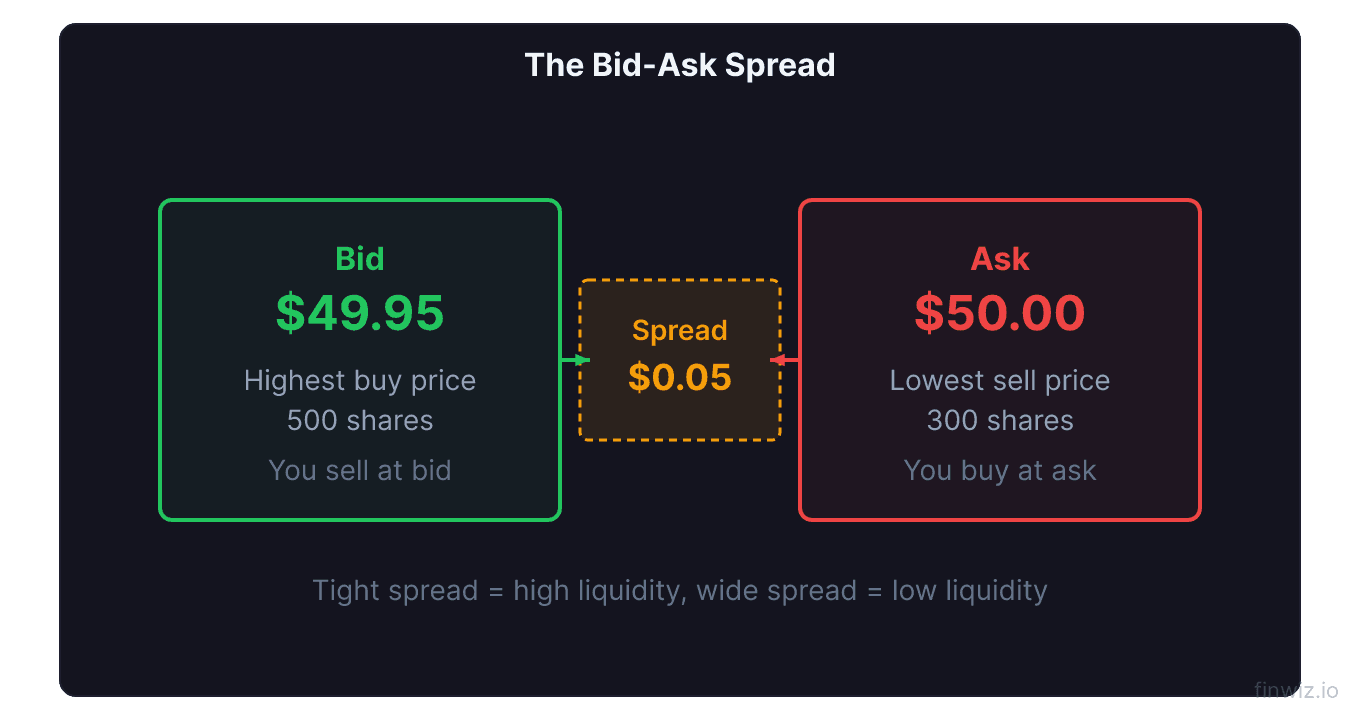
Bid-Ask Spread = Ask Price - Bid PriceEvery stock has two prices at all times: the bid and the ask. When you buy with a market order, you pay the ask. When you sell with a market order, you receive the bid. The spread is the immediate cost of a round trip transaction.
Understanding Bid and Ask
The bid represents the demand side of the market. It is the highest price that current buyers are willing to pay. There may be thousands of buyers at various bid levels, but the highest bid is the one displayed.
The ask (also called the offer) represents the supply side. It is the lowest price that current sellers are willing to accept.
The spread between them exists because buyers always want to pay less and sellers always want to receive more. The spread is where these competing interests meet.
Why the Spread Matters for Traders
The spread is a hidden transaction cost. Every time you enter and exit a trade, you pay the spread.
If you buy at the ask of $50.00 and immediately sell at the bid of $49.95, you lose $0.05 per share without the stock moving at all. For a 1,000-share position, that is $50 in spread cost.
For day traders making multiple trades per day, spread costs compound rapidly. A trader making 10 round trips per day on stocks with a $0.05 spread on 500-share positions pays $500/day in spread costs alone.
This is why liquidity matters. Liquid stocks with tight spreads minimize this friction. Illiquid stocks with wide spreads make profitable trading significantly harder.
| Stock Type | Typical Spread | Cost per 1,000 Shares (Round Trip) |
|---|---|---|
| Mega-cap, liquid | $0.01 | $10 |
| Large-cap | $0.01-0.03 | $10-30 |
| Mid-cap | $0.03-0.10 | $30-100 |
| Small-cap | $0.05-0.25 | $50-250 |
| Penny stock / OTC | $0.10-1.00+ | $100-1,000+ |
Pro Tip
What Affects the Spread
Liquidity
The single biggest factor affecting spreads is volume and liquidity. Stocks with millions of shares traded daily have very tight spreads because there are many buyers and sellers competing at each price level.
Volatility
During periods of high volatility, spreads typically widen. Uncertainty causes market makers to increase their spread to compensate for the risk of rapid price changes.
Time of Day
Spreads are typically tightest during the middle of the trading day when normal trading flow is established. They can be wider at the open (as the market finds equilibrium) and during the final minutes (as traders square positions).
Market Conditions
During market crises, spreads can widen dramatically even on the most liquid stocks. The 2008 financial crisis and the 2020 pandemic crash saw spreads on major stocks widen from pennies to dimes or more.
Market Makers and the Spread
Market makers are firms that continuously provide bid and ask quotes, creating liquidity for other traders. They profit primarily from the spread: buying at the bid and selling at the ask.
For a market maker, the spread is their compensation for providing liquidity and taking on the risk of holding inventory. In highly competitive markets, this compensation is very small (pennies per share), which is why market makers rely on high volume.
Using Limit Orders to Manage Spread Costs
You can reduce your spread costs by using limit orders instead of market orders.
Instead of buying at the ask, you can place a limit order between the bid and ask. For example, if the bid is $49.95 and the ask is $50.00, you might place a buy limit at $49.97. If filled, you save $0.03 per share compared to paying the full ask.
This is called price improvement and is a common technique among experienced traders. It does not always work (the order may not fill if no seller is willing to match your price), but it reduces costs over many trades.
Reading the Bid-Ask for Market Insight
The bid and ask provide valuable information about short-term supply and demand:
- Large bid: A large number of shares at the bid suggests strong buying interest at that level. It can act as temporary support.
- Large ask: A large number of shares at the ask suggests significant selling interest. It can act as temporary resistance.
- Shrinking spread: A tightening spread often indicates increasing interest and potential price movement.
- Widening spread: A widening spread can signal decreasing liquidity or increasing uncertainty.
Frequently Asked Questions
Can I buy at the bid price or sell at the ask price?
To buy at the bid price, you place a buy limit order at the bid. However, this only fills if a seller is willing to come down to your price. There may be other orders ahead of yours at the same price. Similarly, to sell at the ask, you place a sell limit order at the ask, but you are competing with other sellers.
Why are options spreads so much wider than stock spreads?
Options have fewer participants and more variables (strike price, expiration, delta) distributing liquidity across many contracts. A stock has one bid-ask spread; its options chain may have hundreds of individual contracts, each with its own spread. This is why market orders on options should be avoided.
What is a reasonable spread for a stock I want to trade?
As a general rule, the spread should be less than 0.1% of the stock price for active trading. A $100 stock should have a spread of $0.10 or less. For swing trading with longer holding periods, slightly wider spreads are acceptable because the spread cost is a smaller percentage of your expected profit.
Does the spread change throughout the day?
Yes. Spreads are typically widest at the market open as the order book establishes equilibrium. They tighten during normal trading hours as liquidity builds, and may widen again in the final minutes. During extended hours (pre-market and after-hours), spreads are significantly wider due to low participation.
How does the spread relate to market depth?
The bid-ask spread shows only the best bid and best ask. Market depth (Level 2 data) shows all bids and asks at every price level. A stock may have a tight spread at the best bid/ask but thin depth behind it, meaning larger orders would experience more slippage.
Disclaimer
This is educational content, not financial advice. Trading involves risk, and you should consult a qualified financial advisor before making any investment decisions. Past performance does not guarantee future results.
Spread Dynamics Throughout the Trading Day
The Opening Spread
The market open typically features the widest spreads of the regular session. This occurs because:
- Overnight order flow creates uncertainty about fair value
- Market makers widen spreads to protect against adverse selection (trading against informed participants)
- Competing orders from overnight news and pre-market activity create temporary imbalances
- Opening auctions are still settling the opening price
Spreads typically narrow within the first 15-30 minutes as normal trading flow establishes equilibrium. This is one reason experienced traders often wait before placing their first trade of the day.
Midday Narrowing
During the midday hours (approximately 11:30 AM to 2:00 PM ET), spreads tend to be at their tightest because:
- Normal two-way trading flow is well-established
- Institutional algorithms are actively providing liquidity
- Volatility is typically at its lowest point of the day
This period is often best for entering swing trades with limit orders, as you are most likely to receive tight fills.
The Closing Period
In the final 30-60 minutes, spreads can widen slightly as traders square positions and institutional closing auctions begin. However, volume is typically high during this period, which partially offsets the wider spreads.
Spread and Different Securities
Stock Spreads
Major stocks (large-cap, high-volume) typically have spreads of $0.01 to $0.03. Mid-cap stocks range from $0.03 to $0.10. Small-cap and micro-cap stocks can have spreads of $0.10 to $1.00 or more.
ETF Spreads
ETFs generally have very tight spreads, especially popular ones like SPY, QQQ, and IWM, which often have penny spreads. Less popular, niche, or thematic ETFs may have wider spreads due to lower trading volume. Always check the spread before trading any ETF.
Options Spreads
Options consistently have wider spreads than stocks because liquidity is distributed across many strike prices and expiration dates. A stock with a $0.01 spread might have options with $0.05 to $0.50 spreads. This is why limit orders are essential for all options trading.
The spread on options represents a significant transaction cost that must be factored into your expected profit. If the spread is $0.10 on a $2.00 option, you are immediately paying 5% in spread cost upon entry. This cost doubles when you include the exit spread, making tight-spread options on liquid underlyings much more attractive for active trading.
Related Articles
12 chapters covering charts, indicators, risk management & more. Plus weekly trading insights.