
Trading Halts & Circuit Breakers: Why Stocks Get Halted
⚡ Key Takeaways
- Trading halts temporarily pause trading in a security and can last from minutes to days depending on the reason
- LULD (Limit Up-Limit Down) halts trigger automatically when a stock
What Is a Trading Halt?
A trading halt is a temporary suspension of trading activity in a specific security or across an entire market. During a halt, no buy or sell orders can be executed. The stock literally stops trading, and all pending orders are placed in a queue until trading resumes.
Trading halts serve a critical function in maintaining fair and orderly markets. They give investors time to absorb material information, prevent panic-driven price dislocations, and protect against technical glitches that could distort prices. Without halts, the speed of modern electronic trading could amplify volatility to destructive levels.
Halts can be initiated by stock exchanges, the SEC, or triggered automatically by price movement thresholds. Understanding the different types of halts and how to respond to them is essential knowledge for active traders, particularly those engaged in day trading or gap strategies.
Types of Trading Halts
Trading halts fall into several categories, each with different triggers, durations, and implications for traders.
Regulatory Halts are imposed by the exchange or the SEC. These are the most common type and include halts for pending news, non-compliance with listing standards, or when the SEC believes trading should be paused in the public interest.
LULD (Limit Up-Limit Down) Halts are automatic halts triggered when a stock's price moves outside of calculated price bands. These replaced the old single-stock circuit breaker system in 2013.
Market-Wide Circuit Breakers halt all trading across all U.S. exchanges when the S&P 500 index declines by specified percentages from its previous close.
Operational Halts occur due to technical issues such as exchange system problems or order imbalances at the open.
| Halt Code | Type | Reason | Typical Duration |
|---|---|---|---|
| T1 (HALT) | Regulatory | News pending | Minutes to hours |
| T2 | Regulatory | Non-compliance with listing | Days to indefinite |
| T5 | Regulatory | Single stock trading pause | 5 minutes |
| T6 | Regulatory | Extraordinary market activity | Varies |
| T8 | Regulatory | Exchange-traded fund | Varies |
| M | Regulatory | Volatility Trading Pause (MWCB) | 15 minutes |
| LUDP | LULD | Limit Up-Limit Down | 5-10 minutes |
LULD Halts: The Limit Up-Limit Down Mechanism
The Limit Up-Limit Down (LULD) mechanism is designed to prevent extreme price movements in individual securities. It establishes a dynamic price band around each stock, and trading is paused if the stock's price threatens to move outside this band.
How LULD bands are calculated: The bands are based on a reference price (typically the average price over the preceding five minutes) and a percentage parameter that varies by stock type and time of day.
For Tier 1 stocks (S&P 500, Russell 1000, and select ETPs), the band is 5% above and below the reference price during regular trading hours. For Tier 2 stocks (all other NMS securities), the band is 10% for stocks priced above $3.00 and broader bands for lower-priced stocks.
During the first and last 15 minutes of the trading day, these bands are doubled to accommodate the naturally higher volatility at the open and close.
When a stock's price touches the LULD band, it enters a Limit State. If the stock does not trade back within the band within 15 seconds, a five-minute trading pause is triggered. During this pause, the exchange recalculates new price bands, and trading resumes with a reopening auction.
Upper Band = Reference Price × (1 + Percentage Parameter)Pro Tip
T1 Halts: News Pending
A T1 halt (also called a news pending halt) is a regulatory halt initiated when a company is about to release material, market-moving information. The exchange pauses trading to ensure that all market participants have equal access to the news before trading resumes.
Common triggers for T1 halts include earnings announcements released during market hours, merger and acquisition announcements, FDA drug approval decisions for biotech companies, material restatements of financial results, and major corporate actions like leadership changes or bankruptcy filings.
T1 halts can last anywhere from a few minutes to several hours. The exchange will not resume trading until the news has been disseminated and the market has had time to process it. The exchange may also require the company to issue a formal press release before lifting the halt.
For traders, T1 halts create both opportunity and danger. When trading resumes after a positive news event, the stock may gap significantly higher. After negative news, the gap down can be devastating. The key risk is that you cannot exit your position during the halt. If you hold shares when a T1 halt is triggered, you are locked in until trading resumes.
T2 Halts and Non-Compliance Issues
A T2 halt is far more serious than a T1 halt. It is imposed when a company has failed to meet the exchange's ongoing listing requirements or has not provided required information to the exchange.
T2 halts can last for days, weeks, or even indefinitely. They often signal significant problems with the company, including failure to file financial statements on time, inability to meet minimum share price or market capitalization requirements, or concerns about the accuracy of the company's public disclosures.
For investors holding shares in a T2-halted stock, the situation is dire. You cannot sell your position, and the halt may not be lifted until the company resolves its compliance issues. In some cases, the company may be delisted from the exchange entirely, with shares moving to the OTC market.
Market-Wide Circuit Breakers
Market-wide circuit breakers (MWCBs) are designed to halt all U.S. stock trading when the broad market experiences severe declines. These were implemented after the 1987 crash and have been updated several times since.
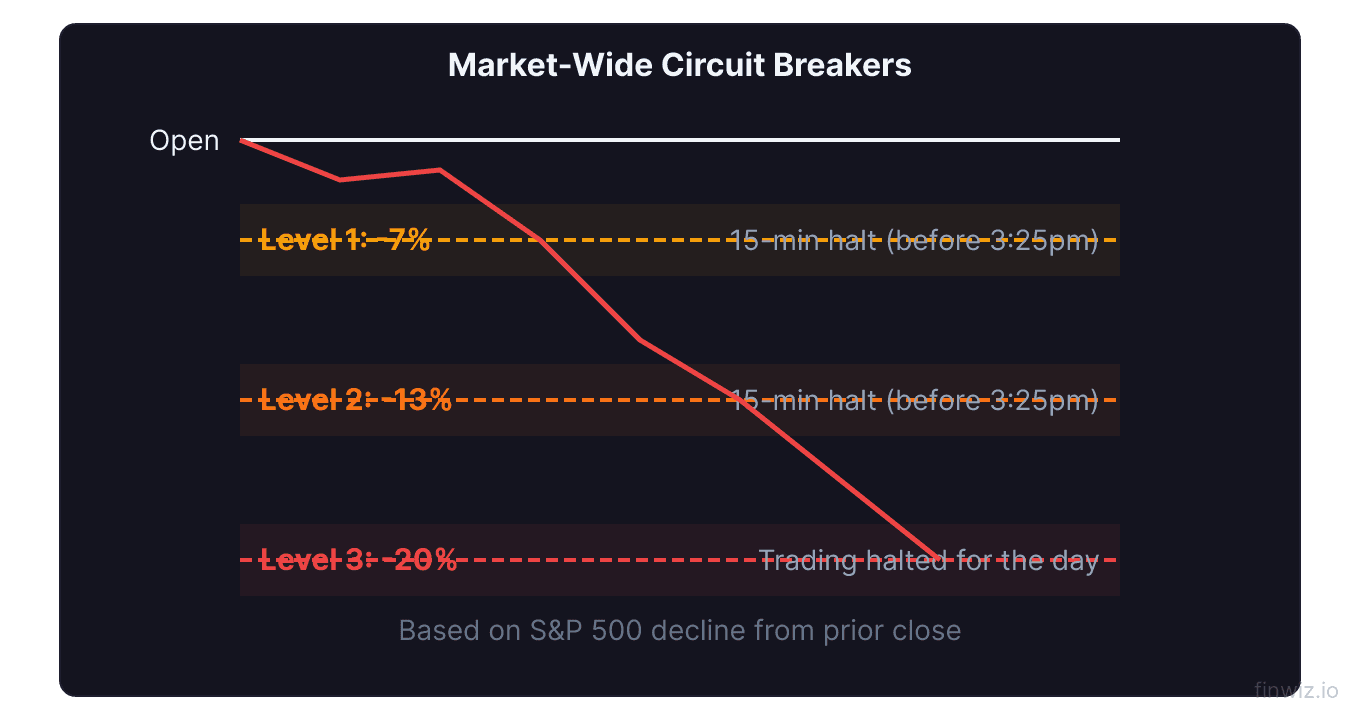
The current system is based on the S&P 500 index and has three levels:
Level 1: 7% decline triggers a 15-minute trading halt if it occurs before 3:25 PM ET. If it occurs after 3:25 PM, trading continues.
Level 2: 13% decline also triggers a 15-minute trading halt if it occurs before 3:25 PM ET. After 3:25 PM, trading continues.
Level 3: 20% decline triggers a halt for the remainder of the trading day regardless of when it occurs.
Each level can only be triggered once per day. The percentage declines are calculated based on the S&P 500's closing price from the prior day.
Market-wide circuit breakers have been triggered rarely. The most notable instance was on March 9, 2020, when COVID-19 pandemic fears caused the S&P 500 to decline more than 7% at the open, triggering the Level 1 breaker within minutes of the opening bell. The Level 1 breaker was triggered again on March 12 and March 16 of that same week.
How to Handle Trading Halts as a Trader
Active traders, particularly day traders, must have a plan for dealing with trading halts. Being caught unprepared can lead to significant losses.
Before the halt: If you are trading a volatile stock that is approaching LULD bands, consider reducing your position size or tightening your stops. Recognize that a halt is possible and factor it into your risk management.
During the halt: Do not panic. Assess the situation calmly. If it is a T1 halt, try to find the news that triggered it. Check the company's press releases, SEC filings, and newswires. If it is an LULD halt, the stock will likely resume within 5-10 minutes.
Placing orders during a halt: Most brokers allow you to place orders during a halt, but they will not execute until trading resumes. Be extremely cautious with market orders during halts. When trading resumes, the opening price can be dramatically different from the pre-halt price, and a market order will fill at whatever price is available.
After the halt resumes: Expect extreme volatility in the first few minutes after a halt is lifted. Bid-ask spreads will be wide, and price action can be erratic. Wait for the stock to establish a clear direction before entering a new position.
Trading Halts and Short Sellers
Short sellers face unique risks during trading halts. If you have an open short position when a halt is triggered, you cannot cover your position until trading resumes. If the halt is due to positive news (like an acquisition offer at a premium), the stock may open significantly higher, causing substantial losses on your short position.
This risk is amplified by the fact that some of the most halted stocks are the same volatile, low-float names that attract short sellers. A short squeeze combined with a trading halt can create catastrophic losses for shorts.
The uptick rule (SEC Rule 201) adds another layer of complexity. If a stock declines 10% or more from its previous close, short selling is restricted to prices above the current best bid for the remainder of that day and the following day. This rule interacts with LULD halts because stocks that trigger LULD on the downside often also trigger the uptick rule.
Order Types and Halt Behavior
Understanding how different order types behave during and after halts is critical for protecting your capital.
Market orders placed during a halt will execute at the reopening price, which can be drastically different from the pre-halt price. This is the most dangerous order type during halts.
Limit orders placed during a halt will only execute at your specified price or better. This provides protection against adverse price movements when trading resumes. Always use limit orders when a halt is in effect.
Stop orders are converted to market orders when triggered, making them vulnerable to gap moves when a halt lifts. A stop at $50 on a stock that reopens at $30 will execute at approximately $30, not $50.
Stop-limit orders provide more protection because they convert to limit orders when triggered. A stop-limit with a stop at $50 and a limit at $48 would not execute if the stock reopens at $30, though this means your position remains open.
Frequently Asked Questions
Can I cancel an order during a trading halt?
It depends on your broker and the type of halt. Most brokers allow you to cancel orders during a halt, but the cancellation may not be processed until trading resumes. Contact your broker immediately if you need to cancel an order during a halt.
How do I know when a halt will end?
For LULD halts, trading typically resumes after a 5-minute pause. For T1 (news pending) halts, the exchange will post a tentative resumption time, but this can be extended. The NASDAQ and NYSE post halt status updates on their websites in real time.
Do trading halts apply to options on the halted stock?
Yes. When trading in a stock is halted, trading in all listed options on that stock is also halted. Options resume trading when the underlying stock resumes. This is important for options traders who may not be able to exercise, sell, or roll positions during a halt.
Can a stock be halted in premarket or after-hours trading?
Yes. LULD halts do not apply outside regular trading hours, but the SEC and exchanges can impose regulatory halts at any time, including premarket and after-hours sessions. These halts affect all trading venues.
How many times can a stock be halted in one day?
There is no limit. A stock can be halted multiple times in a single trading session. Highly volatile stocks, particularly low-float names experiencing news catalysts, can be halted five, ten, or even more times in a day. Each halt-and-resume cycle can bring additional volatility.
Disclaimer
This is educational content, not financial advice. Trading involves risk, and you should consult a qualified financial advisor before making any investment decisions. Past performance does not guarantee future results.
Related Articles
12 chapters covering charts, indicators, risk management & more. Plus weekly trading insights.