
What Is an IPO? How Initial Public Offerings Work
⚡ Key Takeaways
- An IPO (Initial Public Offering) is the process by which a private company sells shares to the public for the first time
- The IPO process involves underwriters, SEC filings, a roadshow, and pricing based on institutional demand
- Lock-up periods (typically 90-180 days) restrict insiders from selling shares immediately after the IPO
- IPO stocks are highly volatile in their first weeks and months of trading, making them risky for inexperienced traders
- Waiting for the lock-up expiration and a chart base to form before trading an IPO reduces risk significantly
What Is an IPO?
An IPO (Initial Public Offering) is the process through which a privately held company offers its shares to the public for the first time. Before an IPO, the company's shares are owned by founders, employees, and private investors like venture capitalists. After the IPO, anyone with a brokerage account can buy and sell the shares on a stock exchange.
Companies go public to raise capital for expansion, pay off debt, or provide liquidity to early investors. For the investing public, IPOs represent opportunities to invest in companies at relatively early stages of their public life.
The IPO Process
Step 1: Choosing Underwriters
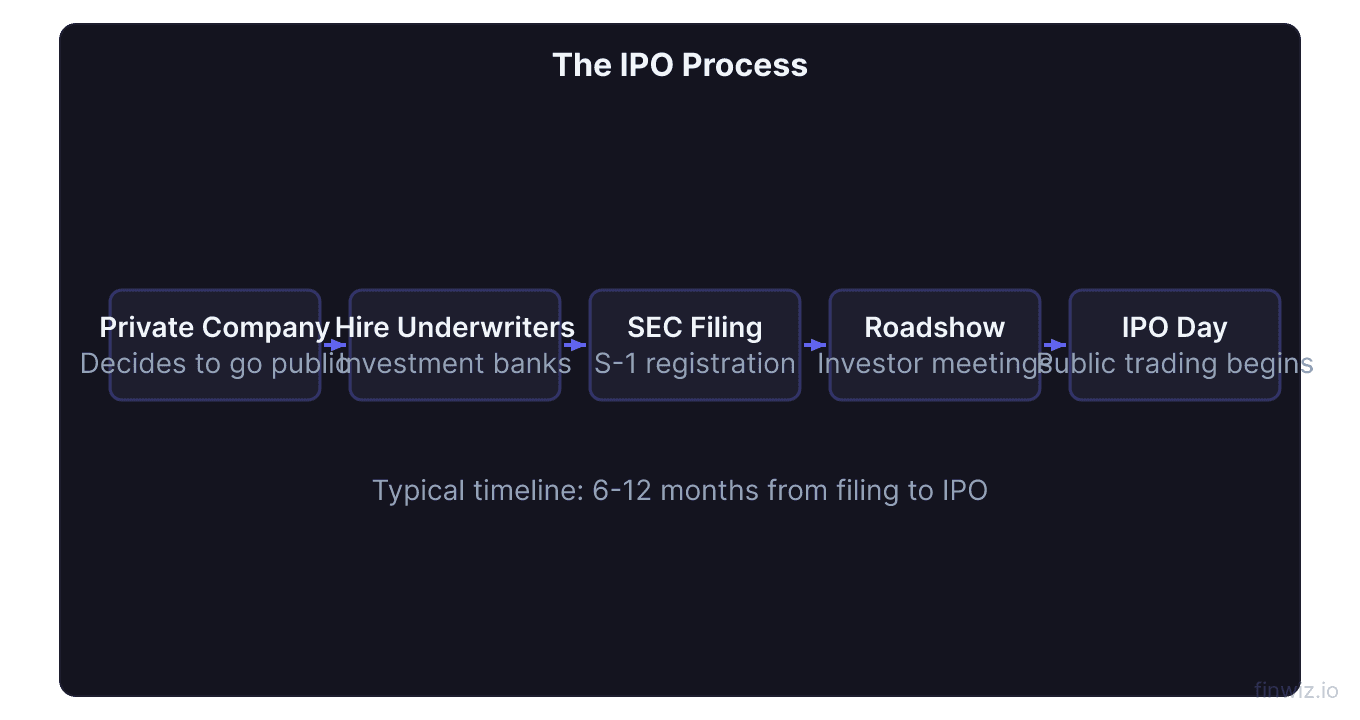
The company selects one or more investment banks to serve as underwriters. The lead underwriter manages the IPO process, helps determine the offering price, and sells the shares to institutional investors. In exchange, the underwriter earns a fee, typically 3-7% of the total capital raised.
Step 2: SEC Filing
The company files a registration statement (the S-1 form) with the Securities and Exchange Commission (SEC). This document contains extensive information about the company's business, financials, risks, management team, and how it plans to use the IPO proceeds. The S-1 becomes publicly available, allowing potential investors to evaluate the opportunity.
Step 3: The Roadshow
The company's management and underwriters conduct a roadshow, presenting to institutional investors (mutual funds, hedge funds, pension funds) across major financial centers. The roadshow generates interest and allows underwriters to gauge demand at various price levels.
Step 4: Pricing
Based on roadshow feedback and market conditions, the underwriters set the IPO price the night before trading begins. This price balances the company's desire to raise maximum capital with investor demand. The IPO price is the price at which institutional investors purchase shares before public trading starts.
Step 5: First Day of Trading
On the first trading day, the stock opens on the exchange. The opening price may differ significantly from the IPO price based on supply and demand. A stock that opens well above the IPO price is said to have a strong debut or "popped". A stock that opens below the IPO price has a weak debut.
Pro Tip
Understanding the Lock-Up Period
The lock-up period is a contractual agreement that prevents company insiders, including founders, executives, and early investors, from selling their shares for a specified period after the IPO, typically 90 to 180 days.
Why Lock-Up Periods Matter
When the lock-up expires, a large number of shares suddenly become eligible for sale. If insiders sell aggressively, the increased supply can push the stock price down. Many IPO stocks experience significant price drops around their lock-up expiration date.
Smart traders watch the lock-up expiration date and monitor the stock's behavior around that event. A stock that holds its price through the lock-up expiration shows strength. One that drops may offer a buying opportunity after the selling pressure subsides.
How to Trade IPOs
The Wait-and-See Approach
The safest approach for most traders is to wait before trading an IPO. New stocks lack the price history needed for reliable technical analysis. There is no established support and resistance, no moving average history, and no volume baseline.
A common rule is to wait for the stock to form its first consolidation base on the daily chart, which typically takes 3-8 weeks. Then, trade the breakout from that base with volume confirmation.
Trading the First Day
First-day IPO trading is extremely volatile and is best left to experienced traders. Prices can swing 20-50% or more. If you trade the first day:
- Wait at least 15-30 minutes after the open for the initial chaos to settle
- Use limit orders exclusively; never use market orders on an IPO
- Keep your position size small
- Have a clear exit plan before entering
Trading After the Lock-Up Expiration
The lock-up expiration creates predictable selling pressure. Some traders wait for this event, let the stock sell off, and then look for a bottom to form. This approach can offer entry prices significantly below the stock's post-IPO peak.
IPO Risks
- Limited information: Public companies have only a short track record of financial reporting.
- Extreme volatility: IPO stocks routinely swing 10-20% in a single day.
- Hype-driven pricing: Popular IPOs can be priced on excitement rather than fundamentals.
- No technical levels: Without price history, there are no proven support or resistance levels.
- Lock-up overhang: The potential for insider selling creates ongoing uncertainty.
- Underperformance: Research consistently shows that many IPOs underperform the broader market over their first year.
IPO Valuation Basics
While detailed valuation is complex, understanding basic metrics helps you evaluate whether an IPO is reasonably priced:
- Price-to-Earnings (P/E) ratio: How does the IPO's P/E compare to established companies in the same industry?
- Revenue growth rate: High-growth companies command premium valuations, but the growth rate must justify the price.
- Market cap: Is the company's total valuation reasonable compared to its revenue and earnings?
Frequently Asked Questions
Can individual investors buy shares at the IPO price?
Some brokers offer IPO access to their customers, but allocation is typically limited and prioritized for larger accounts. Most individual investors buy shares in the secondary market (regular exchange trading) after the IPO begins, usually at a higher price than the IPO price.
How do I find upcoming IPOs?
IPO calendars are available on major financial websites and through your brokerage platform. The SEC's EDGAR database contains all S-1 filings. Focus on companies with strong revenue growth, a clear business model, and underwriting by reputable investment banks.
Should I buy every IPO that comes to market?
No. Most IPOs are not worth trading, especially for retail investors. Focus on IPOs with strong fundamentals, reasonable valuations, and clear growth catalysts. Many experienced traders skip the IPO entirely and wait for a base pattern to develop before considering an entry.
What is a SPAC and how does it differ from a traditional IPO?
A SPAC (Special Purpose Acquisition Company) is a shell company that goes public through its own IPO, then uses the proceeds to acquire a private company. The target company becomes public through the acquisition rather than through a traditional IPO. SPACs offer a different risk profile and timeline compared to traditional IPOs.
How long should I hold an IPO stock?
This depends on your strategy. If you are trading the IPO for short-term gains, use swing trading timeframes (days to weeks). If you are investing for the long term, evaluate the company's fundamentals and be prepared to hold through significant volatility in the early months.
Disclaimer
This is educational content, not financial advice. Trading involves risk, and you should consult a qualified financial advisor before making any investment decisions. Past performance does not guarantee future results.
IPO Performance Patterns
The First-Day Pop
Historically, IPOs have experienced an average first-day gain (the "pop") because underwriters tend to price IPOs below fair market value to ensure demand. This built-in discount benefits institutional investors who receive allocations at the IPO price. Retail investors who buy at the opening price may pay a premium over the IPO price.
The size of the first-day pop varies widely. Some IPOs open 50-100% above their IPO price, while others open below it. Extremely hot IPOs with large first-day pops often underperform over the following months as the initial excitement fades.
The Six-Month Pattern
Many IPOs follow a predictable pattern over their first six months:
- First day: Excitement drives the price up (the pop)
- Weeks 1-4: Initial volatility as the market finds fair value
- Months 1-3: The stock often drifts sideways or lower as early excitement fades
- Months 3-6: The lock-up expiration creates selling pressure, often pushing the stock to new lows
- After lock-up: The stock establishes its true supply and demand dynamics and begins to trade more normally
Understanding this pattern helps you identify the best timing for entry. Many successful IPO traders wait until after the lock-up expiration and subsequent selling pressure to establish positions.
Due Diligence Before Trading an IPO
Reading the S-1 Filing
The S-1 filing is the most comprehensive source of information about a company going public. Key sections to focus on:
- Business description: What does the company actually do?
- Risk factors: What does the company itself identify as potential threats?
- Financial statements: Revenue growth, profitability, cash flow, and debt
- Use of proceeds: How will the company use the money raised?
- Management: Who leads the company, and what is their track record?
- Competitive landscape: Who are the competitors, and what is the company's advantage?
Red Flags in IPO Filings
Be cautious of IPOs that exhibit:
- Accelerating losses without corresponding revenue growth
- Heavy insider selling at the IPO (insiders cashing out rather than holding)
- Aggressive accounting or unusual revenue recognition practices
- Single-customer concentration: Over-reliance on one or few customers
- Excessive debt relative to the company's cash flow
- Vague use of proceeds: "General corporate purposes" with no specific plans
IPO Alternatives for Conservative Investors
If you want exposure to IPOs without the individual stock risk, consider IPO-focused ETFs that hold baskets of recently public companies. These provide diversified exposure to the IPO market with lower single-stock risk, though they will not produce the outsized gains that individual successful IPOs can deliver.
Related Articles
12 chapters covering charts, indicators, risk management & more. Plus weekly trading insights.