
Short Selling: How It Works, Risks & Mechanics
⚡ Key Takeaways
- Short selling involves borrowing shares and selling them with the expectation of buying them back at a lower price for profit
- The theoretical risk of short selling is unlimited because a stock can rise indefinitely
- A short squeeze occurs when a heavily shorted stock rises sharply, forcing short sellers to buy back shares and driving the price even higher
- Margin requirements for short selling include the initial margin (typically 50%) and maintenance margin (typically 25-30%)
- Short selling requires a margin account and incurs borrowing costs that increase with the difficulty of locating shares
What Is Short Selling?
Short selling is a trading strategy that profits from a decline in a stock's price. Instead of the traditional "buy low, sell high" approach, short sellers "sell high, buy low" by reversing the order of the transaction.
The mechanics are straightforward in concept: you borrow shares from your broker, sell them at the current market price, and later buy them back (cover) at a lower price, returning the shares and keeping the difference as profit.
Short selling plays an important role in markets by providing liquidity, improving price discovery, and allowing traders to express bearish views.
The Mechanics of a Short Sale
Step by Step
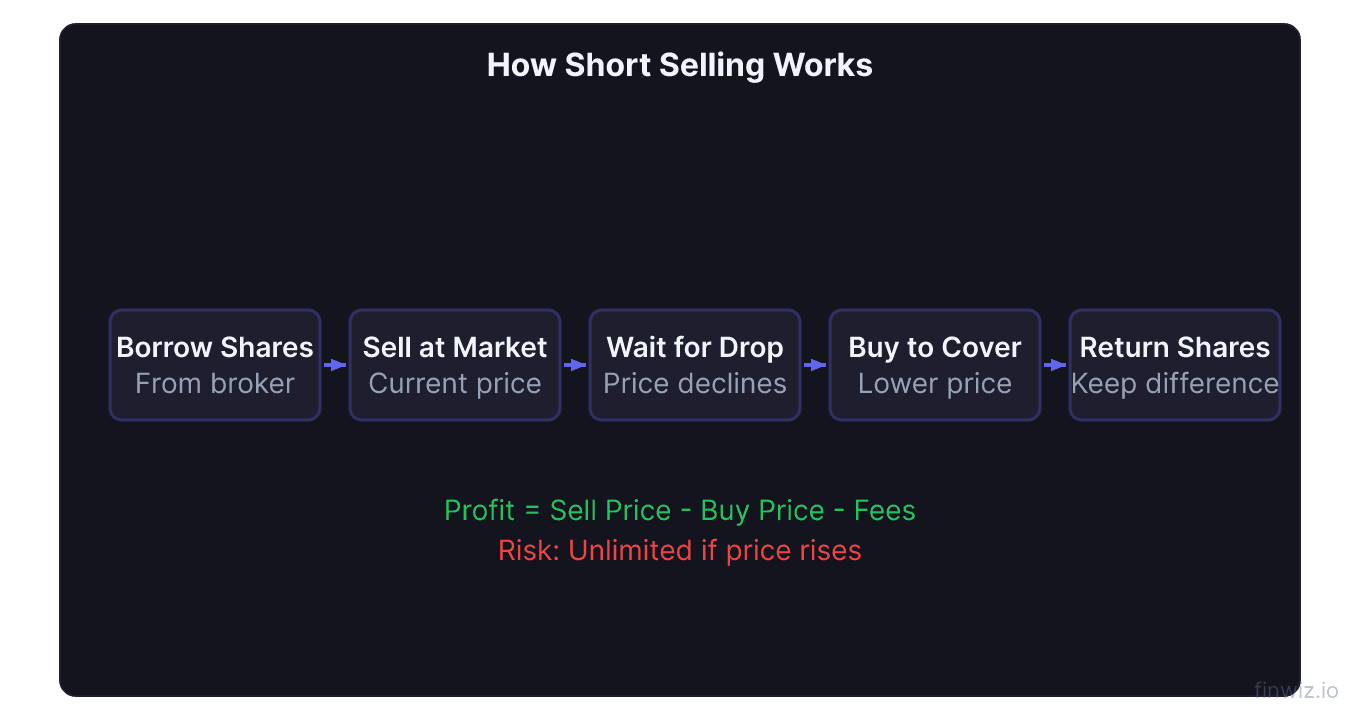
- Locate shares: Your broker finds shares available to borrow, typically from other clients' accounts or institutional lenders.
- Sell the borrowed shares: The shares are sold at the current market price. The cash from the sale is credited to your account but held as collateral.
- Wait for the price to drop: You hold the short position, hoping the stock declines.
- Buy to cover: When the stock drops to your target price (or your stop loss), you buy back the same number of shares.
- Return the shares: The purchased shares are returned to the lender. You keep the difference between the selling price and the buying price.
Example
You short 100 shares of a stock at $50.00, receiving $5,000. The stock drops to $40.00. You buy to cover at $40.00, paying $4,000. You return the 100 shares and keep the $1,000 difference as profit (minus fees and borrowing costs).
Short Selling Profit = (Sell Price - Buy Price) x Shares - Borrowing CostsShort Squeeze Risk
A short squeeze is the most dangerous scenario for short sellers. It occurs when a heavily shorted stock begins to rise, forcing short sellers to buy back shares to limit their losses. This buying pressure drives the price even higher, triggering more short sellers to cover, creating a cascading upward spiral.
Short squeezes can produce extreme, rapid price increases that are disconnected from the company's fundamentals. Stocks have risen hundreds of percent in days during severe short squeezes.
Conditions that Lead to Short Squeezes
- High short interest: A large percentage of the float is sold short
- Low float: Fewer available shares make it harder for shorts to cover
- Positive catalyst: News that triggers buying interest in a heavily shorted stock
- Rising price: As the price rises, short sellers face mounting losses and margin pressure
Pro Tip
Margin Requirements
Short selling requires a margin account. You cannot short sell in a cash account.
Initial Margin
When you open a short position, you must deposit the initial margin, typically 50% of the total short sale value (set by Regulation T). If you short $10,000 worth of stock, you need at least $5,000 in margin.
Maintenance Margin
You must maintain a minimum equity level in your account, typically 25-30% of the current value of the short position (varies by broker). If the stock rises and your equity drops below this level, you receive a margin call.
Margin Calls
A margin call requires you to deposit additional funds or close positions immediately. If you cannot meet the margin call, your broker may forcibly buy back your short position at the current market price, locking in your loss.
Margin Call Price = Short Price x (1 + Initial Margin) / (1 + Maintenance Margin)The Unlimited Risk Problem
When you buy a stock (go long), your maximum loss is the amount you invested. The stock can only go to zero.
When you short a stock, your loss is theoretically unlimited because there is no ceiling on how high a stock can rise. A stock you short at $50 could go to $100, $200, or higher, and your loss grows with every dollar of increase.
This asymmetric risk profile makes stop-loss orders and position sizing absolutely critical for short sellers.
Costs of Short Selling
- Borrowing fees: You pay interest on the borrowed shares. For easy-to-borrow stocks, this is minimal. For hard-to-borrow stocks, fees can be substantial (sometimes 20-50% annualized or more).
- Dividend liability: If the stock pays a dividend while you are short, you must pay the dividend to the share lender.
- Margin interest: You pay interest on the margin your broker extends.
- Uptick rule: The SEC's alternative uptick rule (Rule 201) restricts short selling on stocks that have declined 10% or more in a day.
Short Selling Strategies
Shorting Resistance Rejections
When a stock in a downtrend rallies to a resistance level and shows rejection (bearish candle patterns, declining volume), short sellers enter positions expecting the downtrend to resume.
Shorting Breakdowns
When a stock breaks below a significant support level on heavy volume, short sellers enter expecting the decline to accelerate. This is the bearish equivalent of breakout trading.
Shorting Overextended Stocks
Stocks that have rallied far above their moving averages or have extremely high RSI readings may be candidates for mean-reversion short trades. This approach is higher risk because strong stocks can stay overbought for extended periods.
Frequently Asked Questions
Is short selling legal?
Yes, short selling is legal in most markets. It is a legitimate trading activity that contributes to market efficiency and liquidity. However, naked short selling (selling shares without first borrowing them) is illegal in the United States. Certain restrictions, like the uptick rule, also apply during periods of significant decline.
Can I hold a short position indefinitely?
In theory, yes, as long as you can meet margin requirements and pay borrowing fees. In practice, borrowing fees can become expensive over time, and the lender can recall the shares at any time, forcing you to close the position. Short positions are generally better suited for shorter-term trading.
What is the difference between short selling and buying puts?
Both profit from a price decline. Short selling involves borrowing and selling shares with unlimited risk. Buying put options gives you the right to sell at a specific price with risk limited to the premium paid. Puts offer defined risk but cost money (the premium) and have expiration dates.
How do I find stocks to short?
Look for stocks in established downtrends (lower highs and lower lows), stocks with deteriorating fundamentals, stocks approaching significant resistance levels, and stocks in weak sectors. High short interest can indicate that other traders see the same bearish case, but it also increases squeeze risk.
What happens if a company I am short goes bankrupt?
If the company goes to zero, you achieve the maximum possible profit on a short trade. You buy back the shares at or near $0 and keep approximately the entire original sale price as profit. However, the stock may not immediately go to zero and can remain listed for extended periods even after a bankruptcy filing.
Disclaimer
This is educational content, not financial advice. Trading involves risk, and you should consult a qualified financial advisor before making any investment decisions. Past performance does not guarantee future results.
Short Selling and Market Efficiency
The Role of Short Sellers in Healthy Markets
Short sellers serve an important function in financial markets. By betting against overvalued stocks, they contribute to price discovery, the process by which stock prices reflect a company's true value. Without short sellers, overvalued stocks could remain inflated for much longer, creating bigger bubbles and more painful corrections.
Short sellers also serve as fraud detectors. Many major corporate frauds have been exposed by short sellers who identified discrepancies in financial statements and made their research public. Their financial incentive to find overvaluation makes them some of the most thorough analysts in the market.
Regulatory Constraints on Short Selling
Short selling faces several regulatory constraints designed to prevent market manipulation:
- Regulation SHO: Requires brokers to have a reasonable belief that shares can be borrowed before executing a short sale (the locate requirement)
- Rule 201 (Alternative Uptick Rule): Restricts short selling when a stock drops 10% or more in a single day, preventing shorts from piling on during severe declines
- Public disclosure: In some jurisdictions, large short positions must be publicly reported
- Short selling bans: During extreme market stress, regulators have occasionally banned short selling on specific stocks or sectors, though research suggests these bans are generally ineffective
Building a Short-Selling Checklist
If you plan to incorporate short selling into your trading, develop a specific checklist:
- Confirm the stock is in a clear downtrend (lower highs, lower lows)
- Check short interest as a percentage of float (avoid stocks above 30% for squeeze risk)
- Confirm shares are available to borrow and note the borrowing cost
- Identify a specific resistance level for entry
- Place a stop loss above the most recent swing high
- Calculate position size accounting for the unlimited risk nature of short selling
- Set a profit target at the next support level
Related Articles
12 chapters covering charts, indicators, risk management & more. Plus weekly trading insights.