
Margin Trading: How It Works, Risks & Margin Calls
⚡ Key Takeaways
- Margin trading allows you to borrow money from your broker to buy more shares than your cash alone would allow
- Initial margin requires you to deposit at least 50% of the purchase price; maintenance margin requires ongoing equity of 25-30%
- A margin call occurs when your account equity drops below the maintenance requirement, forcing you to deposit funds or sell positions
- Leverage amplifies both gains and losses: a 2x leveraged position doubles your profit potential but also doubles your loss potential
- Margin interest is charged on borrowed funds and compounds daily, making long-term margin positions expensive
What Is Margin Trading?
Margin trading is the practice of borrowing money from your broker to purchase securities. It allows you to buy more shares than your available cash would permit, effectively using leverage to amplify your buying power.
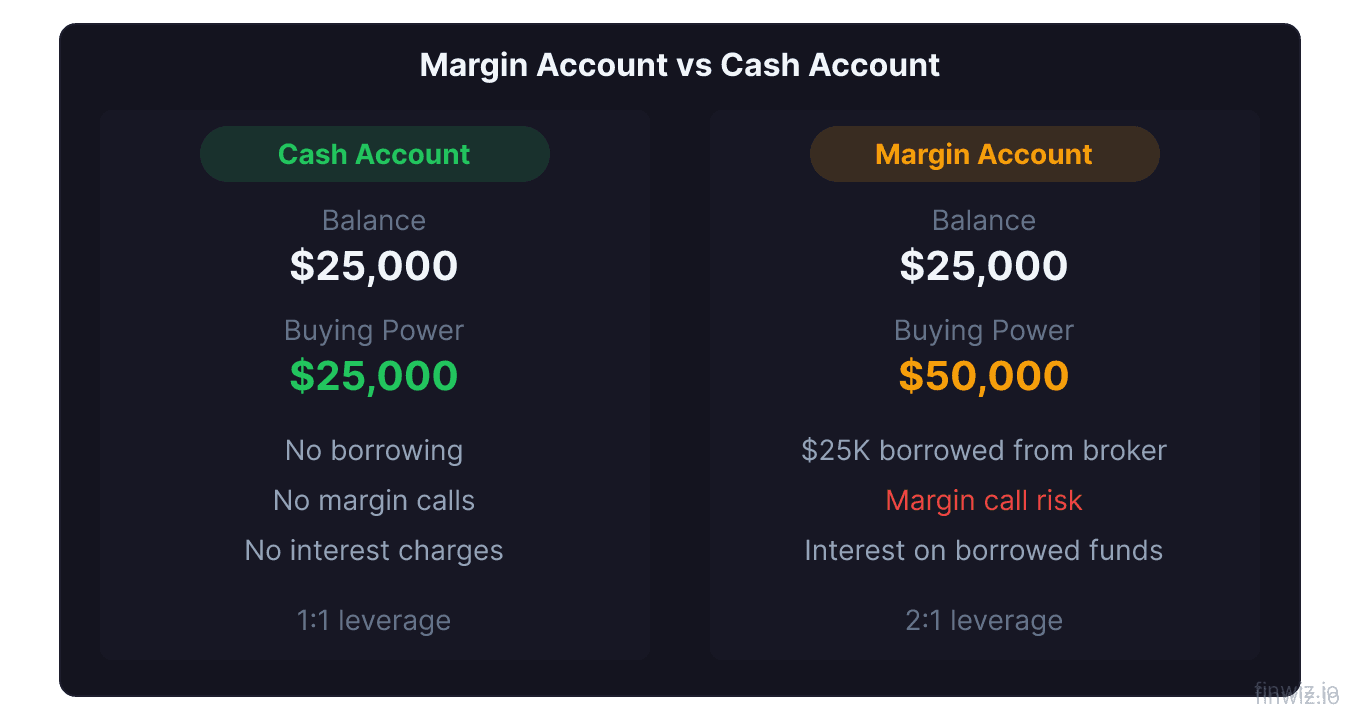
When you open a margin account, your broker extends credit using the securities in your account as collateral. If you have $10,000 in cash, margin allows you to buy up to $20,000 worth of stock (at the standard 2:1 leverage ratio). The additional $10,000 is a loan from your broker.
Margin trading is a double-edged sword. It magnifies your profits when trades go well and magnifies your losses when they go poorly. Understanding the mechanics, costs, and risks is essential before using leverage.
How Margin Works
Opening a Margin Account
To trade on margin, you must open a margin account with your broker, which is different from a standard cash account. Margin accounts require:
- A minimum deposit (typically $2,000, per FINRA rules)
- Agreement to the broker's margin terms and conditions
- Understanding of the risks involved
Buying on Margin Example
You have $10,000 cash and want to buy a stock at $50 per share.
Without margin: You can buy 200 shares ($10,000 / $50).
With margin (2:1): You can buy 400 shares ($20,000 / $50). You put up $10,000 and borrow $10,000 from your broker.
If the stock rises to $55:
- Without margin: Profit = 200 x $5 = $1,000 (10% return)
- With margin: Profit = 400 x $5 = $2,000 (20% return on your $10,000)
If the stock falls to $45:
- Without margin: Loss = 200 x $5 = $1,000 (10% loss)
- With margin: Loss = 400 x $5 = $2,000 (20% loss on your $10,000)
Leverage doubles both the gain and the loss.
Initial Margin and Maintenance Margin
Initial Margin
Initial margin is the percentage of the purchase price you must deposit when buying on margin. Under Regulation T set by the Federal Reserve, the initial margin requirement is 50% for most stocks.
Minimum Initial Deposit = Total Purchase Price x 50%Maintenance Margin
After the purchase, you must maintain a minimum level of equity in your account. FINRA requires a minimum maintenance margin of 25%, though most brokers set their requirement higher, typically 30-40%.
Account Equity = Market Value of Securities - Margin LoanIf your equity percentage falls below the maintenance requirement, you receive a margin call.
Margin Calls
A margin call is a demand from your broker to deposit additional funds or sell securities to bring your account equity back above the maintenance requirement.
Example of a Margin Call
You buy 400 shares at $50 ($20,000 total). You used $10,000 cash and $10,000 margin loan. Your broker's maintenance requirement is 30%.
The stock drops to $38:
- Market value: 400 x $38 = $15,200
- Margin loan: $10,000
- Equity: $15,200 - $10,000 = $5,200
- Equity percentage: $5,200 / $15,200 = 34.2%
The stock drops further to $35:
- Market value: 400 x $35 = $14,000
- Equity: $14,000 - $10,000 = $4,000
- Equity percentage: $4,000 / $14,000 = 28.6%
Margin call triggered (below 30%). You must either deposit additional funds or sell shares to restore the equity percentage above 30%.
Margin Call Price = Loan Amount / (Shares x (1 - Maintenance Margin %))Pro Tip
Margin Interest
Borrowing on margin is not free. Your broker charges margin interest on the borrowed amount. Interest rates vary by broker and by the amount borrowed, typically ranging from 5% to 12% annually.
Interest accrues daily and is usually charged monthly. For short-term trades (days to weeks), the interest cost is minimal. For longer-term positions, interest can significantly erode returns.
| Loan Amount | Annual Rate | Monthly Cost | Annual Cost |
|---|---|---|---|
| $10,000 | 8% | $66.67 | $800 |
| $25,000 | 7% | $145.83 | $1,750 |
| $50,000 | 6% | $250.00 | $3,000 |
Leverage Risk
The concept of leverage seems attractive, but the risk is real and unforgiving.
At 2:1 leverage, a 50% decline in the stock wipes out your entire equity. You still owe the broker the loan amount, meaning you could end up owing more than your original investment.
| Stock Move | Return Without Margin | Return With 2:1 Margin |
|---|---|---|
| +20% | +20% | +40% |
| +10% | +10% | +20% |
| -10% | -10% | -20% |
| -20% | -20% | -40% |
| -50% | -50% | -100% (total loss) |
Responsible Margin Use
If you choose to use margin, follow these guidelines:
- Never use full margin capacity: Just because you can borrow 100% of your equity does not mean you should. Many successful traders limit themselves to 20-30% of their margin capacity.
- Use margin for short-term trades: The shorter the holding period, the lower the interest cost and the less time for adverse moves to develop.
- Always use stop losses: Margin positions must have hard stop losses to prevent margin calls.
- Maintain a cash buffer: Keep extra cash in your account above the minimum maintenance requirement.
- Position size conservatively: Calculate your position size based on your cash equity, not your margin buying power.
Frequently Asked Questions
Who should use margin trading?
Margin trading is appropriate for experienced traders who understand leverage risk and have disciplined risk management. It is not suitable for beginners, long-term buy-and-hold investors (due to interest costs), or anyone who cannot afford to lose more than their initial investment.
Can I lose more than I invest with margin?
Yes. If a margined stock declines enough, you can lose your entire investment and still owe money to your broker. This is one of the most significant risks of margin trading and is why stop-loss orders are critical.
Is margin trading the same as options trading?
No. Margin trading involves borrowing money to buy more shares. Options trading involves buying contracts that give you the right to buy or sell shares at specific prices. Options provide leverage through a different mechanism and have defined maximum risk (the premium paid).
What happens to margin positions over weekends?
Your margin position remains open over weekends. If negative news causes the stock to gap at Monday's open, you could face a margin call immediately. This weekend risk is why conservative margin use is important for swing traders.
How do I close a margin position?
You close a margin position by selling the shares you purchased on margin. The proceeds first go to repay the margin loan plus any accrued interest. The remainder is your profit (or you may owe additional funds if the sale does not cover the loan).
Disclaimer
This is educational content, not financial advice. Trading involves risk, and you should consult a qualified financial advisor before making any investment decisions. Past performance does not guarantee future results.
Margin Trading and Market Events
Margin During Earnings
Holding margined positions through earnings announcements is particularly risky because overnight gaps can trigger margin calls before you have a chance to respond. A stock that gaps down 15% on a disappointing earnings report can immediately push a 2:1 leveraged position beyond the maintenance margin threshold.
If you trade on margin, consider:
- Reducing or closing margined positions before earnings reports
- Using only cash positions for stocks approaching their earnings date
- Maintaining extra cash buffer in your account during earnings season
Margin During Market Corrections
During broad market corrections, the combination of falling stock prices and margin requirements creates a dangerous feedback loop:
- Stock prices fall, reducing the equity in margined accounts
- Brokers issue margin calls, requiring additional deposits or forced selling
- Forced selling puts additional downward pressure on prices
- Lower prices trigger more margin calls across more accounts
- The cycle repeats, amplifying the decline
This margin-driven selling cascade is one reason why market corrections can be sharper and faster than the preceding rally. Understanding this dynamic helps you recognize when margin liquidation may be driving irrational price action and potentially creating buying opportunities for well-capitalized investors.
Portfolio Margin
Portfolio margin is an alternative margin calculation method available to qualified traders (typically requiring $100,000+ in account equity). Instead of applying fixed percentages to each position, portfolio margin evaluates the overall risk of the entire portfolio using a stress test approach.
Portfolio margin can significantly reduce margin requirements for well-diversified or hedged portfolios because it recognizes that offsetting positions reduce risk. However, it can also provide extremely high leverage on concentrated positions, amplifying the risks described above.
Portfolio margin is a powerful tool for experienced traders but is inappropriate for beginners due to the complexity of risk management required.
Related Articles
12 chapters covering charts, indicators, risk management & more. Plus weekly trading insights.