
Gap Trading: How to Trade Gap Ups & Gap Downs
⚡ Key Takeaways
- A gap occurs when a stock opens significantly higher or lower than its previous close, creating an empty space on the chart
- The four gap types are common gaps, breakaway gaps, runaway (continuation) gaps, and exhaustion gaps
- Gap fills occur when price retraces to cover the empty space, and most common gaps fill relatively quickly
- Breakaway and runaway gaps often do not fill and signal strong directional moves worth trading in the gap direction
- Volume is essential for classifying gaps: high-volume gaps on breakouts are more significant than low-volume gaps
What Is a Gap in Trading?
A gap occurs when a stock opens at a significantly different price from its previous closing price, leaving an empty space (or gap) on the chart where no trading took place. Gaps reflect a sudden shift in sentiment that occurred while the market was closed, often driven by earnings reports, news events, analyst upgrades or downgrades, or pre-market trading activity.
Gaps are important because they represent areas where the balance between supply and demand shifted dramatically. Understanding the different types of gaps and how to trade them gives you an edge in anticipating whether the gap will continue in its direction or reverse and fill.
On a candlestick or bar chart, a gap appears as a visible space between two consecutive candles. A gap up means the open of the new candle is above the high of the previous candle. A gap down means the open is below the low of the previous candle.
The Four Types of Gaps
Not all gaps are created equal. The context in which a gap occurs determines its significance and trading implications.
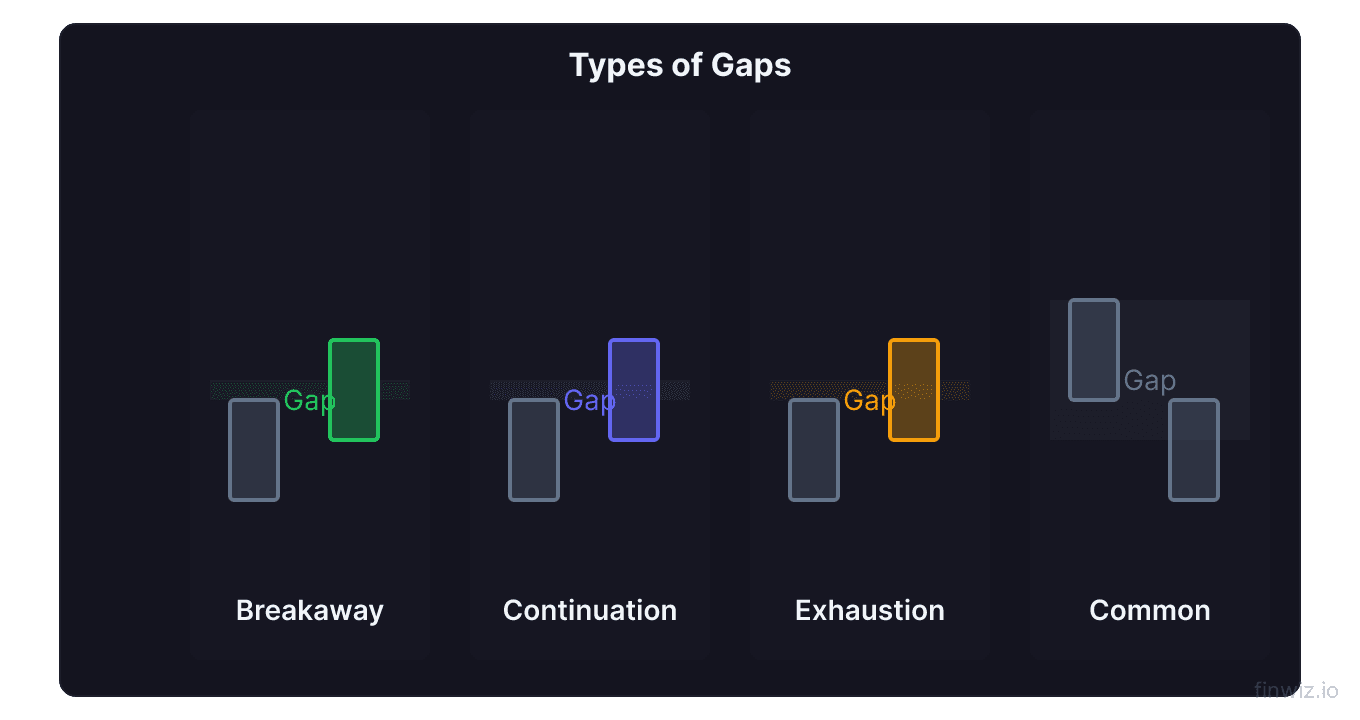
Common Gaps
Common gaps occur within a trading range or during normal price fluctuations and carry little technical significance. They are not associated with a breakout or a major trend event.
Characteristics of common gaps:
- Occur in the middle of a range-bound market
- Low to average volume on the gap day
- Fill relatively quickly, often within days
- No meaningful trend implications
Common gaps are the least useful for directional trading. If you spot a gap within a clearly range-bound stock with no catalyst, expect the gap to fill.
Breakaway Gaps
Breakaway gaps occur when a stock gaps above resistance or below support, signaling the beginning of a new trend. These are among the most significant gaps because they represent a decisive shift in sentiment.
Characteristics of breakaway gaps:
- Occur at the end of a consolidation or base
- Above-average to heavy volume
- Gap through a key support or resistance level
- Often do not fill, or take a very long time to fill
- Signal the start of a new directional move
Breakaway gaps are opportunities to enter a new trend at an early stage. A stock that gaps above resistance on heavy volume after a multi-week base is exhibiting classic breakaway gap behavior.
Runaway (Continuation) Gaps
Runaway gaps, also called continuation gaps or measuring gaps, occur in the middle of a strong trend. They signal that the trend has accelerated and that there is still significant momentum in the direction of the move.
Characteristics of runaway gaps:
- Occur during an established trend
- Moderate to heavy volume
- The gap appears roughly in the middle of the overall move
- Often do not fill until the trend reverses
- Can be used to project the length of the remaining move
Because runaway gaps often appear near the midpoint of a trend, they can be used to estimate how far the trend will extend. Measure the distance from the trend start to the runaway gap, then project that same distance from the gap to estimate the trend target.
Projected Target = Gap Level + (Gap Level - Trend Start)Exhaustion Gaps
Exhaustion gaps occur near the end of a strong trend and signal that the move is running out of steam. They are the opposite of breakaway gaps: instead of starting a trend, they finish one.
Characteristics of exhaustion gaps:
- Occur after a prolonged, extended trend
- Can have very heavy volume (final rush of buyers or sellers)
- The stock fails to continue in the gap direction
- Often fill within a few days
- Signal a potential reversal
The tricky part is distinguishing an exhaustion gap from a runaway gap in real time. Both occur during trends, and both can have strong volume. The key difference is what happens after the gap. If the stock fails to make further progress and starts reversing, the gap was likely an exhaustion gap.
Pro Tip
Gap Fill: When and Why Gaps Close
A gap fill occurs when the price retraces back through the gap area, covering the empty space on the chart. Gap fill analysis is a popular strategy because gaps create a natural magnet for price.
Why Gaps Fill
- Overreaction: Gaps often represent overreactions to news. Once emotions settle, the price returns to more rational levels.
- Support and resistance: The area where the gap originated often acts as a magnetic level that draws price back.
- Profit-taking: Traders who bought the gap up (or shorted the gap down) take profits, pushing price back toward the fill level.
Which Gaps Fill and Which Do Not?
| Gap Type | Fill Probability | Typical Fill Timeframe |
|---|---|---|
| Common | Very high (80%+) | Days to weeks |
| Exhaustion | High (70%+) | Days |
| Breakaway | Low (30-40%) | Months or never |
| Runaway | Low (20-30%) | Months or never |
This distinction is crucial. Trading gap fills indiscriminately will lead to losses on breakaway and runaway gaps. Always identify the gap type before assuming it will fill.
Gap Trading Strategies
Strategy 1: Gap and Go
The gap and go strategy trades in the direction of the gap, expecting continuation. It works best with breakaway gaps and runaway gaps.
Rules:
- The stock gaps up (or down) on at least 2x average volume.
- The gap occurs at or through a significant level (resistance, all-time high, etc.).
- The first candle after the open is bullish (for gap ups) or bearish (for gap downs).
- Enter on the break of the first candle's high (gap up) or low (gap down).
- Stop loss below the first candle's low (gap up) or above the first candle's high (gap down).
Strategy 2: Gap Fill Fade
The gap fill fade strategy trades against the gap direction, betting that the gap will fill. It works best with common gaps and exhaustion gaps.
Rules:
- The stock gaps into a clear resistance level (gap up) or support level (gap down).
- Volume on the gap is average or below average, or the gap shows exhaustion characteristics.
- A reversal candle pattern forms in the first 15-30 minutes.
- Enter in the direction of the gap fill.
- Target the prior close (gap fill level).
- Stop loss beyond the gap day's high (for gap up fades) or low (for gap down fades).
Strategy 3: Gap Pullback Entry
This strategy waits for a partial fill of the gap before entering in the gap direction. It offers a better risk-to-reward ratio than the gap and go strategy.
Rules:
- Identify a breakaway or runaway gap.
- Wait for the price to pull back partially into the gap area.
- Look for a bullish reversal candle on the pullback.
- Enter with a stop below the low of the pullback.
- Target the gap day's high and beyond.
Pre-Market and After-Hours Gaps
Most gaps form during pre-market and after-hours trading when liquidity is thin and price can move dramatically on relatively small orders. Earnings announcements, economic data releases, and overnight news are common catalysts.
When analyzing gaps, consider:
- Pre-market volume: Heavy pre-market volume on a gap supports the move. Thin pre-market volume suggests the gap may not be sustainable.
- The gap relative to pre-market range: If the gap was 5% but the stock has already traded a 3% range in pre-market, much of the move may already be absorbed.
- Overnight sentiment: Gaps that align with overall market direction (futures up, stock gaps up) are more reliable than those going against the broader market.
Frequently Asked Questions
Do all gaps eventually fill?
While common gaps fill the vast majority of the time, not all gaps fill. Breakaway gaps at the start of major trends and runaway gaps during strong trending moves can remain unfilled for months or years. The claim that all gaps fill is a widely repeated myth that can lead to significant losses if you blindly trade against a strong breakaway gap.
How do I tell the difference between a runaway gap and an exhaustion gap?
In real time, it can be difficult. The key factors are context and follow-through. A runaway gap occurs in the middle of a trend that still has room to run. An exhaustion gap occurs after an extended trend and is the final push. Watch the price action for 2-3 days after the gap. If the stock fails to make progress and starts filling the gap, it was likely exhaustion.
Can I trade gaps in after-hours or pre-market?
You can trade during extended hours, but be aware that liquidity is significantly lower, bid-ask spreads are wider, and price movements can be exaggerated. Many gap traders prefer to wait for the regular session open when liquidity increases and the gap direction becomes clearer.
What is the most reliable gap trading strategy?
The gap and go strategy on breakaway gaps with strong volume confirmation is considered the most reliable. When a stock breaks out of a multi-week base with a gap on 2x or more average volume, the probability of follow-through is high. The key is correctly identifying the gap as a breakaway type rather than a common or exhaustion gap.
How do gaps affect stop-loss orders?
Gaps can cause stop-loss orders to fill at prices significantly worse than the stop price. If your stop is at $48 and the stock gaps down to $45 at the open, your stop will fill at approximately $45, not $48. This is called slippage and is an inherent risk with stop orders. Stop-limit orders can prevent this slippage but carry the risk of not filling at all.
Disclaimer
This is educational content, not financial advice. Trading involves risk, and you should consult a qualified financial advisor before making any investment decisions. Past performance does not guarantee future results.
Related Articles
12 chapters covering charts, indicators, risk management & more. Plus weekly trading insights.