
Bullish & Bearish Divergence: How to Spot Trend Reversals Early
⚡ Key Takeaways
- Divergence occurs when price moves in one direction while an indicator moves in the opposite direction, signaling potential reversals
- Regular bullish divergence forms when price makes lower lows but the indicator makes higher lows, suggesting weakening selling pressure
- Regular bearish divergence forms when price makes higher highs but the indicator makes lower highs, suggesting weakening buying pressure
- Hidden divergence signals trend continuation rather than reversal and is used to enter pullbacks within existing trends
- RSI and MACD are the two most popular indicators for identifying divergence setups
What Is Divergence in Trading?
Divergence is a powerful concept in technical analysis that occurs when the direction of a price chart and the direction of a technical indicator move apart from each other. This disagreement between price and an indicator signals that the current trend may be losing momentum and a reversal or correction could be approaching.
Think of divergence as an early warning system. While the price may still be making new highs or lows, the underlying momentum is shifting. Experienced traders use divergence to anticipate trend changes before they become obvious on the price chart alone.
Divergence is not a timing tool on its own. It tells you that the conditions for a reversal are building, but it does not tell you exactly when that reversal will occur. Combining divergence signals with support and resistance, candlestick patterns, and volume analysis dramatically improves timing.
Regular Bullish Divergence
Regular bullish divergence occurs when the price makes a lower low while the indicator makes a higher low. This pattern appears at the end of downtrends and suggests that selling pressure is weakening even though the price continues to fall.
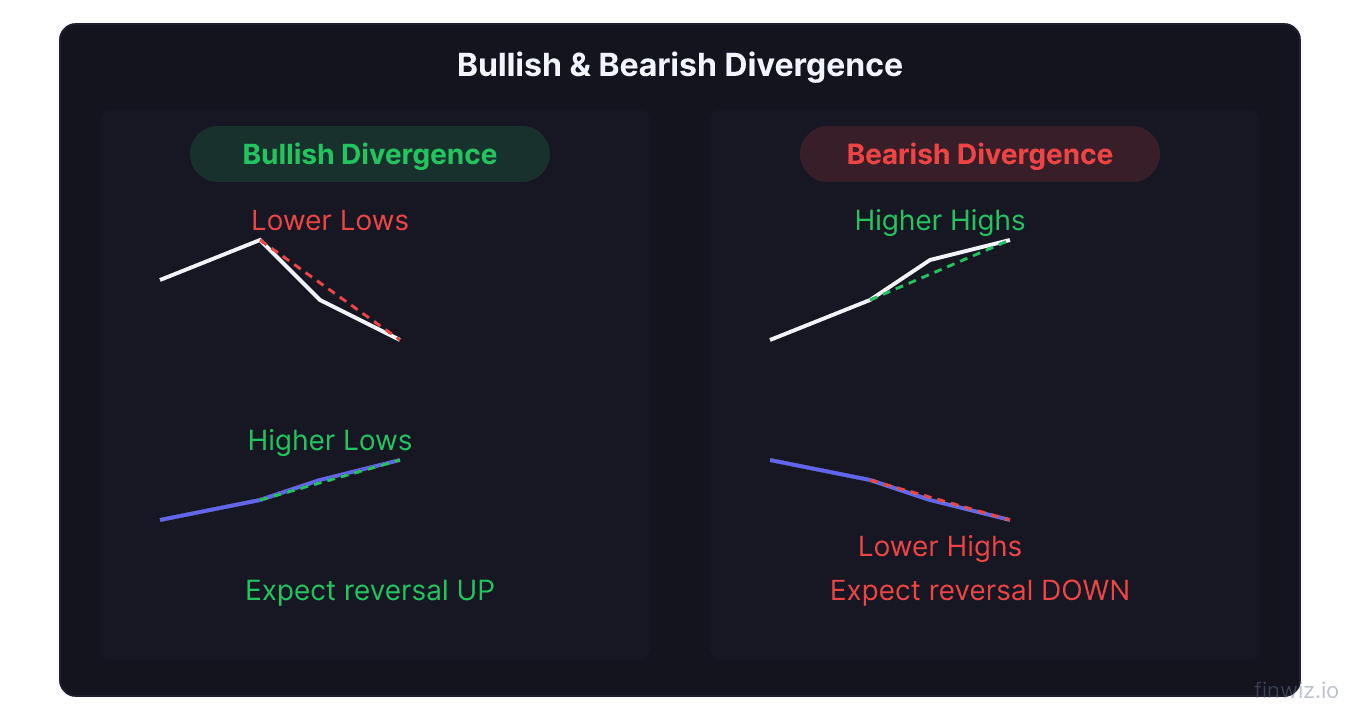
Here is how it develops:
- The stock is in a downtrend and makes a swing low.
- The stock bounces, then falls again to a new lower low.
- However, the indicator (such as RSI or MACD) forms a higher low compared to its previous reading.
- This divergence signals that sellers are losing conviction.
Why it works: Even though the price is making new lows, the indicator shows that the momentum behind the selling is decreasing. Fewer sellers are participating at each new low, which means the supply of shares being sold is drying up. Once buyers step in, even modestly, the price can reverse.
Trading Regular Bullish Divergence
- Identify the divergence: Look for lower lows on the price chart and higher lows on the indicator.
- Wait for confirmation: Do not buy the moment you spot divergence. Wait for a bullish candle pattern, a break above a short-term trend line, or a cross of the signal line on the MACD.
- Set your stop loss: Place it below the most recent swing low.
- Target: Aim for the nearest resistance level or use a risk-reward ratio of at least 2:1.
Pro Tip
Regular Bearish Divergence
Regular bearish divergence is the mirror image of bullish divergence. It occurs when the price makes a higher high while the indicator makes a lower high. This pattern appears at the end of uptrends and suggests buying momentum is weakening.
How it develops:
- The stock is in an uptrend and makes a swing high.
- The stock pulls back, then rallies to a new higher high.
- However, the indicator fails to make a corresponding higher high, instead forming a lower high.
- This divergence warns that buyers are losing steam.
Why it works: The price is making new highs, but with less momentum behind each push. Buyers are becoming exhausted, and it takes less selling pressure to cause a reversal.
Trading Regular Bearish Divergence
- Identify the divergence: Look for higher highs on the price chart and lower highs on the indicator.
- Wait for confirmation: Look for a bearish candle pattern, a break below a short-term trend line, or a MACD signal line cross.
- Set your stop loss: Place it above the most recent swing high.
- Target: Aim for the nearest support level or use a minimum 2:1 risk-reward ratio.
Hidden Divergence: The Continuation Signal
While regular divergence signals reversals, hidden divergence signals trend continuation. It is used to identify pullback opportunities within an existing trend.
Hidden Bullish Divergence
Hidden bullish divergence occurs when the price makes a higher low (consistent with an uptrend) while the indicator makes a lower low. Despite the indicator dipping lower, the price is holding at a higher level, confirming that the uptrend is intact.
This pattern tells you that the pullback within the uptrend is a buying opportunity. The temporary dip in momentum is not accompanied by a corresponding dip in price, which means buyers are still in control.
Hidden Bearish Divergence
Hidden bearish divergence occurs when the price makes a lower high (consistent with a downtrend) while the indicator makes a higher high. The temporary spike in momentum is not accompanied by a new price high, confirming the downtrend remains intact.
This pattern signals that a rally within a downtrend is a selling or shorting opportunity.
| Divergence Type | Price Action | Indicator Action | Signal |
|---|---|---|---|
| Regular Bullish | Lower low | Higher low | Reversal up |
| Regular Bearish | Higher high | Lower high | Reversal down |
| Hidden Bullish | Higher low | Lower low | Continuation up |
| Hidden Bearish | Lower high | Higher high | Continuation down |
Using RSI for Divergence
The RSI is one of the most popular indicators for spotting divergence because it is bounded between 0 and 100, making it easy to compare successive peaks and troughs.
RSI divergence is especially reliable when:
- The RSI is in overbought territory (above 70) during bearish divergence
- The RSI is in oversold territory (below 30) during bullish divergence
- The divergence occurs on the daily chart or higher timeframe
- The divergence aligns with a key support or resistance level
One important note: RSI divergence can persist through multiple swings before the price actually reverses. This is called extended divergence and is why confirmation is essential before entering a trade.
Using MACD for Divergence
The MACD is another excellent tool for identifying divergence. You can measure divergence using either the MACD line itself or the MACD histogram.
MACD histogram divergence is particularly sensitive because the histogram represents the rate of change of momentum, making it an early signal. Compare the heights of successive histogram peaks during an uptrend or the depths of successive histogram troughs during a downtrend.
When the MACD histogram makes a shallower peak while price makes a higher high, bearish divergence is present. When the histogram makes a shallower trough while price makes a lower low, bullish divergence is present.
Pro Tip
Multi-Indicator Divergence
The most powerful divergence signals occur when multiple indicators diverge simultaneously. If both the RSI and the MACD show bearish divergence while the price makes a higher high, the signal is significantly stronger than divergence on a single indicator.
Steps for multi-indicator divergence analysis:
- Check the RSI for divergence against price.
- Check the MACD line or histogram for divergence.
- Optionally check the Stochastic oscillator or OBV for additional confirmation.
- If two or more indicators agree, the divergence signal is high-probability.
Divergence Trading Setups
The Double Divergence Setup
Sometimes divergence forms across three swing points rather than two, creating a triple divergence pattern (or double divergence, since two separate divergences overlap). This occurs when:
- Price makes a low, followed by a lower low, followed by an even lower low.
- The indicator makes a low, then a higher low, then an even higher low.
Triple divergence is relatively rare but extremely powerful. The extended period of divergence means the trend has been losing momentum for a prolonged time, and the eventual reversal tends to be significant.
Divergence with Trend Line Break
Combine divergence with a trend line break for a high-conviction setup:
- Identify divergence (regular bullish or bearish).
- Draw a short-term trend line on the price chart.
- Wait for the price to break the trend line in the direction suggested by the divergence.
- Enter on the break with a stop beyond the recent swing point.
Common Divergence Mistakes
- Trading divergence without confirmation: Divergence alone is not a trade signal. Always wait for price confirmation.
- Looking for divergence on low timeframes: Divergence on 1-minute or 5-minute charts produces many false signals. Daily and 4-hour charts are more reliable.
- Ignoring the broader trend: Regular divergence works best at the extremes of mature trends. In the middle of a strong trend, divergence may simply lead to a brief pause rather than a reversal.
- Confusing regular and hidden divergence: Regular divergence signals reversals; hidden divergence signals continuations. Mixing them up leads to trading against the trend.
Frequently Asked Questions
How reliable is divergence as a trading signal?
Divergence is a moderately reliable signal that improves significantly when combined with other tools. On its own, divergence can produce false signals, especially in strong trending markets. When divergence aligns with support and resistance, candlestick patterns, and volume analysis, its accuracy increases substantially.
Can divergence last for a long time before a reversal?
Yes. Extended divergence can persist across three, four, or even more swing points. A stock can continue making new highs with bearish divergence for weeks. This is why trading divergence without confirmation is dangerous. The divergence tells you conditions are changing; the confirmation tells you the change is happening now.
Which indicator is best for divergence?
The RSI and MACD are the two most widely used indicators for divergence. RSI is preferred for its bounded range (0-100), which makes comparison straightforward. MACD is preferred for its sensitivity through the histogram. Many traders check both for multi-indicator confirmation.
Does divergence work on all timeframes?
Divergence appears on all timeframes, but higher timeframes produce more reliable signals. Daily and weekly chart divergence signals tend to lead to significant moves. Intraday divergence, particularly on very short timeframes, produces more noise and false signals.
What is the difference between regular and hidden divergence?
Regular divergence signals that a trend is about to reverse. Hidden divergence signals that a trend is about to continue after a pullback. Regular divergence occurs at trend extremes; hidden divergence occurs during corrections within the trend.
Disclaimer
This is educational content, not financial advice. Trading involves risk, and you should consult a qualified financial advisor before making any investment decisions. Past performance does not guarantee future results.
Related Articles
12 chapters covering charts, indicators, risk management & more. Plus weekly trading insights.