
Whipsaw: When the Market Fakes You Out
⚡ Key Takeaways
- A whipsaw occurs when price breaks through a key level, triggers traders into a position, then immediately reverses — trapping them on the wrong side of the trade
- Whipsaws are most common during low-volume breakouts, choppy range-bound markets, and around major news events where price discovery is chaotic
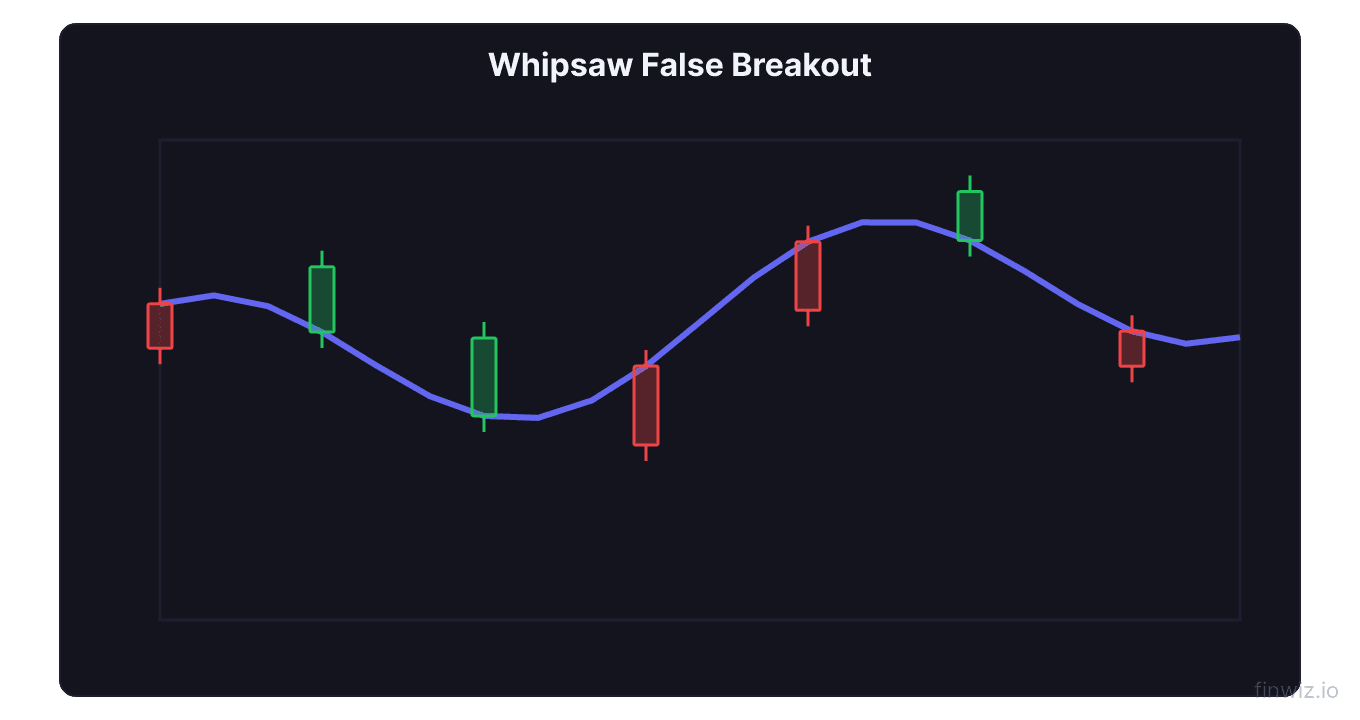
- The classic whipsaw sequence starts with a breakout above resistance, triggers buy orders and stop-losses, then reverses sharply — forming what chart readers call a bull trap or bear trap
- Strategies to avoid getting whipsawed include using wider stops, waiting for confirmation candles, requiring volume confirmation, and trading breakouts from longer consolidation periods
- Accepting that some whipsaws are unavoidable is part of the process — the goal is to reduce their frequency and minimize the damage when they occur
What Is a Whipsaw?
A whipsaw is a rapid price reversal that catches traders on the wrong side of a move. The term comes from the lumberjack's saw — a long, flexible blade that cuts in both directions. In trading, a whipsaw cuts your account in both directions too. You buy the breakout, price reverses and stops you out, then the stock continues in your original direction — without you.
Here is a real-world pattern that plays out daily. GOOGL has been trading between $165 and $170 for two weeks. At 10:15 AM, price breaks above $170 on what looks like solid momentum. Breakout traders buy. Traders who were short place stop-loss orders above $170 that now trigger as buy orders, adding more upward pressure. Price spikes to $171.20.
Then it reverses. By 10:45 AM, GOOGL is back at $168.50. The breakout was fake. Everyone who bought above $170 is underwater. Those who had tight stops at $169.50 already got stopped out for a loss. This is a whipsaw — and it is one of the most frustrating experiences in trading.
The Anatomy of a False Breakout
Understanding why whipsaws happen requires understanding market mechanics. At key technical levels (support, resistance, round numbers), large clusters of orders accumulate. Above resistance, there are buy-stop orders from short sellers and breakout buy orders from momentum traders. Below support, the mirror image exists.
When price pushes through resistance, it triggers these clustered orders. The burst of buying creates a temporary spike that looks like a genuine breakout. But if the breakout is not backed by sustained buying interest — real institutional demand, not just triggered stops — the spike exhausts itself quickly.
What happens next is the trap. Large players and algorithms that pushed price through resistance begin selling into the breakout buyers. Price reverses through the breakout level. Now the breakout buyers are losing money and their stop-losses start triggering, adding selling pressure. The reversal accelerates. What started as a breakout becomes a bull trap — price not only fails to hold above resistance but drops below where the breakout started.
Whipsaw Sequence (Long Side):Market Conditions That Produce the Most Whipsaws
Not all market environments whipsaw equally. Certain conditions make false breakouts far more likely.
Range-bound and consolidating markets are the primary whipsaw generators. When price is trapped between clear support and resistance with no strong directional catalyst, breakout attempts in both directions tend to fail. Each push toward the boundary triggers stops and reverses. Traders who try to trade breakouts in a choppy range get whipsawed repeatedly.
Low-volume breakouts are the biggest red flag. A genuine breakout is driven by strong participation — high volume confirming that real buyers (or sellers) are committing capital. When price breaks a level on average or below-average volume, the move lacks conviction. These low-volume breakouts fail at a much higher rate.
Pre-news positioning around earnings, FOMC meetings, and economic data releases creates whipsaw conditions. Traders position ahead of the event, price moves in one direction as the news hits, then reverses as the market digests the implications. The classic "buy the rumor, sell the news" pattern is essentially a planned whipsaw.
Algorithmic stop-hunting is a contested but observable phenomenon. Some market participants push price just past key levels to trigger stop-loss clusters, then trade in the opposite direction once the stops have been absorbed. Whether this is deliberate manipulation or simply the natural behavior of liquidity-seeking algorithms, the result for retail traders is the same: their stops get hit right before price reverses in their favor.
Pro Tip
Strategies to Avoid Getting Whipsawed
No strategy eliminates whipsaws entirely, but several approaches reduce their frequency and cost.
Use wider stops. If your stop is $0.50 below the breakout level and the stock whipsaws $0.70 before continuing in the breakout direction, a wider stop of $1.00 would have kept you in the trade. The trade-off is a larger loss when the trade genuinely fails. Use the stock's ATR to set stops that give the trade room to absorb normal volatility — a stop at 1.5-2x the ATR below your entry is a common approach.
Wait for confirmation candles. Instead of buying the instant price breaks above resistance, wait for the breakout candle to close above the level. Better yet, wait for a second candle to close above the level. This confirmation filter means you miss the first portion of genuine breakouts, but you avoid the majority of false breakouts that reverse within minutes.
Require volume confirmation. Only trade breakouts where volume on the breakout bar is at least 1.5-2x the average volume for that timeframe. High volume means real participation. Low volume means the breakout is more likely to be a stop-triggered spike with no follow-through.
Trade breakouts from longer consolidations. A breakout from a two-day consolidation is far less reliable than a breakout from a three-week consolidation. Longer consolidation periods build up more order clusters, more trader attention, and more institutional interest. When these levels finally break, the move is more likely to be sustained.
Whipsaw Reduction Checklist:Fade the first breakout, trade the second. Some experienced traders deliberately skip the first breakout attempt at a level and wait for the whipsaw. After the false breakout traps breakout traders and reverses, the stock often settles back into the range. When it breaks the level a second time, the whipsaw traders have already been flushed out and the move is cleaner. This strategy requires patience but has a higher success rate per trade.
Pro Tip
Frequently Asked Questions
How do I tell the difference between a whipsaw and a genuine reversal?
A whipsaw is a temporary fake-out that resolves quickly — usually within minutes to hours — before price resumes the original trend or breaks out for real. A genuine reversal involves a sustained change in direction backed by volume, a shift in market structure (lower highs and lower lows replacing higher highs and higher lows), and often a fundamental catalyst. If price breaks a level and holds beyond it for a full session close, it is more likely a genuine move than a whipsaw.
Are whipsaws more common in certain stocks or sectors?
Yes. Stocks with lower float and lower institutional ownership tend to whipsaw more because their order books are thinner and more susceptible to stop-triggered spikes. High-beta technology and biotech stocks whipsaw more than defensive sectors like utilities. ETFs like SPY and QQQ whipsaw less on an absolute basis because of their deep liquidity, though they still produce false breakouts at key technical levels.
Should I stop trading breakout strategies if I keep getting whipsawed?
Not necessarily — but you should refine your filters. Pure breakout trading without volume confirmation, timeframe confirmation, and proper stop placement will produce a high whipsaw rate. Add the filters described in this article and backtest the results. If breakouts still do not work for your style, consider pullback entries instead — waiting for the breakout, then entering on the first pullback to the breakout level. This approach avoids the initial whipsaw risk entirely, though you may miss breakouts that never pull back.
12 chapters covering charts, indicators, risk management & more. Plus weekly trading insights.