
Historical Volatility: Measuring Past Price Movement
⚡ Key Takeaways
- Historical volatility (HV) measures the actual price variability of a security over a past period, calculated as the annualized standard deviation of logarithmic daily returns.
- Common lookback periods include 20-day (one trading month), 30-day, and 252-day (one trading year), with shorter periods capturing recent conditions and longer periods providing a broader perspective.
- Historical volatility looks backward at what has already happened, while implied volatility (IV) looks forward at what the options market expects to happen — comparing the two reveals whether options are relatively cheap or expensive.
- HV is expressed as an annualized percentage, so an HV of 30% means the stock's price has been fluctuating at an annualized rate of 30% based on recent data.
- Traders use historical volatility for options pricing, position sizing, stop-loss placement, and assessing whether a stock's current price movement is normal or unusual.
What Is Historical Volatility?
Historical volatility (HV) is a statistical measure of how much a security's price has fluctuated over a specific past time period. It quantifies the degree of price variation by calculating the standard deviation of the security's logarithmic daily returns, then annualizing the result to produce a percentage figure that is comparable across different time horizons.
If a stock has a historical volatility of 25%, it means that based on recent price data, the stock's annualized rate of price fluctuation has been 25%. Higher historical volatility indicates wider price swings — the stock has been moving more aggressively. Lower historical volatility indicates tighter price action — the stock has been relatively calm.
Historical volatility is purely backward-looking. It tells you what has already happened, not what will happen next. However, past volatility tends to cluster — periods of high volatility are often followed by more high volatility, and periods of low volatility tend to persist as well. This clustering effect, described by the GARCH family of models, makes historical volatility useful for forecasting near-term risk.
The Historical Volatility Formula
The calculation of historical volatility involves several steps: computing daily returns, converting to logarithmic returns, calculating the standard deviation, and annualizing.
Step 1: Calculate daily logarithmic returnsLogarithmic returns are used instead of simple percentage returns because they are additive over time and more accurately model the compounding nature of returns. The difference between log returns and simple returns is small for daily data but becomes meaningful over longer periods.
The annualization factor of sqrt(252) converts the daily standard deviation to an annual figure, assuming 252 trading days per year. This allows you to compare volatility across different securities and time periods on a common scale.
Worked Example
Consider a stock with the following five closing prices:
| Day | Price | Daily Log Return |
|---|---|---|
| 1 | $100.00 | — |
| 2 | $102.00 | ln(102/100) = 0.0198 |
| 3 | $99.50 | ln(99.5/102) = -0.0248 |
| 4 | $101.00 | ln(101/99.5) = 0.0150 |
| 5 | $103.00 | ln(103/101) = 0.0196 |
Mean log return = (0.0198 + (-0.0248) + 0.0150 + 0.0196) / 4 = 0.0074
Variance = [(0.0198 - 0.0074)^2 + (-0.0248 - 0.0074)^2 + (0.0150 - 0.0074)^2 + (0.0196 - 0.0074)^2] / 3
Variance = [0.000154 + 0.001037 + 0.0000058 + 0.000149] / 3 = 0.000449
Daily SD = sqrt(0.000449) = 0.0212
Annualized HV = 0.0212 x sqrt(252) = 0.0212 x 15.87 = 0.3366 = 33.7%
This stock has a historical volatility of approximately 33.7% based on this short sample. In practice, you would use 20 or more data points for a meaningful calculation.
Pro Tip
Choosing a Lookback Period
The lookback period — the number of trading days used in the calculation — significantly affects the HV reading. Different periods serve different analytical purposes.
20-Day Historical Volatility
The 20-day HV captures approximately one trading month of data. It is the most common short-term lookback period and is highly responsive to recent price action. A sudden spike in daily price moves will show up quickly in the 20-day HV.
Use 20-day HV for:
- Short-term options trading decisions
- Identifying recent volatility regime changes
- Setting short-term position sizes and stop losses
30-Day Historical Volatility
The 30-day HV is another popular short-term measure, roughly equivalent to one calendar month. It provides slightly more smoothing than the 20-day while still being responsive to recent conditions.
252-Day Historical Volatility
The 252-day HV covers one full trading year and provides a comprehensive view of the stock's typical volatility. It smooths out short-term spikes and captures the full range of market conditions the stock experienced over the past year.
Use 252-day HV for:
- Long-term risk assessment
- Comparing volatility across different securities
- Portfolio construction and asset allocation
| Lookback Period | Responsiveness | Best For |
|---|---|---|
| 10-day | Very high | Ultra-short-term, scalping |
| 20-day | High | Short-term options, swing trading |
| 30-day | Moderate-high | General purpose, options comparison |
| 60-day | Moderate | Medium-term analysis |
| 252-day | Low | Long-term risk assessment, benchmarking |
Historical Volatility vs. Implied Volatility
The comparison between historical volatility (HV) and implied volatility (IV) is one of the most important concepts in options trading.
Historical volatility tells you how much the stock has actually moved in the past.
Implied volatility tells you how much the options market expects the stock to move in the future. IV is derived from options prices using models like Black-Scholes. Higher options prices imply higher expected volatility.
| Attribute | Historical Volatility | Implied Volatility |
|---|---|---|
| Direction | Backward-looking | Forward-looking |
| Derived from | Past price data | Current options prices |
| Represents | Actual realized movement | Market's expected movement |
| Changes when | Past data window shifts | Options supply/demand changes |
| Used for | Risk measurement, benchmarking | Options pricing, strategy selection |
The HV-IV Relationship
When IV exceeds HV, options are relatively expensive. The market is pricing in more future volatility than the stock has recently exhibited. This condition favors options sellers — selling premium when IV is high relative to HV is a core strategy for options income traders.
When HV exceeds IV, options are relatively cheap. The stock has been moving more than the options market expects. This condition favors options buyers — purchasing options when IV is low relative to HV provides exposure at a discount.
This comparison is often visualized using an IV rank or IV percentile, which measures where current IV falls relative to its own historical range. An IV percentile of 90% means current IV is higher than 90% of its readings over the past year.
Pro Tip
Uses of Historical Volatility
Options Pricing and Strategy Selection
Historical volatility serves as a reality check for options prices. If you are considering buying a call option on a stock with 30-day HV of 20% but IV is priced at 45%, you know the options market is pricing in significantly more movement than the stock has recently shown. This context helps you decide whether the premium is justified.
Options strategies like straddles and strangles are directly affected by the relationship between HV and IV. Buying straddles works best when you expect future volatility to exceed current IV. Selling straddles works best when you expect future volatility to be less than current IV.
Position Sizing
Historical volatility helps you size positions appropriately. A stock with 50% annualized HV will have daily moves roughly 2.5 times larger than a stock with 20% HV. If you use the same dollar position size for both, the volatile stock will generate 2.5 times the daily P&L swings.
To equalize risk, divide your standard position size by the stock's relative volatility. This approach, known as volatility-adjusted position sizing, ensures that each position contributes roughly equal risk to your portfolio.
Stop-Loss Placement
Setting stop losses based on historical volatility prevents your stops from being triggered by normal price noise. If a stock's daily standard deviation is $2.00, placing a stop $1.00 away from your entry invites a stop-out on normal fluctuation. A stop placed 2-3 daily standard deviations from entry provides breathing room while still protecting against adverse moves.
The ATR indicator is a closely related tool that measures average true range — a volatility metric that incorporates gaps and is often used for stop-loss placement.
Risk Assessment
Historical volatility is a core input in risk models like Value at Risk (VaR) and the Sharpe ratio. These models use HV to estimate the probability of losses exceeding a certain threshold over a given time period. Higher HV means greater downside risk (and upside potential) per unit of time.
Volatility Regimes and Mean Reversion
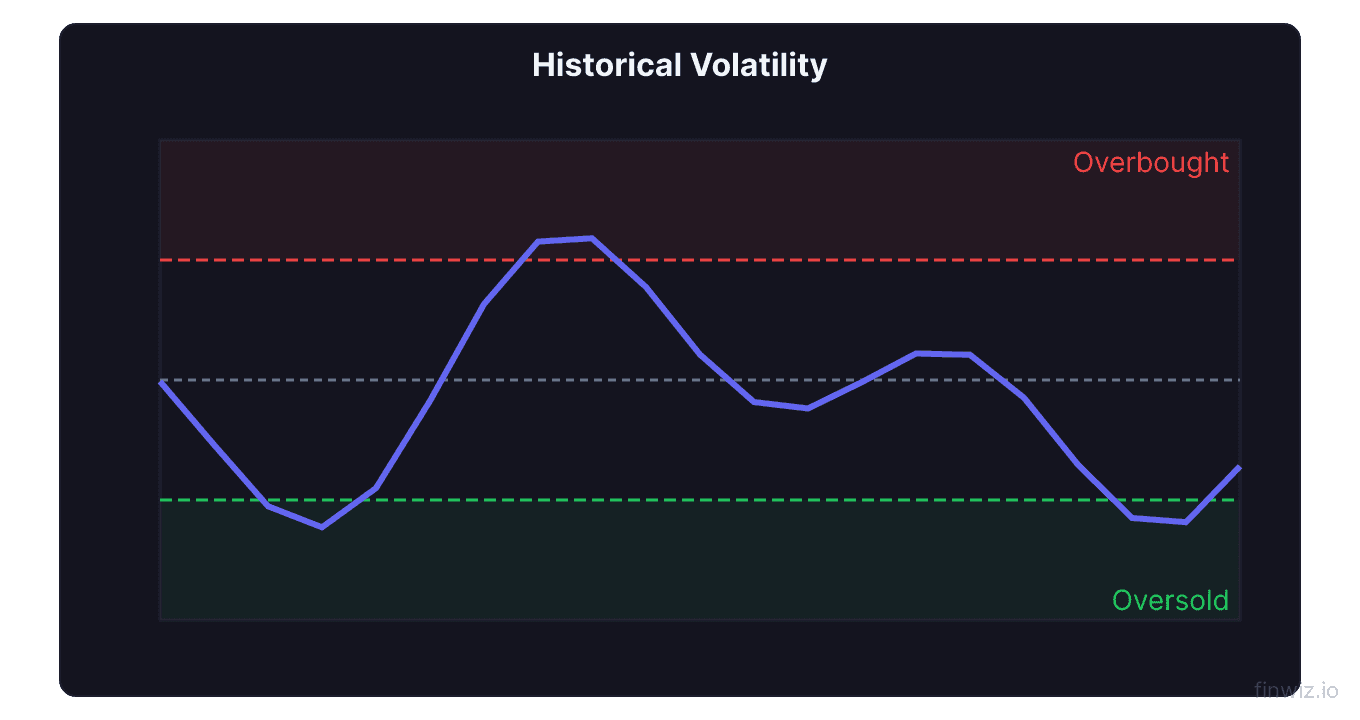
One of the most useful properties of historical volatility is its tendency to mean-revert. Volatility does not trend indefinitely — it cycles between periods of expansion and contraction.
When HV is significantly below its long-term average, it tends to increase. When HV is significantly above its long-term average, it tends to decrease. This mean-reversion tendency is more reliable than mean reversion in price, making volatility-based strategies attractive.
Traders exploit this property by:
- Buying options (or volatility) when HV is at historical lows, anticipating an expansion
- Selling options (or volatility) when HV is at historical highs, anticipating a contraction
- Adjusting position sizes based on where current volatility sits relative to its range
Frequently Asked Questions
What is a good historical volatility number?
There is no universally "good" or "bad" HV number — it depends on the asset class and context. Large-cap stocks like those in the S&P 500 typically have HV between 15% and 30%. Small-cap and biotech stocks may have HV of 40% to 80% or more. Index ETFs tend to have lower HV than individual stocks due to diversification.
How often should I check historical volatility?
For options traders, reviewing HV before every trade is essential because the HV-IV comparison directly affects strategy selection. For stock traders, checking HV weekly or when adjusting position sizes is sufficient. Monitor HV more frequently during periods of market stress when volatility regimes can shift rapidly.
Does high historical volatility mean a stock is risky?
High HV indicates that the stock has been experiencing large price swings, which means higher uncertainty and the potential for larger gains or losses. Whether that constitutes "risk" depends on your perspective. For a buy-and-hold investor, high HV can be unsettling. For an options seller, high HV creates opportunity to collect larger premiums.
Can historical volatility predict future price direction?
No. Historical volatility measures the magnitude of price changes, not the direction. A stock with 40% HV could go up or down — the HV simply tells you the swings are large. Combining HV with directional indicators like moving averages or MACD provides both magnitude and direction context.
Why do we use log returns instead of simple returns?
Logarithmic returns are preferred because they are time-additive (daily log returns can be summed to get cumulative returns), symmetric around zero, and better approximate the normal distribution assumption underlying standard deviation calculations. For small daily moves, the difference between log returns and simple percentage returns is negligible.
Disclaimer
This is educational content, not financial advice. Trading involves risk, and you should consult a qualified financial advisor before making any investment decisions. Past performance does not guarantee future results.
12 chapters covering charts, indicators, risk management & more. Plus weekly trading insights.