
Risk/Reward Ratio: How to Calculate & Use It in Every Trade
⚡ Key Takeaways
- The risk-reward ratio compares the potential loss on a trade to the potential gain
- A 2:1 ratio means you stand to gain twice as much as you risk, which is the minimum standard for most strategies
- With a 2:1 ratio, you only need to win 34% of your trades to break even
- Higher risk-reward ratios allow for lower win rates while remaining profitable
- Always calculate the risk-reward ratio before entering a trade; if it does not meet your minimum, skip the trade
What Is the Risk-Reward Ratio?
The risk-reward ratio (R:R) compares how much you stand to lose on a trade to how much you stand to gain. It is one of the most important concepts in trading because it determines whether your strategy is mathematically viable.
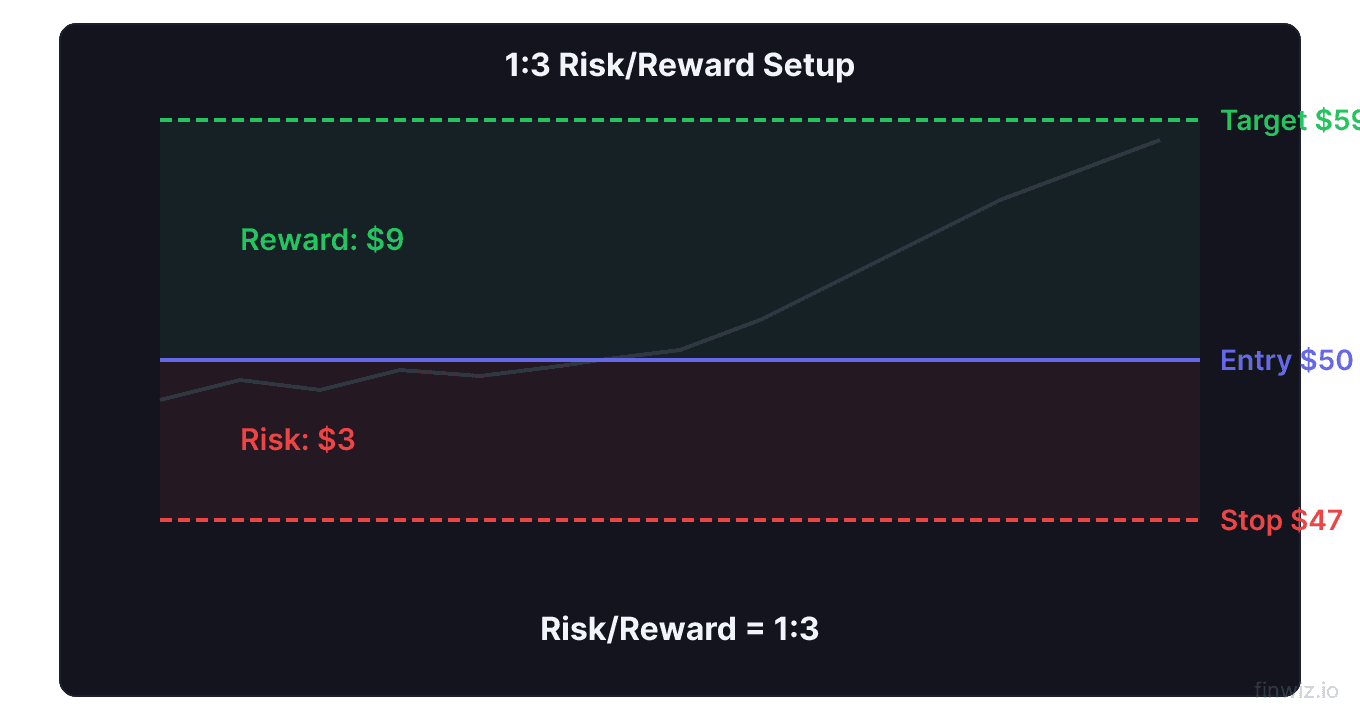
Risk-Reward Ratio = (Target Price - Entry Price) / (Entry Price - Stop Loss Price)A 2:1 ratio means you risk $2 to make $4. If you achieve this ratio consistently, you can lose more trades than you win and still make money.
Try It: Risk-Reward Calculator
Why Risk-Reward Matters More Than Win Rate
Many traders obsess over their win rate (the percentage of trades that are profitable). While win rate matters, the risk-reward ratio is equally or more important.
The Math of R:R and Win Rate
| Risk-Reward | Win Rate Needed to Break Even |
|---|---|
| 1:1 | 50% |
| 1.5:1 | 40% |
| 2:1 | 34% |
| 3:1 | 25% |
| 4:1 | 20% |
With a 2:1 risk-reward ratio, you only need to win 34% of your trades to break even. With a 3:1 ratio, you only need 25%. This means you can be wrong most of the time and still make money.
Breakeven Win Rate = 1 / (1 + Risk-Reward Ratio) x 100Expected Value
The expected value of a trading strategy combines win rate and R:R:
Expected Value = (Win Rate x Average Win) - (Loss Rate x Average Loss)A positive expected value means the strategy makes money over time.
Pro Tip
Setting Up a 2:1 (or Better) Trade
Step 1: Define Your Stop Loss
Place your stop loss at a level where your trade thesis is invalidated. This might be below support, below a moving average, or beyond a specific chart pattern.
Step 2: Calculate Your Risk
Your risk is the distance between your entry price and your stop loss, multiplied by your position size.
Step 3: Set Your Profit Target
Your target must be at least 2x your risk distance from your entry. This target should also align with a logical chart level (prior swing high, resistance, measured move).
Step 4: Verify the Target Is Realistic
A 2:1 target that requires the stock to break through three resistance levels is not realistic. Ensure there is a clear path for the price to reach your target.
R-Multiple: Standardizing Your Results
R-multiple is the actual result of a trade expressed in terms of the initial risk (R).
R-Multiple = Actual Profit (or Loss) / Initial RiskTracking trades in R-multiples normalizes your results across different stocks and position sizes. Your goal is to have an average R-multiple above zero.
| R-Multiple | Meaning |
|---|---|
| -1R | Full stop loss hit |
| -0.5R | Partial loss (exit before stop) |
| 0R | Breakeven |
| +1R | Gained your risk amount |
| +2R | Gained twice your risk |
| +3R or more | Exceptional winner |
Common Mistakes with Risk-Reward
- Widening stops to improve the ratio: Moving your stop further away to make the ratio look better does not actually improve the trade. Your stop should be based on the chart, not on making the math work.
- Using unrealistic targets: Setting a target at 5:1 when the stock needs to cross major resistance to get there is wishful thinking. Targets must be achievable.
- Ignoring probability: A 5:1 trade that only has a 10% chance of working has a negative expected value. R:R must be paired with a reasonable win probability.
- Cutting winners at 1R: If you consistently exit at 1R instead of letting trades reach 2R or 3R, you are undermining your own strategy. Let winners run to at least the planned target.
Adjusting R:R for Different Strategies
| Strategy | Typical R:R | Typical Win Rate | Expected Value |
|---|---|---|---|
| Breakout | 2:1 to 3:1 | 40-50% | Positive |
| Pullback | 2:1 to 2.5:1 | 50-60% | Positive |
| Range trade | 1.5:1 to 2:1 | 55-65% | Positive |
| Reversal | 3:1 to 5:1 | 30-40% | Positive |
| Scalping | 1:1 to 1.5:1 | 55-70% | Positive |
Different strategies have different optimal R:R profiles. Reversal trades have lower win rates but higher R:R ratios. Pullback trades have higher win rates with moderate R:R ratios.
Frequently Asked Questions
What is the minimum risk-reward ratio I should accept?
Most professional traders use a minimum of 2:1. This provides enough cushion for the strategy to be profitable even with a moderate win rate. Some traders accept 1.5:1 on very high-probability setups, but going below 1.5:1 makes profitability difficult.
Is a 1:1 risk-reward ratio ever acceptable?
A 1:1 ratio requires a win rate above 50% to be profitable. While achievable with some strategies (particularly scalping and range trading), it provides no margin for error. Most traders find that maintaining a win rate above 50% consistently is more difficult than maintaining a 2:1 R:R.
How do I improve my risk-reward ratio?
Three approaches: (1) find entries closer to support so your stop is tighter, (2) target areas further from your entry with clear potential, (3) use trailing stops to capture moves that exceed your initial target.
Should I take partial profits at 1:1?
Taking partial profits at 1R (selling half the position when the profit equals the initial risk) is a common and effective approach. This locks in profit on half the position while allowing the remaining half to run toward a 2:1 or 3:1 target. Move the stop to breakeven on the remaining position.
Does the risk-reward ratio guarantee profitability?
No. The R:R ratio only defines the relationship between wins and losses. You also need a sufficient win rate to create a positive expected value. A 5:1 R:R with a 5% win rate is not profitable. R:R and win rate work together to determine profitability.
Disclaimer
This is educational content, not financial advice. Trading involves risk, and you should consult a qualified financial advisor before making any investment decisions. Past performance does not guarantee future results.
Building a Risk-Reward Mindset
Thinking in R-Multiples
One of the most transformative mental shifts a trader can make is to stop thinking in dollars and start thinking in R-multiples. Instead of saying "I made $500 today," say "I made 2.5R today." Instead of "I lost $300," say "I lost 1.5R."
This shift is powerful because:
- It normalizes results across different position sizes and stocks
- It removes emotional weight from dollar amounts
- It focuses attention on the quality of the trade rather than the dollar outcome
- It makes performance tracking and comparison easier
The Expectancy Formula
Your trading system's expectancy combines your win rate and R:R into a single number that represents your average expected gain per dollar risked:
Expectancy = (Win Rate x Average Win in R) - (Loss Rate x Average Loss in R)An expectancy of 0.6R means you earn $0.60 for every $1.00 you risk, on average. Over 100 trades risking $200 each, you would expect to earn $12,000.
Using Risk-Reward to Filter Trades
Before entering any trade, verify the R:R meets your minimum. This simple filter eliminates many low-quality trades:
- Calculate entry price based on your setup
- Calculate stop loss based on chart structure
- Calculate target based on the nearest logical level
- Divide reward by risk
- If below your minimum (e.g., 2:1), do not enter
This process takes less than 30 seconds and prevents you from taking trades with unfavorable mathematics, regardless of how good the setup looks visually.
The Asymmetry of Risk and Reward
A key insight is that risk-reward ratios create an asymmetric payoff profile. With a 3:1 ratio, your winners are three times larger than your losers. This means:
- You can afford to be wrong 65% of the time and still break even
- A small improvement in win rate produces a disproportionate improvement in total returns
- The emotional pressure to be right on every trade diminishes dramatically
This asymmetry is the mathematical foundation that makes trading viable as a profession. Without favorable risk-reward ratios, even a high win rate cannot overcome the inherent costs of trading (spreads, slippage, emotional errors).
Related Articles
12 chapters covering charts, indicators, risk management & more. Plus weekly trading insights.