
Entry & Exit Points: How to Time Your Trades
⚡ Key Takeaways
- Entry points should be based on a confluence of pattern completions, indicator signals, and key price levels rather than a single trigger
- Exit points must be planned before entering a trade, covering both profit targets and stop losses
- The risk-reward ratio determines whether an entry is worth taking; a minimum of 2:1 reward-to-risk keeps your edge intact even with a sub-50% win rate
- Trailing stops allow you to lock in profits while staying in a trade as long as the trend continues
- Time-based exits prevent capital from being tied up in trades that are not working within your expected timeframe
Why Entries and Exits Define Your Results
Knowing what to trade is only part of the equation. Knowing when to enter and when to exit determines whether your edge translates into actual profits.
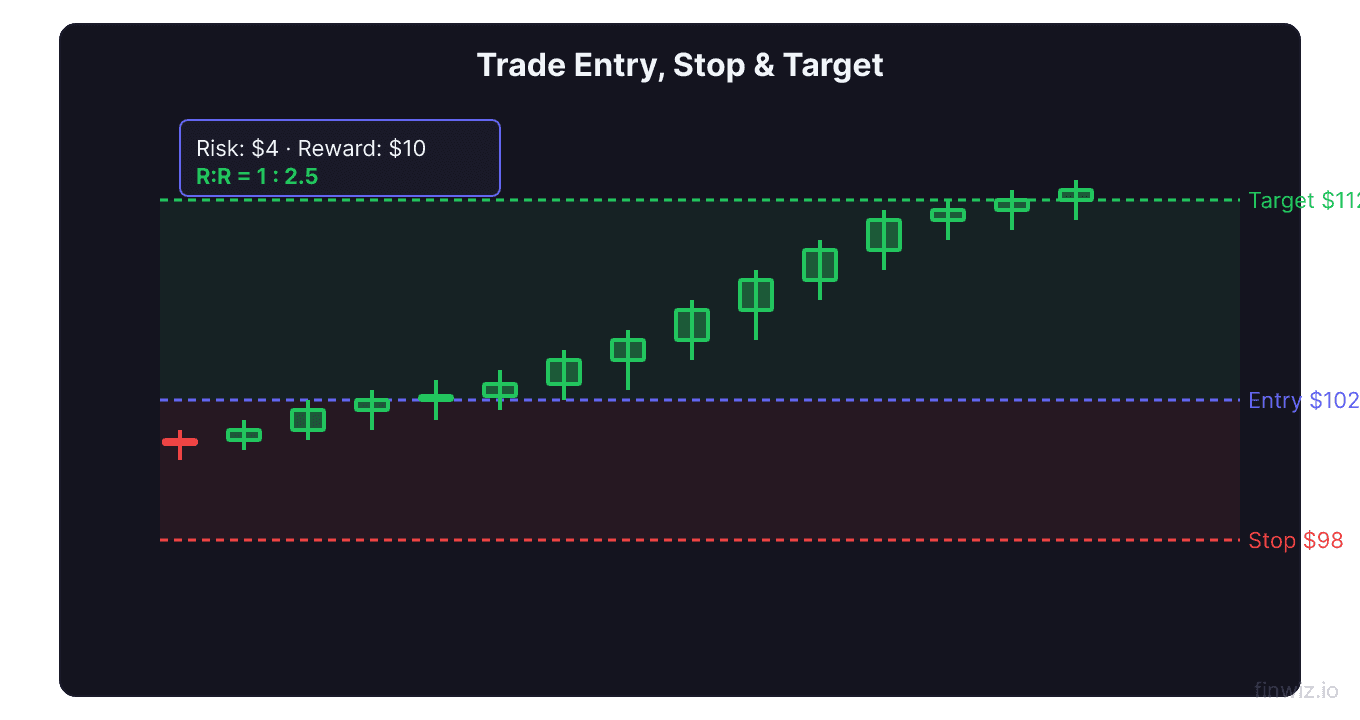
A good entry minimizes risk by getting you into a position at a price where the trade idea is quickly validated or invalidated. A good exit either captures the bulk of the move when you are right or cuts the loss short when you are wrong.
Most traders spend 90% of their effort on finding entries and 10% on exits. The split should be closer to 50/50. A perfect entry with a poor exit strategy still produces mediocre results. Conversely, a decent entry with a disciplined exit plan can be highly profitable over time.
The framework below applies to all trading styles, whether you are day trading NVDA on 5-minute charts or swing trading SPY on daily charts. The principles are identical; only the timeframe and specific tools change.
Entry Strategies Based on Chart Patterns
Pattern-based entries are triggered when a recognizable chart formation completes. The completion point gives you a defined entry price, a logical stop loss, and a measurable target.
Breakout entry: Enter when price closes above resistance or below support with confirming volume. Place your stop on the opposite side of the broken level. For example, if MSFT breaks above a $420 flat base on strong volume, buy the close above $420 and set your stop at $415.
Pullback entry: Wait for a breakout, then enter on the pullback to the broken level. This offers a better price and tighter stop than the breakout itself. See the full guide on pullbacks and throwbacks for detailed setups.
Pattern completion entry: Enter when a pattern like a double bottom, cup and handle, or inverse head and shoulders completes by breaking its neckline or trigger line. The pattern's measured move provides your initial target.
The key rule for pattern entries: wait for confirmation. Enter after the pattern completes, not in anticipation. Anticipation entries have lower win rates and lead to getting caught in failed patterns.
Entry Strategies Based on Indicators
Indicator-based entries use mathematical signals derived from price and volume to time trades. The best indicator entries combine two or three signals rather than relying on a single one.
Moving average bounce: Enter when price pulls back to a rising moving average and bounces. The 20 EMA works for short-term trades, and the 50 SMA works for swing trades. AAPL has historically respected its 50-day SMA during trending phases, providing multiple entry opportunities per year.
Oversold/overbought signals: Enter long when RSI drops below 30 and then crosses back above it, signaling that selling exhaustion is ending. Enter short when RSI rises above 70 and then crosses back below. These work best in range-bound markets and at support and resistance levels.
MACD crossover: Enter when the MACD line crosses above the signal line after both have been below zero. This confirms that downside momentum has shifted to upside momentum. Exit signals come from the reverse crossover.
Pro Tip
Entry Strategies Based on Key Levels
Level-based entries use predefined price zones where you expect buying or selling to emerge. These levels come from prior swing highs and lows, Fibonacci retracements, round numbers, and volume profiles.
The support and resistance framework provides the foundation. Price levels where the stock has previously reversed carry significance because traders remember those levels and place orders around them.
Fibonacci confluence entry: When a pullback lands at a Fibonacci retracement level that also aligns with a prior swing high or a moving average, you have a high-probability entry zone. TSLA pulling back to the 61.8% retracement of a rally, where the 50 EMA also sits, is a textbook confluence setup.
Round number entry: Stocks frequently find support or resistance at round numbers ($100, $250, $500). These levels attract large clusters of buy and sell orders, making them natural zones for entries.
Confluence Score = Number of Independent Technical Levels Aligning at a Single Price ZoneSetting Profit Targets
Knowing when to take profits is the most underrated trading skill. There are three primary methods.
Measured move target: Use the height of the pattern or the prior swing to project the expected move. If you enter a breakout from a range that is $10 wide, your initial target is $10 above the breakout point.
Measured Move Target = Entry Price + Pattern HeightResistance-based target: Identify the next significant resistance level above your entry. This is where selling is likely to emerge. Take partial or full profits as price approaches this level.
Risk-multiple target: Set your target as a multiple of your risk. If your stop loss is $2 below entry, a 2:1 target is $4 above entry, and a 3:1 target is $6 above entry. This approach ties directly to your risk-reward ratio.
Many traders use a hybrid approach: take half the position off at a 2:1 reward level and let the rest run toward a measured move or resistance target with a trailing stop.
Stop Loss Placement
Your stop loss defines the point where the trade thesis is invalidated. It is not optional.
Below the pattern: For breakout entries, place the stop below the broken level or below the most recent swing low. For pullback entries, place it below the pullback low.
Below the moving average: If you entered on a moving average bounce, the stop goes just below the moving average. Give it a small buffer (0.5-1%) to account for normal volatility.
ATR-based stop: Use 1.5 to 2 times the Average True Range below your entry. This adapts your stop to the stock's current volatility. Volatile stocks get wider stops; calm stocks get tighter stops.
ATR Stop = Entry Price - (ATR × Multiplier)The critical rule: never widen your stop after entering. If the stock hits your stop, exit. Moving a stop further away to avoid being stopped out destroys risk management.
Trailing Stops and Time-Based Exits
A trailing stop moves your stop loss in the direction of the trade as the position moves in your favor. It locks in profits while keeping you in the trade as long as the trend continues.
Common trailing stop methods include the trailing stop order set at a fixed percentage or dollar amount below the highest price, moving the stop to each successive swing low as the trend advances, or trailing the stop below a moving average like the 10 or 20 EMA.
Time-based exits address trades that go nowhere. If you enter a swing trade expecting a move within 5-7 days and the stock has not moved after 10 days, exit. Dead money is a real cost because your capital could be deployed in a better opportunity.
A practical rule: if the trade has not reached at least 1:1 reward within half your expected holding period, close it and move on.
Pro Tip
FAQ
Should I enter all at once or scale in?
Scaling in (buying a partial position first, then adding on confirmation) reduces risk on the initial entry but can result in a higher average cost if the stock moves quickly. For beginners, entering the full position at a single defined entry point with a pre-set stop is simpler and easier to manage. Scale-in strategies work best for experienced traders with larger accounts.
What is the ideal risk-reward ratio for an entry?
A minimum of 2:1 reward-to-risk is the standard threshold. This means your target should be at least twice the distance of your stop. At 2:1, you only need to win 34% of your trades to break even. At 3:1, you only need 26%. Never take a trade where the potential reward does not justify the risk.
How do I know if I exited too early?
If you followed your plan and hit your target, it was not too early. Every trader experiences the frustration of watching a stock continue higher after they sell. Evaluate your exits over a sample of 50 or more trades, not on individual results. If your average exit consistently captures less than 50% of the available move, consider adjusting your trailing stop method or target strategy.
Disclaimer
This is educational content, not financial advice. Trading involves risk, and you should consult a qualified financial advisor before making any investment decisions. Past performance does not guarantee future results.
12 chapters covering charts, indicators, risk management & more. Plus weekly trading insights.