
Dow Theory: The Foundation of Technical Analysis
⚡ Key Takeaways
- Dow Theory is the foundation of modern technical analysis, establishing that market prices move in identifiable trends confirmed by volume and index correlation.
- Charles Dow developed the theory through his Wall Street Journal editorials in the late 1800s; William Hamilton and Robert Rhea later formalized it into six core tenets.
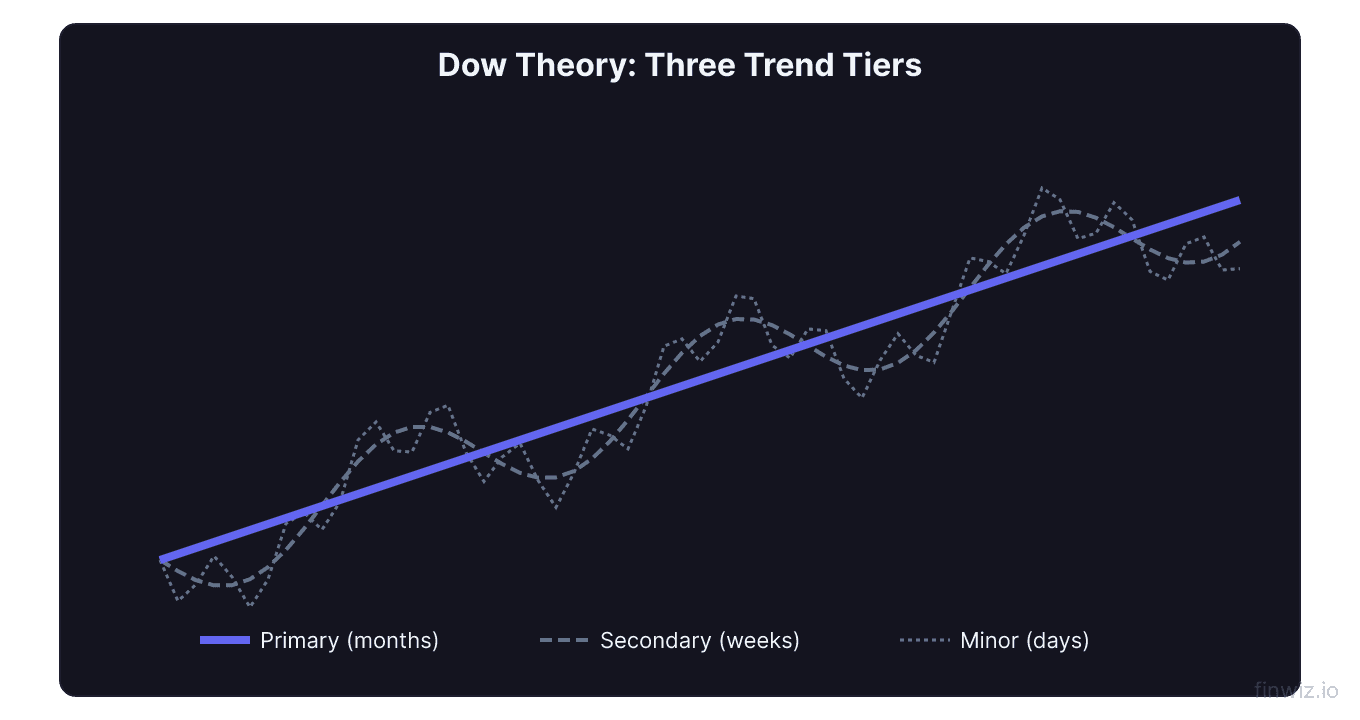
- The theory defines three trend types: primary trends (months to years), secondary trends (weeks to months), and minor trends (days to weeks).
- Dow Theory requires confirmation between the Dow Jones Industrial Average and the Dow Jones Transportation Average — a new high in one index without a matching high in the other signals weakness.
- Despite being over 120 years old, Dow Theory's core principles remain embedded in how traders identify trends, confirm breakouts, and interpret volume.
Origins of Dow Theory
Charles Dow co-founded Dow Jones & Company in 1882 and created the Dow Jones Industrial Average (DJIA) in 1896. Through his editorials in the Wall Street Journal, Dow articulated observations about how stock prices behave — observations that became the bedrock of technical analysis.
Dow never called his ideas a "theory." He wrote practical commentary about market behavior for investors. After his death in 1902, William Hamilton (his successor at the WSJ) organized Dow's writings into a coherent framework in the book The Stock Market Barometer (1922). Robert Rhea further refined and codified the principles in The Dow Theory (1932), giving us the formal structure traders reference today.
The theory predates candlestick charting, moving averages, RSI, and every modern indicator. Yet its core insight — that prices trend, and trends can be identified and confirmed — underpins everything in a technical analysis guide.
The Six Tenets of Dow Theory
1. The Market Discounts Everything
All known information — earnings, economic data, political events, investor sentiment — is already reflected in market prices. This means price action itself contains all the information a trader needs. You do not need to understand why prices are moving, only that they are moving and in which direction.
This tenet aligns with what academics later formalized as the Efficient Market Hypothesis, though Dow's version was empirical rather than mathematical.
2. The Market Has Three Trends
Dow identified three concurrent trends operating in every market:
Primary trend: The major directional movement lasting one to several years. This is the bull market or bear market. Everything else is secondary.
Secondary trend: Corrections within the primary trend lasting three weeks to three months, typically retracing 33% to 66% of the prior primary move. In a bull market, secondary trends are pullbacks. In a bear market, they are relief rallies.
Minor trend: Short-term fluctuations lasting less than three weeks. Dow considered these noise and not reliably tradeable. Modern trend analysis still respects this hierarchy.
3. Primary Trends Have Three Phases
Each primary trend unfolds in three distinct phases:
Bull market phases:
- Accumulation: Smart money buys against prevailing pessimism. Prices base. Most investors are still bearish from the prior decline.
- Public participation: The trend becomes obvious. Prices advance steadily. Volume increases. Media coverage turns positive.
- Excess: Euphoria takes hold. Speculation dominates. Prices spike on thin rationale. This is where Shiller's concept of irrational exuberance takes over.
Bear market phases mirror this: distribution, public participation in selling, and panic.
4. Indices Must Confirm Each Other
This is Dow Theory's most distinctive tenet. Dow argued that the Industrials (manufacturers) and the Transports (shippers of manufactured goods) must both confirm a trend for it to be valid. If Industrials make a new high but Transports fail to follow, the economy's health — and the market trend — is suspect.
In 2024, when the DJIA pushed to new highs but the Dow Jones Transportation Average lagged, Dow Theory practitioners flagged the divergence as a caution sign. The logic remains sound: if companies are selling products (Industrials up) but those products are not being shipped (Transports down), something is disconnected.
5. Volume Must Confirm the Trend
Volume should expand in the direction of the primary trend. In a bull market, volume should increase on rallies and decrease on pullbacks. In a bear market, volume should increase on declines and decrease on bounces.
When price makes a new high on diminishing volume, the advance lacks conviction and is more likely to reverse. This principle is now standard practice in breakout confirmation and is embedded in indicators like OBV and the Accumulation/Distribution line.
6. Trends Persist Until Definitive Reversal
A trend remains in effect until clear evidence of reversal appears. This is not a prediction that trends last forever — it is a rule of engagement. Do not anticipate reversals; wait for confirmation. A bull market is intact until the indices break below prior secondary lows with volume confirmation.
This tenet prevents premature exits and counter-trend trading, which is where most retail traders lose money.
Applying Dow Theory Today
Dow Theory does not generate precise entries and exits. It provides a framework for determining the market's primary direction, which shapes every other trading decision.
Step 1: Identify the primary trend. Look at the DJIA and S&P 500 on a weekly chart. Are prices making higher highs and higher lows (bullish) or lower highs and lower lows (bearish)?
Step 2: Check for confirmation. Are the Transports (IYT ETF as a modern proxy) confirming the Industrials? Are small caps (Russell 2000) confirming large caps? Broad confirmation across indices strengthens the trend diagnosis.
Step 3: Evaluate volume. Is volume expanding on moves in the trend direction? Use volume analysis tools to assess whether institutions are accumulating or distributing.
Step 4: Identify the current phase. Is the market in accumulation (early), public participation (mid), or excess (late)? This affects risk management and position sizing.
Pro Tip
Criticisms of Dow Theory
Lagging signals. Dow Theory confirms trends after they are already underway. By the time both indices confirm a new bull market, a significant portion of the move has already occurred. This is by design — Dow prioritized reliability over speed — but it frustrates traders who want to catch bottoms.
Index composition changes. The DJIA today bears little resemblance to Dow's original 12-stock index. Tech giants like AAPL and MSFT dominate, and the price-weighted methodology means high-priced stocks have outsized influence regardless of market capitalization.
Transport relevance. The Industrials-Transports confirmation was designed for a manufacturing economy. In a service and technology-driven economy, some argue the confirmation requirement is outdated. Proponents counter that goods still need to be shipped, and transportation activity remains a valid economic barometer.
Frequently Asked Questions
Is Dow Theory still relevant for modern traders?
Yes. The core principles — trends exist, volume confirms, and indices should agree — are embedded in how every technical trader reads markets. You may never explicitly "use" Dow Theory, but if you trade with the trend, watch volume on breakouts, and check multiple indices for confirmation, you are applying Dow's framework.
How does Dow Theory relate to Elliott Wave Theory?
Elliott Wave builds on Dow's three-phase primary trend by subdividing price movements into five impulse waves and three corrective waves. Elliott explicitly credited Dow as a predecessor. The primary-secondary-minor trend hierarchy in Dow Theory maps roughly to the wave degrees in Elliott Wave analysis.
Can Dow Theory be used for individual stocks?
Dow designed it for broad market indices, not individual stocks. However, the principles translate: individual stocks trend, volume should confirm direction, and trends persist until reversed. The inter-index confirmation tenet does not apply to single stocks, but you can substitute sector confirmation — if a tech stock breaks out but the technology sector ETF (XLK) does not confirm, treat the breakout with skepticism.
12 chapters covering charts, indicators, risk management & more. Plus weekly trading insights.