
What Is a Bear Market? How to Survive & Profit
⚡ Key Takeaways
- A bear market is defined as a decline of 20% or more from a recent high in a broad market index
- The average bear market lasts about 1.3 years with an average decline of 36%
- Bear markets progress through stages: denial, fear, capitulation, and recovery
- Protection strategies include raising cash, defensive sectors, hedging, and selective short selling
What Is a Bear Market?
A bear market occurs when a broad stock market index declines 20% or more from its recent high. The term "bear" likely derives from the way a bear attacks — swiping its paws downward. Bear markets are characterized by falling prices, deteriorating investor confidence, and often accompany or precede economic recessions.
While bear markets are painful, they are a normal part of the market cycle. Since 1929, the S&P 500 has experienced roughly 26 bear markets, averaging one about every 3.6 years. Understanding how bear markets behave and how to navigate them is critical for preserving capital and positioning for the eventual recovery.
Bear markets also create opportunity. Some of the best long-term buying opportunities in market history occurred during the depths of bear markets, when fear peaked and valuations reached their lowest levels.
The Four Stages of a Bear Market
Bear markets typically unfold in four psychological stages:
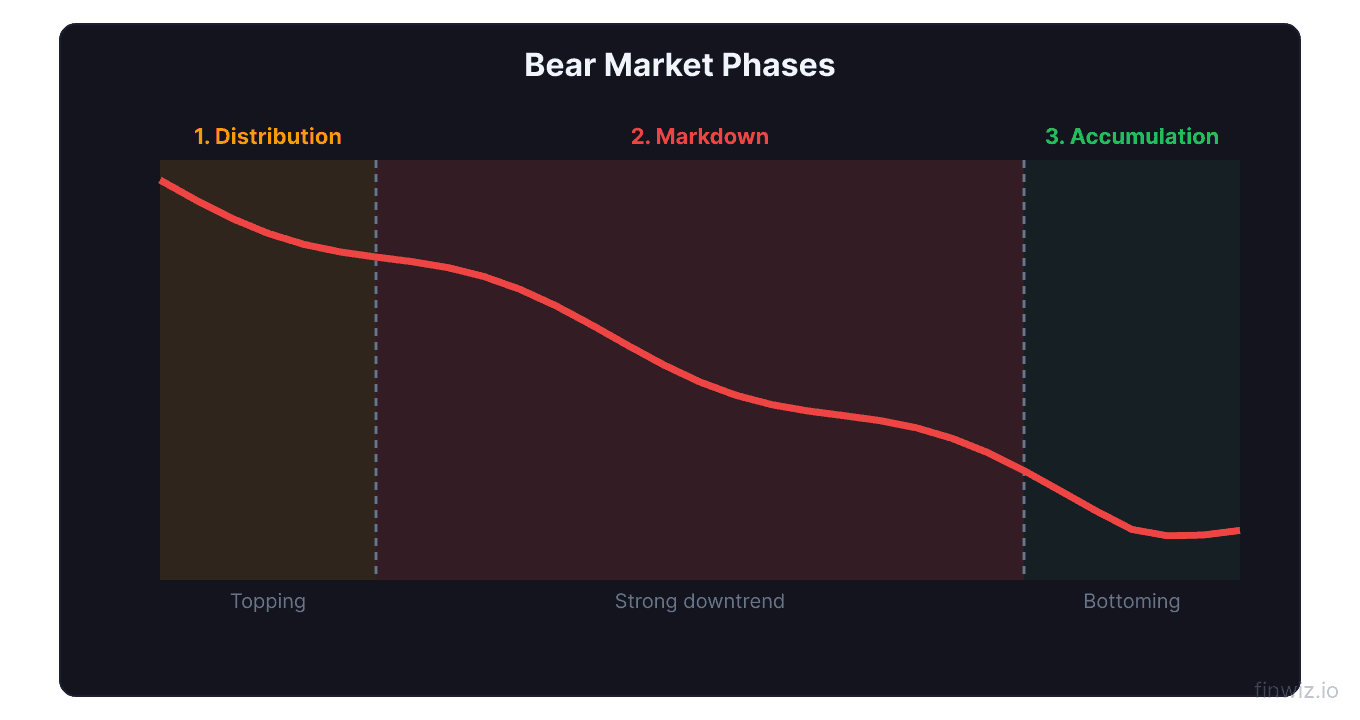
Stage 1: Denial. The market has dropped 10-15% from highs. Most investors believe it is just a correction and expect a quick rebound. "Buy the dip" mentality dominates. Talking heads reassure viewers that fundamentals are strong.
Stage 2: Fear. The decline accelerates past 20%. Economic data deteriorates, earnings estimates are cut, and media coverage turns negative. Investors who bought the dip are now underwater. Selling pressure intensifies.
Stage 3: Capitulation. Panic selling reaches a climax. Investors liquidate at any price, volatility spikes to extremes, and the VIX surges above 40. This stage often includes a dramatic, high-volume sell-off that marks the emotional low.
Stage 4: Recovery. After capitulation, prices stabilize and begin a gradual recovery. Skepticism remains high — most investors do not believe the bottom is in. Volume is low, and gains are tentative. This stage eventually transitions into a new bull market.
Pro Tip
Historical Bear Markets
| Bear Market | Peak to Trough | Decline | Duration | Cause |
|---|---|---|---|---|
| 1929–1932 | Sep 1929 – Jun 1932 | −86% | 2.8 years | Speculation, bank failures |
| 1973–1974 | Jan 1973 – Oct 1974 | −48% | 1.8 years | Oil embargo, inflation |
| 2000–2002 | Mar 2000 – Oct 2002 | −49% | 2.5 years | Dot-com bubble burst |
| 2007–2009 | Oct 2007 – Mar 2009 | −57% | 1.4 years | Housing crisis, financial collapse |
| 2020 | Feb 2020 – Mar 2020 | −34% | 1.1 months | COVID-19 pandemic |
| 2022 | Jan 2022 – Oct 2022 | −25% | 9.6 months | Inflation, rate hikes |
The 2020 bear market was the fastest in history, declining 34% in just 23 trading days before beginning a recovery that recouped all losses within five months. The 2007-2009 bear market was the most severe since the Great Depression, with the S&P 500 losing 57% of its value.
How to Protect Your Portfolio in a Bear Market
Raise cash gradually. As warning signs emerge, consider increasing your cash allocation from a typical 5% to 15-25%. Cash provides both protection and the ability to buy during extreme fear.
Rotate to defensive sectors. Sectors that perform relatively better in bear markets include utilities, consumer staples, healthcare, and dividend-paying stocks. These businesses have stable demand regardless of economic conditions. See our sector rotation guide for timing strategies.
Use hedging strategies. Protective puts, inverse ETFs, and VIX calls can provide portfolio insurance. These positions lose money in rising markets but gain value during declines, offsetting portfolio losses.
Reduce leverage. If you use margin, a bear market can trigger margin calls and forced liquidation at the worst possible time. Reducing or eliminating margin before a bear market protects you from this cascading risk.
Maintain diversification. Bonds, gold, and international markets may decline less than domestic equities during a bear market. A diversified portfolio experiences a less severe drawdown than a concentrated equity portfolio.
Short Selling in Bear Markets
Bear markets create opportunities for short selling — profiting from declining stock prices. Short sellers borrow shares, sell them at current prices, and aim to buy them back at lower prices.
Common short-selling approaches during bear markets:
Individual stock shorts. Targeting companies with deteriorating fundamentals, excessive debt, or declining revenue. The weakest companies in the weakest sectors decline the most.
Inverse ETFs. Products like SH (inverse S&P 500), SDS (2x inverse S&P 500), and SQQQ (3x inverse Nasdaq) provide short exposure without the mechanics of borrowing shares.
Put options. Buying puts on indexes or individual stocks provides leveraged downside exposure with limited risk (the premium paid). Index puts using SPX options also receive favorable 60/40 tax treatment.
Short selling carries significant risks. Bear market rallies — sharp, multi-day counter-trend moves — can be violent and inflict severe losses on short sellers. The 2020 bear market rally was one of the fastest in history, trapping bears who sold near the low.
Bear Market Rallies: The Bull Trap
One of the most dangerous features of bear markets is the bear market rally — a strong, multi-day or multi-week advance that looks like the start of a recovery but ultimately fails.
Bear market rallies are common and can be powerful:
| Bear Market | Number of 10%+ Rallies | Largest Rally |
|---|---|---|
| 2000–2002 | 5 | +21% |
| 2007–2009 | 6 | +24% |
| 1929–1932 | 10+ | +48% |
These rallies lure investors back in, only to see prices resume their decline. Traders call them "bull traps" because they create the illusion that the bear market is over.
Distinguishing a bear market rally from the start of a new bull market requires looking at volume patterns, market breadth, economic data, and whether the fundamental catalysts driving the decline have been resolved.
Bear Market Psychology and Behavioral Traps
Bear markets exploit common psychological biases:
Loss aversion. The pain of losses is psychologically twice as powerful as the pleasure of equivalent gains. This causes investors to hold losing positions too long, hoping for a recovery.
Anchoring. Investors anchor to their purchase price or the previous high, refusing to sell because the stock "should" be worth more.
Herding. When panic selling begins, the herd instinct amplifies the decline. Conversely, during bear market rallies, fear of missing out (FOMO) draws investors back in prematurely.
Recency bias. After a long bull market, investors struggle to believe that sustained losses are possible. This leads to underreaction early in the bear market and overreaction late in it.
The best defense against these biases is a predefined plan. Decide in advance at what level you will reduce exposure, and stick to it regardless of emotion.
What to Buy During a Bear Market
If you have cash and a long time horizon, bear markets offer generational buying opportunities:
High-quality blue chips. Companies with strong balance sheets, consistent earnings, and market leadership recover first and strongest.
Dividend aristocrats. Stocks with 25+ years of consecutive dividend increases tend to maintain dividends during recessions and appreciate strongly in recoveries.
Index funds. Buying S&P 500 or total market index funds during bear markets has historically produced exceptional 5-10 year forward returns.
Beaten-down growth stocks. High-quality growth companies that were punished excessively can deliver outsized returns during the recovery.
FAQ
How long does a bear market typically last?
The average bear market lasts about 1.3 years (approximately 15 months), though they range from less than a month (COVID crash in 2020) to nearly three years (1929-1932). Bear markets accompanied by recessions tend to be longer and deeper.
Should I sell everything during a bear market?
Generally no. Selling everything often means you miss the recovery, which tends to be sharp and front-loaded. The best days in the market frequently occur during bear markets. Instead, focus on rebalancing, raising some cash, and moving to higher-quality positions.
How is a bear market different from a correction?
A correction is a decline of 10-20% from a recent high. A bear market is a decline of 20% or more. Corrections are more frequent (approximately once per year) and shorter-lived. See our market correction guide for more details.
Do bear markets always accompany recessions?
Not always. About two-thirds of bear markets have been associated with recessions, but some occur without a recession (e.g., 1987 crash). Conversely, the stock market typically starts declining 6-12 months before a recession officially begins and starts recovering before the recession officially ends.
What is the best indicator that a bear market is ending?
No single indicator is definitive, but common signs include the VIX declining from extreme levels, improving market breadth, positive earnings revisions, central bank easing, and high-volume capitulation followed by declining volume on pullbacks.
Disclaimer
This is educational content, not financial advice. Trading involves risk, and you should consult a qualified financial advisor before making any investment decisions. Past performance does not guarantee future results.
Related Articles
12 chapters covering charts, indicators, risk management & more. Plus weekly trading insights.