
Sector Rotation: How Money Flows Through the Business Cycle
⚡ Key Takeaways
- Sector rotation is the strategy of shifting investments between market sectors based on the business cycle stage
- The business cycle has four stages: early expansion, mid expansion, late expansion, and contraction
- Different sectors outperform at each stage — cyclicals lead in early recovery, defensives lead in contraction
- ETFs make sector rotation accessible to individual investors through low-cost, liquid sector exposure
What Is Sector Rotation?
Sector rotation is an investment strategy that involves moving capital between different stock market sectors based on where the economy stands in the business cycle. The premise is simple: different industries perform better at different stages of the economic cycle, and by anticipating these shifts, investors can outperform a static buy-and-hold approach.
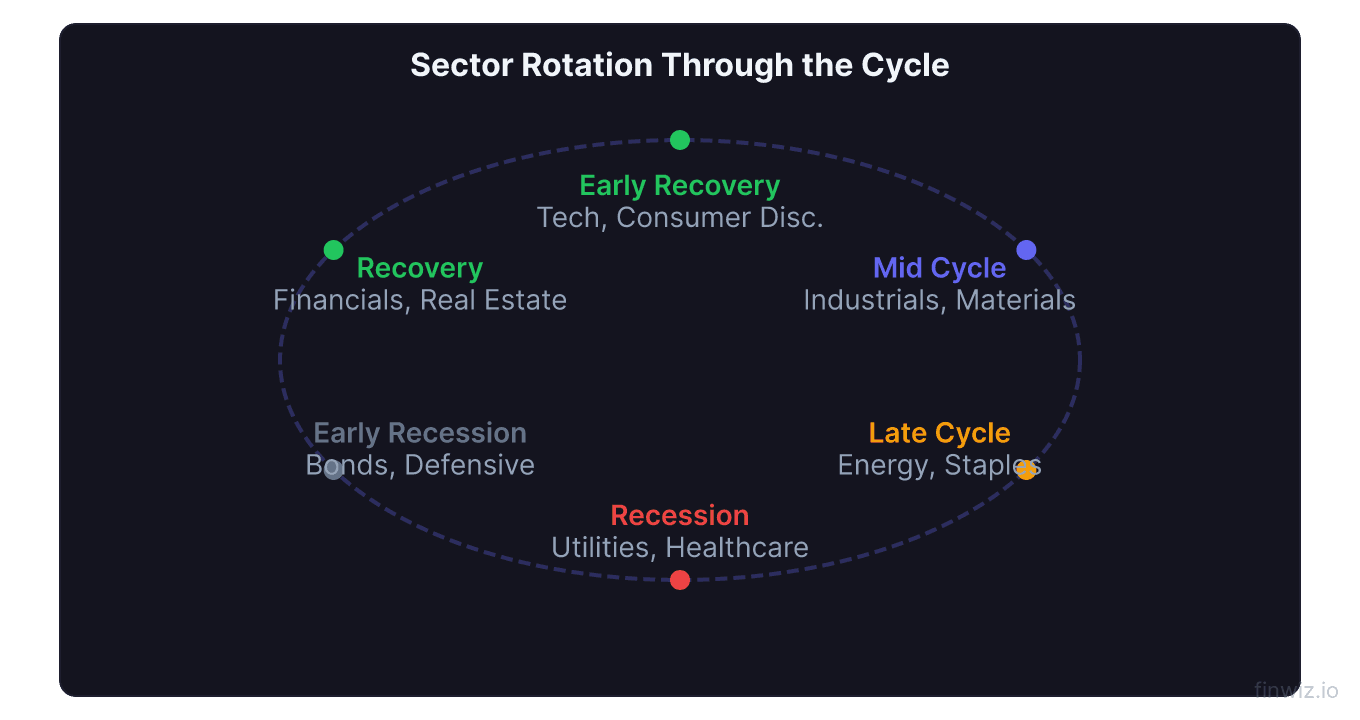
The strategy is grounded in the observation that the economy moves in predictable cycles of expansion and contraction. During expansion, cyclical sectors like technology and consumer discretionary thrive. During contraction, defensive sectors like utilities and healthcare outperform. By rotating ahead of these shifts, you position your portfolio to benefit from each phase.
Sector rotation is widely practiced by institutional investors, hedge funds, and pension funds. Individual investors can implement it through sector ETFs, which provide liquid, low-cost exposure to each of the 11 GICS (Global Industry Classification Standard) sectors.
The Business Cycle and Its Four Stages
The business cycle consists of four stages, each with distinct economic characteristics:
Stage 1: Early Expansion (Recovery)
- GDP growth resumes after a recession
- Unemployment begins falling
- Interest rates are low (Fed has been cutting)
- Consumer confidence recovers
- Corporate earnings growth accelerates from depressed levels
Stage 2: Mid Expansion (Growth)
- GDP growth is strong and steady
- Unemployment continues falling
- The Fed may begin raising rates
- Corporate earnings are robust
- Business investment increases
Stage 3: Late Expansion (Overheating)
- GDP growth slows or plateaus
- Unemployment is very low, wages rise
- The Fed is actively raising rates
- Inflation pressures build
- Credit conditions tighten
Stage 4: Contraction (Recession)
- GDP declines
- Unemployment rises
- The Fed cuts rates aggressively
- Corporate earnings decline
- Consumer and business confidence collapses
Which Sectors Lead in Each Stage
| Business Cycle Stage | Leading Sectors | Lagging Sectors |
|---|---|---|
| Early Expansion | Financials, Consumer Discretionary, Industrials, Real Estate | Utilities, Consumer Staples |
| Mid Expansion | Technology, Communication Services, Industrials | Utilities, Energy |
| Late Expansion | Energy, Materials, Healthcare | Technology, Consumer Discretionary |
| Contraction | Utilities, Consumer Staples, Healthcare | Financials, Industrials, Materials |
Early expansion favors sectors that benefit from economic recovery. Financials benefit from steepening yield curves and reduced loan defaults. Consumer discretionary benefits from returning consumer confidence. Industrials benefit from infrastructure spending and restocking.
Mid expansion favors growth-oriented sectors. Technology companies see increasing demand as businesses invest in productivity. Communication services benefit from advertising spending growth.
Late expansion favors sectors that benefit from rising prices and inflation. Energy companies profit from higher oil prices. Materials companies benefit from elevated commodity prices. Healthcare becomes defensive as growth slows.
Contraction favors sectors with stable, non-cyclical demand. Utilities provide essential services with regulated revenue. Consumer staples sell necessities regardless of economic conditions.
Pro Tip
Implementing Sector Rotation With ETFs
Sector ETFs provide efficient access to each of the 11 GICS sectors:
| Sector | Popular ETF | Expense Ratio |
|---|---|---|
| Technology | XLK | 0.09% |
| Healthcare | XLV | 0.09% |
| Financials | XLF | 0.09% |
| Consumer Discretionary | XLY | 0.09% |
| Consumer Staples | XLP | 0.09% |
| Energy | XLE | 0.09% |
| Utilities | XLU | 0.09% |
| Industrials | XLI | 0.09% |
| Materials | XLB | 0.09% |
| Real Estate | XLRE | 0.09% |
| Communication Services | XLC | 0.09% |
A basic rotation strategy might maintain a core S&P 500 position (70-80% of the portfolio) while allocating 20-30% to overweight sectors expected to lead in the current or upcoming cycle stage.
Identifying the Current Cycle Stage
Several indicators help determine where the economy is in the business cycle:
Leading Economic Indicators (LEI). The Conference Board's LEI index turns down before recessions and turns up before recoveries. Six consecutive monthly declines signal recession risk.
Yield curve shape. A steep yield curve (long rates much higher than short rates) indicates early expansion. A flat or inverted yield curve signals late expansion or approaching contraction.
ISM Manufacturing Index. Readings above 50 indicate expansion; below 50 indicate contraction. The trend direction matters as much as the absolute level.
Unemployment trends. Falling unemployment supports early and mid-expansion positioning. Rising unemployment signals late expansion or contraction.
Federal Reserve policy. Rate cuts signal early expansion positioning. Rate hikes signal mid to late expansion. A pause after hikes may signal the transition to contraction.
Relative Strength Analysis for Sector Timing
Relative strength compares a sector's performance to the overall market. A sector's relative strength line rising means it is outperforming the market; declining means it is underperforming.
Sector Relative Strength = Sector ETF Price ÷ S&P 500 PriceCombining business cycle analysis with relative strength confirmation creates a more robust rotation strategy. The cycle tells you what to expect; relative strength confirms when the rotation is happening.
Common Sector Rotation Mistakes
Rotating too early. Sectors can underperform for longer than expected before the cycle turn occurs. Patience and confirmation are essential.
Ignoring relative strength. Fundamental analysis of the business cycle should be confirmed by price action. If the cycle says financials should lead but financial stocks are still declining relative to the market, wait for confirmation.
Over-rotating. Excessive trading generates transaction costs and tax liabilities. Most rotation strategies require only 2-4 adjustments per year.
Concentrating too heavily. Even during a strong rotation signal, maintain diversification. No sector analysis is perfectly accurate, and unexpected events can disrupt the typical cycle pattern.
Confusing sector rotation with market timing. Sector rotation assumes you remain invested at all times — you are shifting between sectors, not moving in and out of the market entirely.
Advanced Sector Rotation Techniques
Momentum-based rotation. Instead of predicting the business cycle, simply buy the 2-3 sectors with the strongest 3-6 month momentum and rebalance monthly. Research shows this approach captures most of the rotation benefit with less forecasting error.
Risk parity rotation. Weight sectors inversely to their volatility so that each sector contributes equal risk to the portfolio. This approach naturally favors defensive sectors during volatile periods.
Global sector rotation. Extend rotation beyond U.S. sectors to include international markets. Different countries may be at different stages of the business cycle, creating additional rotation opportunities.
FAQ
How often should I rotate sectors?
Most rotation strategies adjust quarterly or when clear cycle transitions occur (typically 2-4 times per year). More frequent rotation increases transaction costs and tax complexity without proportionally improving returns.
Does sector rotation beat the S&P 500?
Academic research shows mixed results. Well-timed sector rotation can add 1-3% annually over a market-cap-weighted index. However, poor timing can underperform significantly. The strategy works best when combined with strong economic analysis and disciplined execution.
What is the best sector during a recession?
Utilities, consumer staples, and healthcare have historically outperformed during recessions. These sectors provide essential products and services with relatively stable demand regardless of economic conditions.
Can individual investors implement sector rotation?
Yes. Sector ETFs make rotation accessible to anyone with a brokerage account. The key requirements are understanding the business cycle, monitoring economic indicators, and maintaining discipline in executing rotations.
How does sector rotation differ from market timing?
Sector rotation keeps you fully invested at all times — you are simply shifting between sectors expected to outperform. Market timing involves moving in and out of stocks entirely (to cash), which requires getting two decisions right (when to sell and when to buy back).
Disclaimer
This is educational content, not financial advice. Trading involves risk, and you should consult a qualified financial advisor before making any investment decisions. Past performance does not guarantee future results.
Related Articles
12 chapters covering charts, indicators, risk management & more. Plus weekly trading insights.