
Bull vs Bear Market: Key Differences Every Trader Should Know
⚡ Key Takeaways
- Bull markets rise 20%+ from lows and average 5.5 years; bear markets decline 20%+ from highs and average 1.3 years
- Bull markets are about 4 times longer than bear markets, reflecting the stock market
Bull vs. Bear Market: Understanding the Two Sides of the Cycle
The stock market alternates between two fundamental states: bull markets (sustained price increases) and bear markets (sustained price declines). These cycles have repeated throughout market history and understanding their characteristics is essential for adapting your investment strategy.
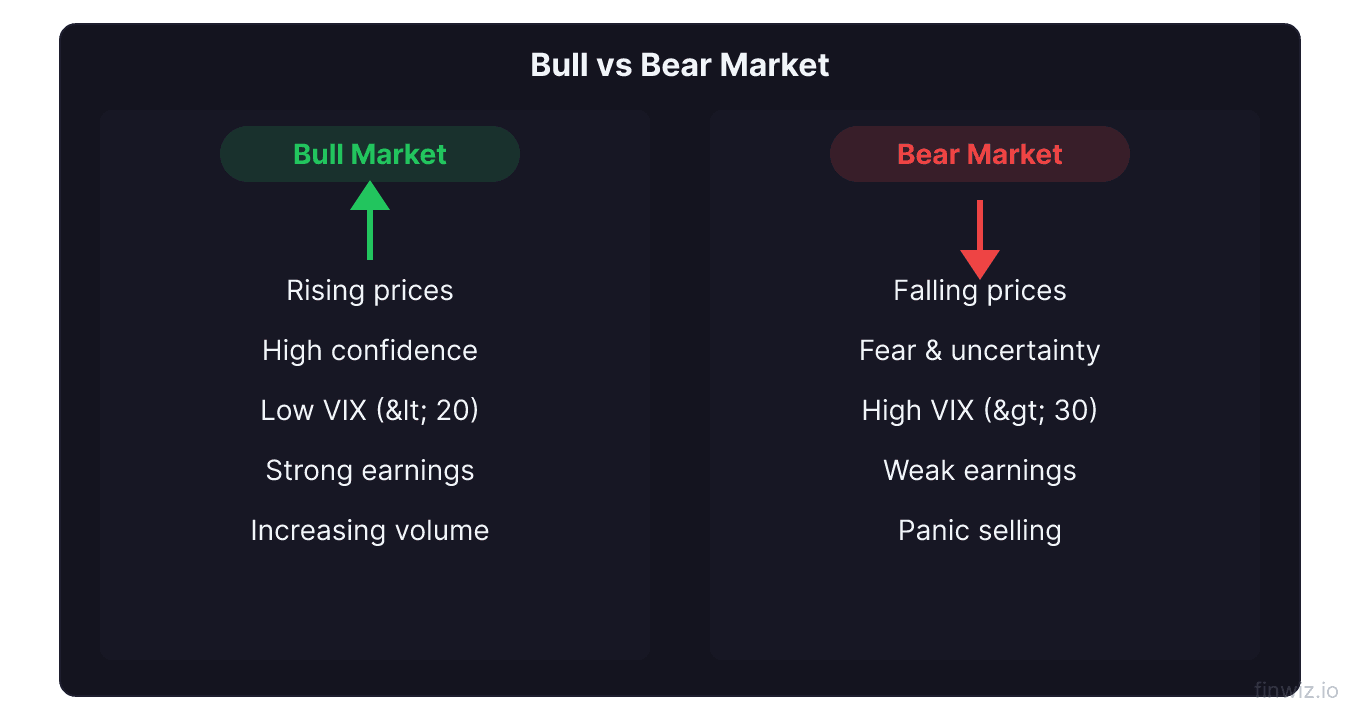
A bull market is officially defined as a rise of 20% or more from a recent market low. A bear market is a decline of 20% or more from a recent high. Between these two extremes, the market may experience corrections (10-20% declines) and rallies that do not meet the full threshold.
The critical insight for investors is that bull markets last far longer than bear markets and produce far larger cumulative gains. This long-term upward bias is why staying invested through both cycles — rather than trying to time them perfectly — has historically produced superior results.
The Complete Comparison Table
| Factor | Bull Market | Bear Market |
|---|---|---|
| Definition | 20%+ rise from recent low | 20%+ decline from recent high |
| Average Duration | 5.5 years | 1.3 years |
| Median Duration | 4.4 years | 1.0 year |
| Average Return | +180% | −36% |
| Frequency | Every 3-5 years | Every 3-5 years |
| Time Spent | ~78% of market history | ~22% of market history |
| GDP Trend | Expanding | Contracting or slowing |
| Unemployment | Falling | Rising |
| Fed Policy | Neutral to accommodative | Tightening or easing late |
| Earnings Trend | Growing | Declining |
| Investor Sentiment | Optimistic to euphoric | Fearful to panicked |
| Dominant Strategy | Buy and hold, buy dips | Defensive, raise cash |
Duration and Return Statistics
The asymmetry between bull and bear markets is striking. Since 1957, the data shows:
Bull markets:
- Average duration: 5.5 years
- Average cumulative return: +180%
- Longest bull: 11 years (2009-2020), +401%
- Shortest bull: ~5 months, +21%
Bear markets:
- Average duration: 1.3 years
- Average cumulative decline: −36%
- Longest bear: 2.8 years (1929-1932), −86%
- Shortest bear: 1 month (2020), −34%
Ratio of Bull to Bear Duration ≈ 4:1This 4:1 ratio is why long-term investors who stay invested through bear markets still achieve strong results. The gains during bull markets far outweigh the losses during bear markets over time.
Investor Behavior: The Psychology Shift
The most dramatic difference between bull and bear markets is investor psychology. The same investors who eagerly buy at market highs become terrified sellers at market lows — the exact opposite of what rational analysis would suggest.
Bull market psychology:
- Early stage: Skepticism, disbelief. "This rally cannot last."
- Mid stage: Confidence grows, participation broadens. "The market always goes up."
- Late stage: Euphoria, FOMO, speculation. "I cannot miss this."
Bear market psychology:
- Early stage: Denial. "It is just a correction, buy the dip."
- Mid stage: Fear, anxiety. "How much lower can it go?"
- Late stage: Capitulation, despair. "I am never investing again."
Pro Tip
Strategy Differences: Bull vs. Bear
Bull Market Strategies
Growth over value. Growth stocks typically outperform value stocks during bull markets. Investors are willing to pay premium valuations for companies with high earnings growth rates.
Cyclical sector emphasis. Technology, consumer discretionary, industrials, and financials tend to lead during bull markets. These sectors benefit most from economic expansion.
Momentum investing. Buying stocks with strong recent performance and riding the trend works well in bull markets. Breakouts from chart patterns have higher success rates.
Buy the dips. Corrections of 5-10% within bull markets are buying opportunities. Dollar-cost averaging during pullbacks enhances returns.
Bear Market Strategies
Quality over growth. Companies with strong balance sheets, low debt, and consistent cash flows outperform speculative growth stocks during bear markets.
Defensive sector emphasis. Utilities, consumer staples, healthcare, and dividend stocks provide relative safety. These sectors offer stability when the broader market declines.
Raise cash and reduce leverage. Increasing cash allocation and eliminating margin protects capital. Cash also provides the ability to buy when prices reach attractive levels.
Hedging. Protective puts, inverse ETFs, and VIX calls can offset portfolio losses. These are insurance strategies, not profit centers.
Short selling. Experienced traders can profit from declining prices through direct short selling, put options, or inverse ETFs. Bear markets reward short sellers — but bear market rallies can be devastating.
How to Identify the Transition Points
Recognizing when the market is shifting from bull to bear (or vice versa) is one of the most valuable — and difficult — skills in investing.
Bull-to-bear transition signals:
- Market breadth narrows (fewer stocks making new highs)
- Yield curve inverts (short-term rates exceed long-term rates)
- Leading economic indicators decline for 3+ consecutive months
- Volatility begins trending higher
- Credit spreads widen (corporate bond yields rise relative to Treasuries)
Bear-to-bull transition signals:
- VIX spikes above 40 then begins declining
- High-volume capitulation day followed by stabilization
- Fed shifts from tightening to easing monetary policy
- Market holds above prior low on a retest
- Leading economic indicators stop declining and begin to improve
Neither transition is ever clean or obvious in real time. Markets overshoot in both directions, and bear market rallies routinely fool investors into thinking the worst is over.
The Role of Corrections in Both Cycles
Market corrections — declines of 10-20% — occur in both bull and bear markets:
| Corrections in Bull Markets | Corrections in Bear Markets |
|---|---|
| Normal and healthy | Part of the broader decline |
| Buying opportunities | Potential bull traps |
| Occur roughly once per year | Rallies of 10-20% are common too |
| Market typically recovers within weeks to months | Recovery fails and new lows follow |
| Volume declines on pullback | Volume spikes on new lows |
The key distinction is context. A 15% pullback in the middle of a strong bull market is a buying opportunity. A 15% rally in the middle of a bear market may be a bull trap that lures investors back in before the next leg down.
Portfolio Construction for Both Environments
The ideal approach is a portfolio that performs reasonably well in both environments, with tactical adjustments at the margins:
Core holdings (60-70% of portfolio): Maintain a diversified mix of high-quality equities, bonds, and alternatives. This core should not change dramatically between cycles.
Tactical allocation (20-30%): Shift between offensive (growth, cyclicals, momentum) and defensive (value, staples, cash) based on cycle positioning.
Opportunistic cash (5-10%): Maintain a cash reserve specifically for buying during bear market capitulation or adding to winners during bull market dips.
This framework avoids the two biggest mistakes investors make: going all-in at market tops (euphoria) and going all-cash at market bottoms (panic).
FAQ
Which lasts longer, bull or bear markets?
Bull markets last significantly longer. The average bull market lasts about 5.5 years compared to 1.3 years for bear markets. The stock market spends roughly 78% of the time in bull market conditions.
Should I try to time bull and bear markets?
Research consistently shows that market timing is extremely difficult. Missing just the 10 best days in the market (which often occur during or immediately after bear markets) can cut your returns by 50% or more. A better approach is to stay invested and adjust your allocation tactically.
How often do bear markets occur?
Bear markets occur approximately every 3.6 years on average, though the interval varies widely. Some periods have seen multiple bear markets in quick succession, while others have gone 11+ years without one.
Can a bear market happen without a recession?
Yes. Approximately one-third of bear markets have occurred without an accompanying recession. The 1987 crash, for example, saw the S&P 500 decline 34% without a recession. However, the most severe and prolonged bear markets are typically associated with recessions.
What should a beginner do during a bear market?
Continue your regular investment contributions (dollar-cost averaging), avoid panic selling, focus on quality holdings, and remember that bear markets are temporary. If anything, a bear market is a gift for young investors who can buy shares at lower prices for decades of future compounding.
Disclaimer
This is educational content, not financial advice. Trading involves risk, and you should consult a qualified financial advisor before making any investment decisions. Past performance does not guarantee future results.
Related Articles
12 chapters covering charts, indicators, risk management & more. Plus weekly trading insights.