
What Is a Bull Market? Characteristics, History & How to Trade
⚡ Key Takeaways
- A bull market is defined as a sustained rise of 20% or more from a recent low in a broad market index
- The average bull market lasts about 5.5 years and delivers average gains of 180%+
- Bull markets are characterized by rising investor confidence, economic expansion, and increasing corporate earnings
- Strategies include staying invested, buying dips, and rotating into growth and cyclical sectors
What Is a Bull Market?
A bull market is a prolonged period of rising stock prices, typically defined as a gain of 20% or more from a recent market low in a broad index like the S&P 500. Bull markets are driven by economic expansion, rising corporate earnings, low unemployment, and growing investor confidence.
The term "bull" likely originates from the way a bull attacks — thrusting its horns upward. In a bull market, prices trend higher, investor sentiment is optimistic, and demand for securities exceeds supply.
Bull markets are the dominant condition in stock market history. Since 1957, the S&P 500 has spent approximately 78% of the time in bull markets. Understanding how to identify, participate in, and manage risk during bull markets is essential for every investor.
Characteristics of a Bull Market
Several defining features distinguish a bull market from a temporary rally:
Rising prices across broad indexes. Not just one sector but the broader market trends upward. The S&P 500, Dow Jones, and Nasdaq all generally advance during a true bull market.
Improving economic fundamentals. GDP growth accelerates, unemployment falls, consumer spending rises, and manufacturing activity expands. The economy provides the foundation for corporate earnings growth.
Increasing corporate earnings. Companies report growing revenues and profits quarter over quarter. Earnings growth justifies higher stock valuations and drives prices upward.
Expanding valuations. Price-to-earnings (P/E) ratios tend to expand during bull markets as investors are willing to pay more for each dollar of earnings. Optimism about the future drives multiple expansion.
Rising investor sentiment. Consumer confidence surveys, investor sentiment indicators, and market breadth all improve. More stocks participate in the advance as the bull market matures.
Historical Bull Markets
The U.S. stock market has experienced numerous bull markets, each with distinct characteristics:
| Bull Market | Duration | S&P 500 Gain | Key Driver |
|---|---|---|---|
| 1949–1956 | 7.1 years | +267% | Post-war economic boom |
| 1982–1987 | 5.0 years | +229% | Volcker disinflation |
| 1987–2000 | 12.3 years | +582% | Tech revolution, globalization |
| 2009–2020 | 11.0 years | +401% | Fed stimulus, low rates |
| 2020–2022 | 1.7 years | +114% | COVID recovery, fiscal stimulus |
| 2022–present | 2+ years | Ongoing | AI revolution, earnings growth |
The longest bull market in history ran from March 2009 to February 2020, lasting nearly 11 years and delivering gains exceeding 400%. It was fueled by unprecedented Federal Reserve monetary policy, low interest rates, and a steady economic recovery after the Great Recession.
Pro Tip
The Stages of a Bull Market
Bull markets typically progress through four stages:
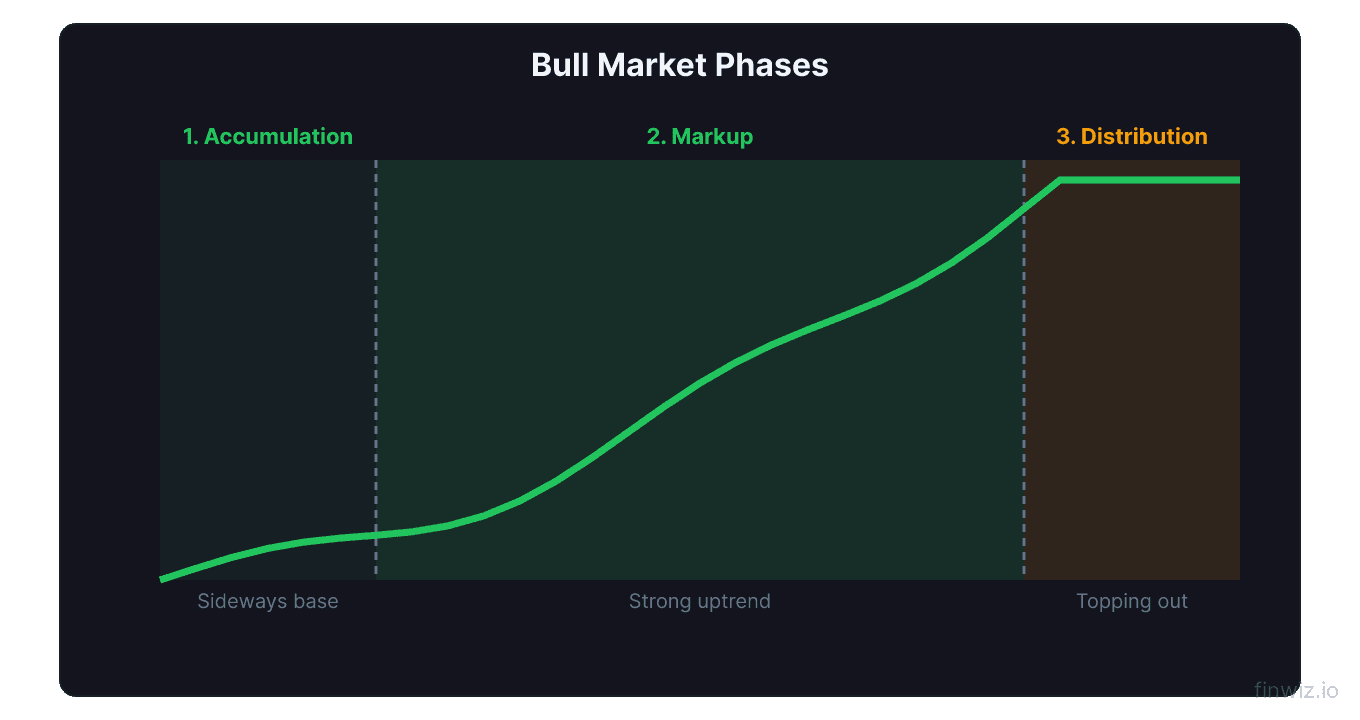
Stage 1: Accumulation. The bear market has ended, but most investors remain pessimistic. Smart money and institutional investors begin buying at depressed prices. Valuations are attractive, but sentiment is terrible.
Stage 2: Participation. The broader market starts trending higher, and more investors join in. Economic data improves, earnings grow, and media coverage turns positive. This is usually the longest and most profitable stage.
Stage 3: Excess. Speculation increases, valuations stretch well above historical averages, and retail investor enthusiasm peaks. IPOs flood the market, and speculative assets (meme stocks, SPACs, crypto) soar. Warning signs of a market bubble may appear.
Stage 4: Distribution. Smart money begins selling to less experienced buyers. Market breadth narrows — fewer stocks lead the advance while the majority lag. Volatility increases, and the market becomes choppy.
Bull Market Investment Strategies
Stay invested. The most important strategy is simply remaining in the market. Studies show that missing just the 10 best days in a bull market can cut your returns by more than half. Time in the market beats timing the market.
Buy the dips. Pullbacks of 5-10% are normal even within strong bull markets. These corrections are buying opportunities, not reasons to panic. Dollar-cost averaging during dips compounds returns.
Favor growth and cyclical sectors. Growth stocks and cyclical sectors (technology, consumer discretionary, industrials) typically outperform during bull markets. Sector rotation strategies can capture this outperformance.
Use leverage judiciously. Some investors use margin or leveraged ETFs to amplify returns during confirmed bull trends. This increases both gains and losses and should be sized appropriately.
Gradually raise cash as the cycle matures. As the bull market enters the excess phase, consider trimming positions and increasing cash or defensive holdings. You will not sell at the exact top, but reducing exposure during late-cycle euphoria protects gains.
Bull Market Risks and Warning Signs
Even in a bull market, risks exist. Watch for these warning signs that the cycle may be nearing its end:
Narrowing market breadth. When fewer stocks make new highs while the index continues to rise, the rally is losing participation. The advance-decline line diverging from the index is a classic warning.
Extreme valuations. The S&P 500 P/E ratio above 25-30 signals that the market may be pricing in overly optimistic expectations. The CAPE ratio (cyclically adjusted P/E) above 35 has historically preceded poor forward returns.
Inverted yield curve. When short-term Treasury yields exceed long-term yields, it signals that the bond market expects economic weakness. An inverted yield curve has preceded every recession in the past 50 years.
Excessive speculation. When taxi drivers, social media influencers, and your neighbor all give stock tips, speculative excess may be peaking. Record-high margin debt, surging options volume, and oversubscribed IPOs are quantifiable signals.
Rising VIX. An increasing VIX (fear gauge) during a rising market suggests growing anxiety beneath the surface.
How Bull Markets End
Bull markets end for different reasons, but common catalysts include:
- Federal Reserve tightening — rising interest rates increase borrowing costs and make bonds more attractive relative to stocks
- Recession onset — declining economic growth erodes corporate earnings
- External shocks — pandemics, geopolitical crises, financial system failures
- Valuation exhaustion — prices reach levels that can no longer be justified by fundamentals
The transition from a bull market to a bear market is not always sudden. Sometimes markets decline gradually, with multiple failed rallies before the full bear market is confirmed. Other times, the transition is violent — the COVID crash in February-March 2020 erased 34% in just 23 trading days.
Bull Markets vs. Bear Markets: A Quick Comparison
For a detailed comparison, see our bull vs. bear market guide.
| Factor | Bull Market | Bear Market |
|---|---|---|
| Definition | 20%+ rise from low | 20%+ decline from high |
| Average Duration | ~5.5 years | ~1.3 years |
| Average Return | +180% | −36% |
| Economic Backdrop | Expansion | Contraction/recession |
| Investor Sentiment | Optimistic/euphoric | Fearful/pessimistic |
| Typical Strategy | Buy and hold, buy dips | Defensive, raise cash |
FAQ
How long does a bull market typically last?
The average bull market lasts approximately 5.5 years, but duration varies widely. The shortest modern bull market lasted about 5 months (1966), while the longest lasted nearly 12 years (1987-2000). There is no fixed timeline.
Should I invest differently in a bull market?
You should maintain your long-term strategy but can tilt toward growth stocks, cyclical sectors, and higher-beta positions during confirmed bull markets. Avoid the temptation to abandon diversification or take excessive leverage, as bull markets can end abruptly.
How do I know if we are in a bull market?
The standard definition is a 20% rise from a recent market low. You can also look at the 200-day moving average — when the S&P 500 is trading above its 200-day moving average with the average trending upward, conditions favor a bull market environment.
Can you lose money in a bull market?
Absolutely. Individual stocks can decline significantly even while the broader market rises. Poor stock selection, excessive concentration, leverage, and panic selling during normal pullbacks can all generate losses during a bull market.
What causes a bull market to start?
Bull markets typically begin when investors anticipate an economic recovery, central banks provide monetary stimulus, valuations reach attractive levels after a decline, or a catalyst sparks renewed confidence. The beginning of a bull market is usually only clear in hindsight.
Disclaimer
This is educational content, not financial advice. Trading involves risk, and you should consult a qualified financial advisor before making any investment decisions. Past performance does not guarantee future results.
Related Articles
12 chapters covering charts, indicators, risk management & more. Plus weekly trading insights.