
Red to Green Move: How to Trade the Intraday Reversal
⚡ Key Takeaways
- A red-to-green move occurs when a stock opens below the prior close (red) and reverses to trade above it (green) during the session
- The prior closing price acts as the key level — a break above it with volume confirms the reversal
- VWAP reclaim and increasing volume are essential confirmation signals before entering
- This pattern works best on stocks with a clear catalyst that were oversold in the premarket
What Is a Red-to-Green Move?
A red-to-green move is a reversal pattern where a stock opens lower than the previous day's close, trades in negative territory, and then reverses course to cross back above the prior close. The name comes from the color coding on most trading platforms — red when a stock is below the prior close, green when above it.
This pattern signals a shift in sentiment. The stock opened weak, attracting short sellers and discouraging buyers. But as the session unfolds, demand absorbs the selling pressure, and the stock reclaims the prior close. That reclaim triggers a cascade of short covering and new buying, often producing a sharp move higher.
Red-to-green moves are related to gap trading concepts — specifically, they represent a failed gap down. When a gap down fails, the resulting reversal is often more powerful than a regular breakout because it traps an entire group of short sellers who entered on the gap.
Why Red-to-Green Moves Work
The mechanics behind this pattern are straightforward. When a stock gaps down at the open, several things happen simultaneously. Short sellers enter positions expecting further downside. Weak holders panic sell. Stop losses on existing long positions trigger below the prior close.
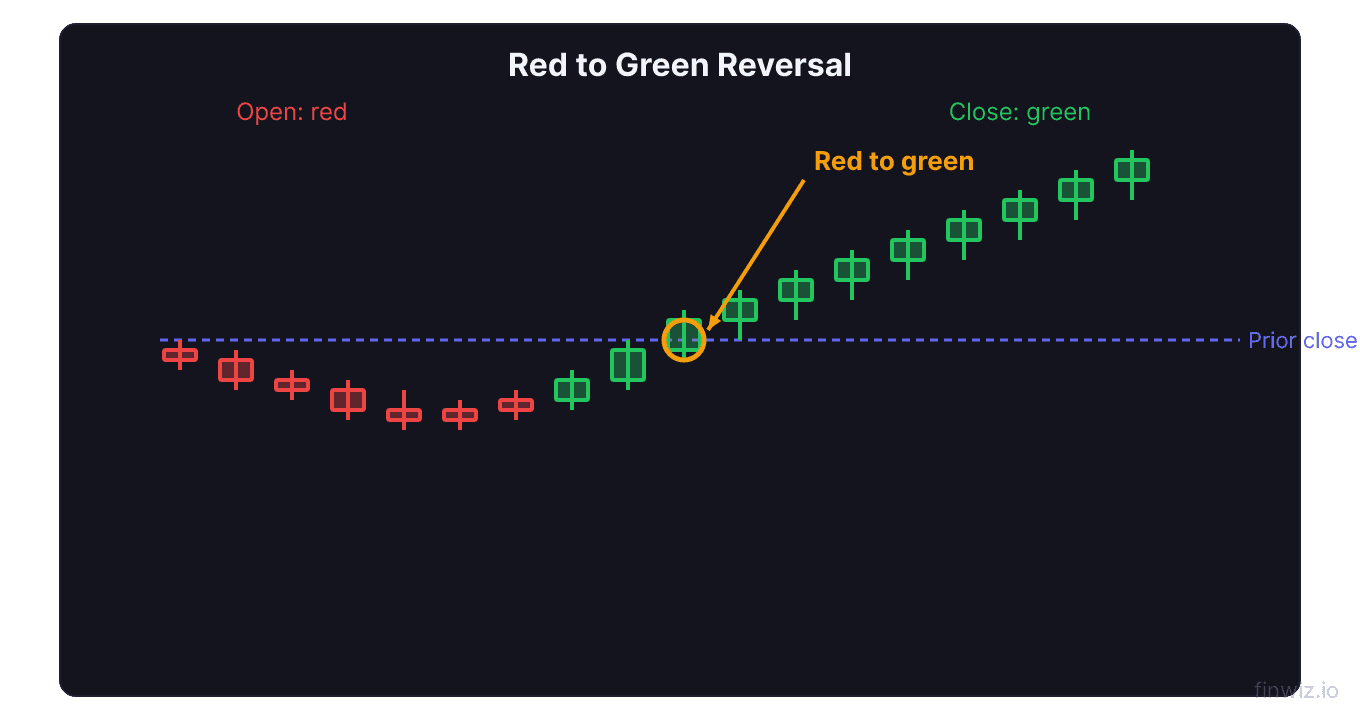
All of this selling creates a temporary imbalance. If the underlying reason for the gap down is not severe enough to sustain selling pressure — maybe the premarket reaction was an overreaction to a minor earnings miss, or the broader market reverses from weakness to strength — buyers step in at lower prices.
As the stock climbs back toward the prior close, short sellers who entered on the gap start to feel pressure. When it crosses the prior close and goes green, those shorts cover aggressively. Their buying adds fuel to the move. This is why the break above the prior close often produces a spike in both price and volume.
Consider META in February 2024 — the stock gapped down 1.5% on a market-wide selloff, traded red for the first hour, then reversed and crossed the prior close at 10:15 AM. By noon it was up 2.8% from its morning low as trapped shorts covered.
Entry Criteria and Setup
Not every stock that goes from red to green is worth trading. Use these filters to identify the best setups.
Required conditions:
- Stock opens at least 0.5% below the prior close (meaningful gap down)
- A clear catalyst explains the gap, but the catalyst is not catastrophic (minor miss, sector rotation, not fraud or bankruptcy)
- Volume in the first 30 minutes is above average (confirms participation)
- Price reclaims VWAP before or as it crosses the prior close
Entry trigger: Buy when the stock closes a 1-minute candle above the prior day's close with volume acceleration. Some traders enter on the VWAP reclaim and add on the prior close break.
Stop loss: Place the stop below the morning low or below VWAP, whichever is tighter. If the stock goes red again after triggering your entry, the thesis is broken.
Pro Tip
Managing the Trade
Once you are in a red-to-green trade, manage it based on momentum and key levels.
First target: The premarket high or the prior day's high — whichever is closer. These levels act as natural resistance where early sellers and overnight holders may take profits.
Trailing stop: Once the stock is 1% above the prior close, trail your stop to the prior close level. This ensures you lock in a profit on any pullback. If the stock continues higher, trail using the rising VWAP or the low of each new 5-minute candle.
Full exit: If volume dries up after the initial break above the prior close, or if the stock makes a lower high on the 5-minute chart, exit the remaining position. The move has stalled and you are now holding hope rather than a trade.
Red-to-green moves are particularly effective during premarket trading analysis because you can identify candidates before the market opens and have your levels mapped out in advance.
Red-to-Green on Earnings Gaps
Earnings season produces some of the most powerful red-to-green setups. A company reports earnings that slightly miss estimates, the stock gaps down 3-5% in the premarket, but the business is fundamentally sound. By the time the market opens, the panic has subsided and institutional buyers see value at the lower price.
AMZN has produced several classic red-to-green earnings moves. The stock gaps down on a revenue miss, trades red for 20-30 minutes as retail traders panic, then institutional buying drives it back above the prior close. The key filter is the severity of the miss — a minor miss on one metric with otherwise strong guidance is ideal. A broad-based miss across revenue, earnings, and guidance is not a red-to-green candidate; it is a short.
Incorporate red-to-green moves into your broader day trading strategies toolkit as a countertrend play for mornings when the market or specific stocks gap down on overblown reactions.
Frequently Asked Questions
How is a red-to-green move different from buying a dip?
Buying a dip is a broad concept with no specific trigger. A red-to-green move has a precise trigger — the stock must cross above the prior day's closing price after opening below it. This level is visible to every participant, making it a focal point for order flow. The prior close is also the level where the stock flips from red to green on screens, creating a visual trigger that attracts additional buying.
What volume should I look for on a red-to-green move?
Volume should increase as the stock approaches and crosses the prior close. Specifically, the breakout candle (the candle that closes above the prior close) should have at least 1.5-2x the volume of the average candle in the first 30 minutes. If the stock crosses the prior close on declining volume, the move is less likely to sustain and more likely to fade back below.
Can I short a green-to-red move using the same logic?
Yes. A green-to-red move is the inverse pattern — a stock opens above the prior close (green) and reverses below it (red). The same mechanics apply in reverse. Short sellers enter when the stock closes a candle below the prior close on volume, with the stop above the morning high. This pattern is effective on stocks that gap up on weak catalysts and fail to hold their gains.
Disclaimer
This is educational content, not financial advice. Trading involves risk, and you should consult a qualified financial advisor before making any investment decisions. Past performance does not guarantee future results.
12 chapters covering charts, indicators, risk management & more. Plus weekly trading insights.