
Gap and Go Strategy: How to Trade Morning Gappers
⚡ Key Takeaways
- The gap-and-go strategy involves buying stocks that gap up significantly at the open and riding the momentum higher
- Key scanner criteria include gap percentage (5%+), relative volume (2x+ average), low float, and a news catalyst
- Entry is typically above the premarket high with a stop loss at VWAP or the premarket low
- Profit targets are often set using predetermined risk-reward ratios (2:1 or 3:1) or prior resistance levels
- This strategy works best in the first 30-60 minutes of the trading session when momentum is strongest
What Is the Gap-and-Go Strategy?
The gap-and-go is one of the most popular momentum trading strategies for day traders. It involves identifying stocks that have gapped up (opened significantly higher than the previous close) due to a catalyst, then buying when the stock breaks above its premarket high to ride the continued momentum.
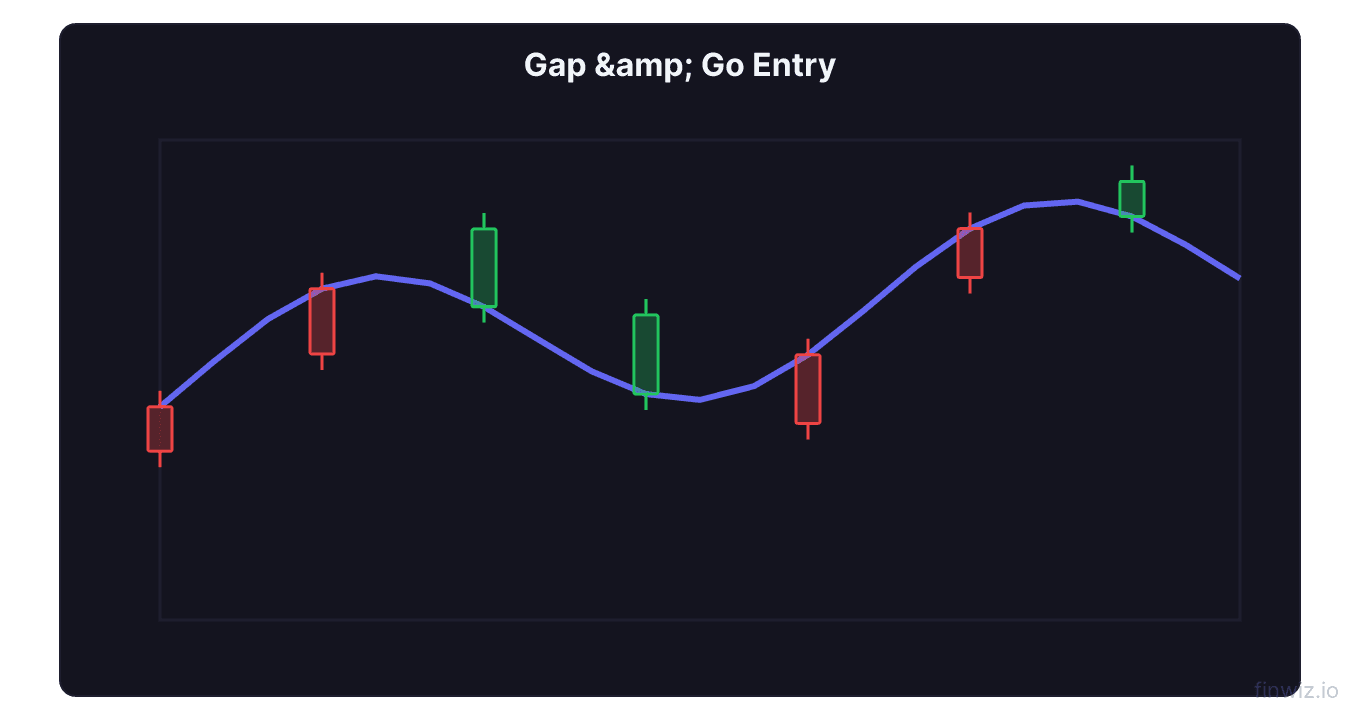
A gap occurs when a stock's opening price is materially different from its previous closing price. Gaps are caused by overnight news, earnings releases, analyst upgrades, FDA decisions, contract announcements, or any event that shifts supply and demand while the regular market is closed.
The "go" part of the strategy is the key. Not every stock that gaps up continues higher. The strategy specifically targets gaps that have follow-through momentum, meaning the buying pressure continues after the market opens. Identifying which gaps will follow through and which will fade is the core skill of this approach.
Gap Scanner Criteria
Finding the right stocks for a gap-and-go strategy starts with your premarket scanner. You can use tools like Trade Ideas, Finviz, or your broker's built-in scanner to filter stocks each morning.
Essential scanner filters:
| Filter | Minimum Value | Purpose |
|---|---|---|
| Gap % | 5% or higher | Identifies significant price dislocations |
| Relative Volume | 2x average or higher | Confirms unusual interest and liquidity |
| Price Range | $2 - $20 (for small caps) | Optimal range for percentage moves |
| Float | Under 20 million shares | Low float amplifies price movement |
| Volume (Premarket) | 100,000+ shares | Confirms tradeable liquidity |
| Average Daily Volume | 500,000+ shares | Ensures sufficient regular-session liquidity |
Optional filters:
- News catalyst: Stocks gapping on real news tend to have better follow-through than those gapping on technical factors alone
- Sector momentum: Stocks in a hot sector (e.g., AI, biotech) may receive additional momentum
- Prior day close relative to range: Stocks closing near the high of their prior day range often gap with more conviction
Pro Tip
Premarket Analysis and Preparation
After your scanner generates candidates, the next step is premarket analysis to narrow your watchlist to the highest-probability setups.
Check the news catalyst. What caused the gap? Earnings beats, FDA approvals, major contract wins, and merger announcements create the strongest gaps. Vague PR releases, paid promotions, or unclear catalysts produce less reliable gaps.
Analyze the premarket chart. Is the stock trending higher in premarket, or is it fading from its initial gap level? Stocks that hold their gap level or push higher into the open are stronger candidates than those that fade.
Identify premarket high and low. The premarket high becomes your entry trigger. The premarket low or VWAP becomes your potential stop loss level. Draw these levels on your chart before the open.
Assess the float. Low-float stocks (under 10-20 million shares) produce the most explosive gap-and-go moves because it takes less buying pressure to push the price higher. However, low-float stocks are also more volatile and can reverse violently.
Check for resistance levels. Are there obvious resistance levels from prior price action (daily chart highs, round numbers, prior pivots) that could stall the momentum? Plan your targets based on these levels.
Entry Execution
The entry is the most critical moment in the gap-and-go strategy. Timing and execution determine whether you catch a strong move or get chopped up in the opening volatility.
Primary entry: Break above premarket high. Wait for the stock to trade above its premarket high during regular market hours. This breakout confirms that buyers who arrived after reviewing the gap are adding to positions, generating fresh momentum.
Do not buy before the premarket high breaks. Many stocks gap up, attract sellers at the open, and pull back significantly before either continuing higher or failing entirely. Buying into the opening print without confirmation is gambling, not trading.
Secondary entry: First pullback to VWAP. If you miss the initial breakout above the premarket high, a pullback to VWAP can provide a second entry opportunity. If the stock bounces off VWAP with strong volume, it confirms that institutional buyers are supporting the price.
Volume confirmation is non-negotiable. The breakout above the premarket high must occur with increasing volume. A breakout on declining volume is suspect and has a higher failure rate.
Stop Loss Placement
Every gap-and-go trade requires a predefined stop loss. Without one, a failed gap can turn a small loss into a devastating one, especially in volatile, low-float stocks.
Stop loss options:
VWAP stop: Place your stop loss just below the VWAP. VWAP represents the average price weighted by volume and acts as a natural support level on strong gap days. If the stock falls below VWAP, institutional buyers are not supporting the gap, and the trade thesis is invalidated.
Premarket low stop: For wider stops, use the premarket low as your stop level. This gives the trade more room but increases the dollar risk, which means your position size must be smaller.
Fixed percentage stop: Some traders use a fixed percentage (e.g., 5% from entry) regardless of technical levels. This simplifies risk management but may not align with the stock's natural support levels.
Position Size = Account Risk / (Entry Price - Stop Loss Price)Profit Targets and Exit Strategy
Knowing when to take profits is essential for the gap-and-go strategy. The strongest gap moves can produce 10-30% gains in minutes, but many gaps also fail quickly after the initial push.
Risk-reward-based targets are the simplest approach. If your stop loss represents $0.70 of risk, a 2:1 reward-to-risk ratio gives you a $1.40 profit target. A 3:1 ratio gives $2.10. Start with a 2:1 target and adjust based on the strength of the move.
Level-based targets use prior resistance levels, round numbers, and Fibonacci extensions as profit targets. If a stock gaps from $10 to $12 and has prior resistance at $14, that is a logical target.
Trailing stop approach: For the strongest gap-and-go moves, a trailing stop allows you to ride extended moves without a fixed target. A common trailing stop method is to trail below each 5-minute candlestick low. As long as each new 5-minute candle makes a higher low, you stay in the trade.
Partial profit taking is a hybrid approach. Sell half your position at a 2:1 target and trail the remaining half. This locks in profits while maintaining exposure to the larger move.
When Gap-and-Go Fails: Fading Gaps
Not every gap follows through. Fading gaps reverse and fill part or all of the gap, trapping traders who bought the initial momentum. Understanding why gaps fail helps you avoid these traps.
No news catalyst: Gaps driven by low-volume premarket moves without a legitimate news catalyst fade frequently. If you cannot find the reason for the gap, be cautious.
Overhead resistance: If the gap carries the stock into a major resistance zone from the daily or weekly chart, sellers may overwhelm the gap momentum.
Market conditions: Gaps during bearish or highly uncertain market environments fail more often because the broader market weakness creates selling pressure that counteracts individual stock momentum.
Late-day gap fills: Even successful morning gap-and-go trades may see the stock pull back significantly by afternoon. This is why the strategy is best executed in the first 30-60 minutes and why day traders typically close positions before the midday lull.
Frequently Asked Questions
What is the difference between a gap-and-go and a gap fill?
A gap-and-go occurs when the stock breaks above its premarket high and continues higher. A gap fill occurs when the stock reverses and trades back down to its previous day's close, "filling" the gap. These are opposite outcomes, and some traders specifically trade gap fills as a mean-reversion strategy.
Can I trade gap-and-go on any stock?
The strategy works best on stocks with high relative volume, a legitimate news catalyst, and a float under 20 million shares. Large-cap stocks can gap up, but they typically have smaller percentage moves and less momentum follow-through due to their larger float and deeper liquidity.
How many gap-and-go setups occur per day?
On a typical trading day, 5-15 stocks might meet basic gap scanner criteria. After manual filtering for news catalysts and premarket pattern quality, you might have 2-5 actionable setups. On major news days (earnings season, Fed announcements), there may be more.
Is the gap-and-go strategy suitable for beginners?
The strategy is conceptually simple but requires fast execution, strong discipline, and comfort with volatile stocks. Beginners should paper trade gap-and-go setups extensively before risking real capital. Starting with very small position sizes is advisable.
What timeframe charts should I use for gap-and-go?
Most gap-and-go traders use 1-minute and 5-minute charts during execution. The 1-minute chart provides granular entry timing, while the 5-minute chart shows the broader trend and key levels. The daily chart should be checked for major support and resistance levels during premarket preparation.
Disclaimer
This is educational content, not financial advice. Trading involves risk, and you should consult a qualified financial advisor before making any investment decisions. Past performance does not guarantee future results.
Related Articles
12 chapters covering charts, indicators, risk management & more. Plus weekly trading insights.