
Level 2 Quotes: How to Read the Order Book Like a Pro
⚡ Key Takeaways
- Level 2 quotes display the full depth of buy and sell orders beyond the best bid and ask, revealing supply and demand at multiple price levels
- The order book shows market maker and ECN identifiers along with their order sizes, helping traders anticipate short-term price direction
- Understanding order book dynamics — including spoofing, iceberg orders, and bid/ask stacking — is essential for advanced day trading
- Level 2 is most valuable for scalpers and short-term traders who need to read real-time supply and demand imbalances
What Are Level 2 Quotes?
Level 2 quotes provide a detailed view of a stock's order book, showing all pending buy (bid) and sell (ask) orders at multiple price levels beyond the standard best bid and best ask. While Level 1 quotes show only the single best bid and ask price — the "top of the book" — Level 2 reveals the depth of the market at every price point where orders are sitting.
Think of Level 1 as looking at the surface of an ocean. You can see the current water level, but you have no idea what lies beneath. Level 2 is like putting on diving goggles — suddenly you can see the layers of buy and sell orders stacked below the surface, giving you a much richer understanding of supply and demand dynamics.
Level 2 data displays the price, size (number of shares), and the market participant identifier (MPID) — which shows which market maker, ECN, or exchange is posting the order. This information allows experienced traders to anticipate short-term price movements, identify institutional activity, and make more informed trading decisions.
Level 1 vs. Level 2: What Is the Difference?
To appreciate Level 2, it helps to understand what Level 1 provides and where it falls short.
Level 1 data includes the current best bid price and size, the current best ask price and size, the last trade price and size, and the daily high, low, open, and volume. This is the standard quote data available on virtually every trading platform and financial website.
Level 2 data adds the full order book depth — all visible bid and ask orders at every price level, identified by the market participant posting them. This reveals how much buying and selling interest exists at prices beyond the current best bid and ask.
| Feature | Level 1 | Level 2 |
|---|---|---|
| Best Bid/Ask | Yes | Yes |
| Order Book Depth | No | Yes (multiple levels) |
| Market Maker IDs | No | Yes |
| Size at Each Level | No | Yes |
| Last Trade Info | Yes | Yes |
| Cost | Free (most brokers) | Free to $15+/month |
For a long-term investor, Level 1 data is perfectly adequate. But for day traders — especially scalpers — Level 2 data is indispensable. It provides the micro-level supply and demand information needed to make split-second trading decisions.
How to Read the Order Book
The Level 2 order book is typically displayed as two columns side by side. The left column shows bids (buy orders) and the right column shows asks (sell orders). Each row contains three key pieces of information:
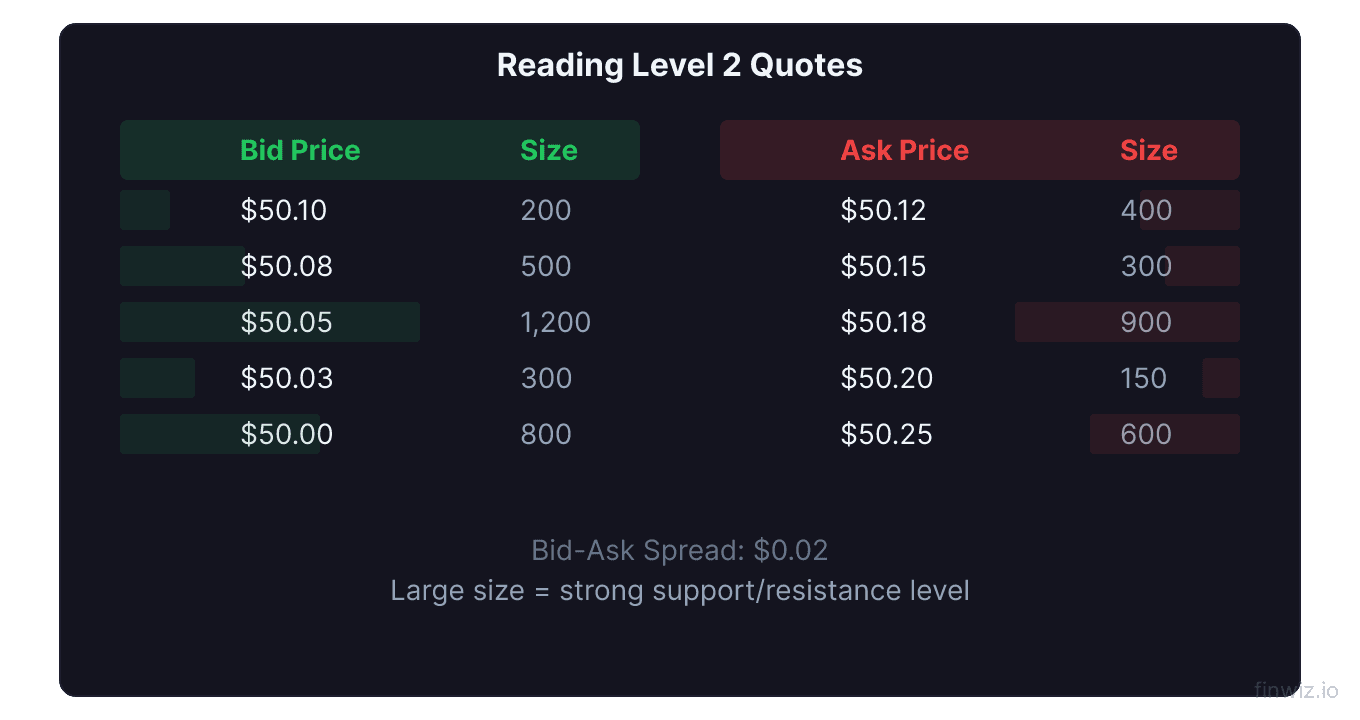
Price. The price at which the market participant is willing to buy (bid) or sell (ask). Bids are sorted from highest to lowest (the best bid is at the top). Asks are sorted from lowest to highest (the best ask is at the top).
Size. The number of shares being offered at that price level. Size is usually displayed in lots (1 lot = 100 shares). So a size of "5" means 500 shares. Some platforms display the actual share count.
MPID (Market Participant ID). The identifier for the market maker, ECN, or exchange posting the order. Common MPIDs include NSDQ (Nasdaq), ARCA (NYSE Arca), BATS (CBOE BZX Exchange), EDGX (CBOE EDGX Exchange), and various market maker codes.
Here is a simplified example of a Level 2 display:
| Bid MPID | Bid Size | Bid Price | Ask Price | Ask Size | Ask MPID |
|---|---|---|---|---|---|
| ARCA | 1,200 | $50.05 | $50.06 | 800 | NSDQ |
| NSDQ | 3,500 | $50.04 | $50.07 | 2,100 | BATS |
| BATS | 500 | $50.03 | $50.08 | 5,000 | ARCA |
| EDGX | 2,000 | $50.02 | $50.09 | 1,500 | EDGX |
In this example, the best bid is $50.05 (1,200 shares from ARCA) and the best ask is $50.06 (800 shares from NSDQ). The spread is $0.01. Looking deeper, there is significant buy support at $50.04 (3,500 shares) and a large sell wall at $50.08 (5,000 shares).
Understanding Market Makers
Market makers are firms that provide liquidity to the market by continuously posting buy and sell orders. They profit from the bid-ask spread — buying at the bid and selling at the ask. On the Nasdaq, market makers are identified by their MPIDs and can be tracked on Level 2.
Key things to know about market makers in the context of Level 2:
They are not always transparent. Market makers can use hidden orders (not displayed on Level 2), reserve orders (only showing a portion of their total size), and multiple MPIDs to disguise their activity. What you see on Level 2 is not always the complete picture.
They provide liquidity. Market makers are required to maintain a two-sided market (both a bid and an ask) in the securities they cover. This ensures that there is always someone willing to buy or sell, even in less liquid stocks.
They can signal intent. Experienced Level 2 readers learn to recognize the behavior patterns of specific market makers. Some market makers consistently lead moves — when they step up their bid, price tends to follow. Others act as laggards, adjusting their quotes after the move has already begun. Recognizing these patterns takes time and observation.
Reading Supply and Demand on Level 2
The real power of Level 2 lies in its ability to show supply and demand imbalances in real time. These imbalances often precede price movements.
Heavy bid, light ask (bullish). When the bid side shows large orders stacked at multiple levels and the ask side shows small orders, it suggests strong buying demand relative to selling supply. This imbalance often leads to price moving higher as sell orders are consumed faster than they are replenished.
Light bid, heavy ask (bearish). The opposite scenario — thin bids and large ask orders — suggests that selling supply overwhelms buying demand. Price is likely to move lower as buy orders at each level are quickly filled without new buyers stepping in.
Large order at a single level (wall). A very large order at a single price level can act as support (if on the bid side) or resistance (if on the ask side). For example, a 50,000-share bid at $25.00 creates a "bid wall" that may prevent price from dropping below $25.00 — at least temporarily.
Thinning book. When orders on the bid or ask side start to thin out — orders being pulled without being filled — it often signals that a move is imminent. Market makers and algorithms pull their orders when they sense adverse directional flow, and this thinning of the book can be a leading indicator of price movement.
Pro Tip
Spoofing and Order Book Manipulation
Not everything on Level 2 is what it appears to be. Spoofing is the practice of placing large orders with no intention of executing them, designed to mislead other traders about supply and demand.
Here is how spoofing works: a trader places a large buy order (say, 100,000 shares) at a price slightly below the current market. Other traders see this large bid on Level 2 and interpret it as strong buying interest, leading them to buy the stock. As the price rises, the spoofer cancels the fake buy order and sells their actual position at the higher price.
Spoofing is illegal under the Dodd-Frank Act and can result in fines and criminal charges. However, it still occurs, and recognizing it is an important skill for Level 2 traders.
Signs of potential spoofing include very large orders that appear and disappear rapidly, orders that are repeatedly placed and canceled at the same price level, large orders that sit far from the current price (not likely to be filled naturally), and orders that are pulled right before they would be executed.
Iceberg orders (also called reserve orders) are a legal form of hidden liquidity. A trader might have a 100,000-share order but only display 1,000 shares on Level 2. As each displayed portion is filled, the next 1,000 shares appear. Iceberg orders are detectable through the tape — you will see the same size printing repeatedly at the same price.
Trading With Level 2 Data
Here are practical strategies for incorporating Level 2 into your day trading:
Support and resistance confirmation. When price approaches a key technical level, use Level 2 to assess the strength of the level. A large bid wall at a support level confirms the support. A thin bid at the same level suggests it may not hold. This adds a layer of confirmation to your technical analysis.
Entry timing. Use Level 2 to time your entries more precisely. If you want to buy a stock that is pulling back, watch the bid side for signs of absorption (large bids holding firm despite selling pressure). Enter when the selling subsides and the ask starts to thin out — this often marks the end of the pullback.
Exit timing. When you are in a profitable trade, watch Level 2 for signs that the move is ending. If large asks start appearing above the current price and the bid is thinning, it may be time to take profits.
Scalp trade execution. For scalpers, Level 2 is the primary decision-making tool. Scalp entries and exits are based almost entirely on what the order book and tape are showing in real time. The chart provides context, but the order book provides execution signals.
Level 2 for Different Market Conditions
The usefulness and interpretation of Level 2 data varies with market conditions:
High-volume, trending market. Level 2 is highly informative during strong trends with heavy volume. You can see the directional flow clearly — bids absorbing on pullbacks in uptrends, asks being consumed on rallies in downtrends. This is when Level 2 reading is most valuable.
Low-volume, choppy market. During the midday lull or on slow days, Level 2 can be misleading. Thin books mean that small orders can create the appearance of supply/demand imbalances that are not meaningful. Be cautious interpreting Level 2 signals during low-volume periods.
News-driven volatility. When a stock is reacting to breaking news, Level 2 can change dramatically within seconds. Orders appear and disappear rapidly, and the book may be too chaotic to read reliably. During these moments, the tape (time and sales) is often more informative than the order book.
Platforms for Level 2 Data
Not all platforms offer the same quality of Level 2 data. Here is what to look for:
| Platform | Level 2 Quality | Cost | Best For |
|---|---|---|---|
| DAS Trader | Excellent (aggregated + individual) | $150+/month | Professional scalpers |
| thinkorswim (Schwab) | Good | Free | General day traders |
| Interactive Brokers TWS | Very Good | Free with account | Active traders |
| Sterling Trader Pro | Excellent | $200+/month | Professional scalpers |
| Webull | Basic | Free | Beginner exposure |
Professional scalping platforms like DAS Trader and Sterling Trader Pro offer superior Level 2 displays with faster refresh rates, hotkey integration, and more granular data. For most day traders who use Level 2 as one of several tools (rather than their primary tool), the free Level 2 on thinkorswim or Interactive Brokers is sufficient.
Getting Started With Level 2
If you are new to Level 2, here is a practical learning path:
Step 1: Observe before trading. Spend at least a few weeks simply watching Level 2 on liquid stocks during active trading hours. Do not trade based on it yet — just watch, observe patterns, and take notes.
Step 2: Correlate with price action. Watch how the order book changes right before and during significant price moves. Start to connect Level 2 patterns with chart movements.
Step 3: Add the tape. Once you are comfortable with Level 2, add the time and sales window to your screen. Practice reading both simultaneously — the order book (intent) and the tape (execution).
Step 4: Practice in paper trading. Use paper trading to make trades based on Level 2 signals. Track your results and refine your reading.
Step 5: Apply with small size. When you transition to live trading, start with very small share sizes. Level 2 reading is a skill that improves with practice and cannot be rushed.
Disclaimer
This is educational content, not financial advice. Trading involves risk, and you should consult a qualified financial advisor before making any investment decisions. Past performance does not guarantee future results.
Frequently Asked Questions
Is Level 2 data free?
It depends on your broker. Many brokers — including thinkorswim (Schwab), Interactive Brokers, and Webull — offer Level 2 data for free to account holders. Some charge a monthly subscription fee, typically $10-$25 per month. Professional-grade Level 2 data on platforms like DAS Trader or Sterling Trader Pro often comes with higher platform fees but provides superior data quality and speed.
Do I need Level 2 to day trade?
No, Level 2 is not required for all day trading strategies. Strategies based on chart patterns, indicators like VWAP or moving averages, and price action can be executed effectively with Level 1 data alone. However, for scalping and very short-term trading, Level 2 is practically essential. Even for other strategies, Level 2 can improve entry and exit timing.
How do I spot fake orders on Level 2?
Fake orders (spoofing) often appear as unusually large orders that seem out of proportion to the stock's normal order size. Watch for orders that are repeatedly placed and canceled, orders at round price levels far from the current market, and large orders that disappear just as price approaches them. The tape (time and sales) helps confirm whether large orders on Level 2 are actually being filled or are being pulled.
What is the difference between Level 2 and Level 3?
Level 3 is a more detailed version of market data that is only available to market makers and registered broker-dealers. It allows them to enter and update quotes, execute orders, and manage their inventory directly. Retail traders do not have access to Level 3 data. For all practical purposes, Level 2 provides the most detailed order book information available to individual traders.
Can I use Level 2 for swing trading?
While Level 2 is primarily a tool for short-term traders, it can be useful for swing traders at the point of entry and exit. When you are ready to enter a swing trade, checking Level 2 for supply/demand dynamics can help you time your entry for a better price. Similarly, watching Level 2 when exiting can help you avoid selling into a thin market. However, for the holding period of a swing trade (days to weeks), Level 2 analysis is not relevant.
12 chapters covering charts, indicators, risk management & more. Plus weekly trading insights.