
Cash Available to Trade vs Settled Cash: What You Can Actually Spend
⚡ Key Takeaways
- Cash available to trade is the balance your broker lets you use immediately after selling a position, while settled cash is the money that has fully cleared through the T+1 settlement cycle
- Under SEC rules, stock trades settle one business day after execution (T+1), meaning proceeds from a Monday sale are officially settled on Tuesday
- In a cash account, trading with unsettled funds can trigger a good faith violation or free-riding violation, both of which carry escalating penalties from your broker
- Margin accounts largely bypass settlement concerns because the broker lends you funds against unsettled proceeds, effectively giving you immediate access to trade again
- Most broker platforms display both figures separately, but the labels vary — Fidelity uses "Cash Available to Trade" versus "Settled Cash," while Schwab shows "Cash & Cash Investments" versus "Settled Funds"
Cash Available vs Settled Cash: What Is the Difference?
The difference between cash available to trade and settled cash comes down to timing. Cash available to trade is the total amount your broker permits you to use for new purchases right now, which may include proceeds from recent sales that have not yet formally cleared. Settled cash is the portion of your balance that has completed the settlement process and is fully yours to use without restriction. In a cash account, the distinction matters enormously because trading with unsettled funds can result in account restrictions. In a margin account, the broker bridges the gap by lending you money, making the difference largely invisible.
Understanding settlement is essential for any active trader. If you sell AAPL on Monday morning, your broker may show those proceeds as "available" within seconds, but the actual settlement — the legal transfer of shares and cash between buyer and seller — does not complete until Tuesday under the T+1 settlement rule. Using those funds before they settle can trigger violations that restrict your account for 90 days.
How T+1 Settlement Works
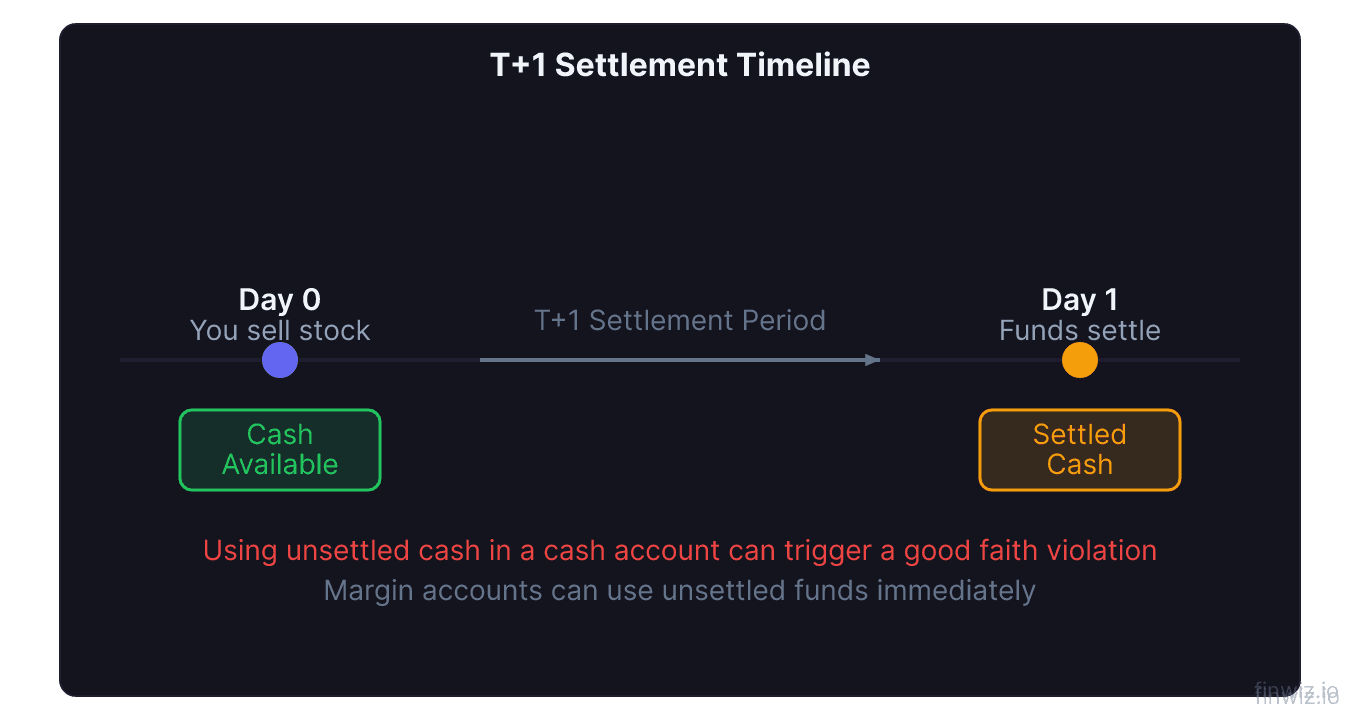
The T+1 settlement cycle means that when you execute a stock trade, the transaction officially settles one business day after the trade date. The "T" stands for the transaction date, and the "+1" represents one additional business day.
Before May 2024, U.S. equities settled on a T+2 basis (two business days). The SEC shortened the cycle to T+1 to reduce counterparty risk and free up capital more quickly. This change was significant for active traders in cash accounts, as it cut the waiting period for settled funds in half.
Settlement timeline example: You sell 100 shares of AAPL at $190 on Monday at 10:00 AM. Your broker credits $19,000 to your "cash available to trade" balance almost immediately. However, that $19,000 does not become "settled cash" until Tuesday (T+1). If Monday is followed by a market holiday, settlement pushes to Wednesday.
During the settlement window, the Depository Trust & Clearing Corporation (DTCC) handles the back-end transfer. Your broker delivers the shares to the buyer's broker, and the buyer's broker delivers cash to yours. Until that exchange completes, the proceeds are technically in transit.
Pro Tip
Cash Available to Trade: What It Includes
Your cash available to trade balance represents the total purchasing power in your account at any given moment. Depending on your account type, this figure may include several components.
In a cash account, cash available to trade typically includes your settled cash plus any unsettled proceeds from recent sales. Your broker allows you to use these unsettled proceeds for new purchases in most cases, but with an important caveat: if you sell the new position before the original proceeds settle, you risk triggering a violation.
In a margin account, cash available to trade includes your settled cash, unsettled proceeds, and any additional buying power provided by margin lending. A margin account with $25,000 in equity might show $50,000 in cash available to trade because the broker extends 2:1 leverage under Regulation T.
The key takeaway is that "available" does not mean "settled." Your broker is extending a courtesy by letting you trade with proceeds that have not yet cleared. That courtesy comes with rules, and violating those rules has consequences.
Settled Cash: What It Means
Settled cash is the portion of your account balance that has fully completed the settlement process. These funds carry no restrictions. You can trade with them, withdraw them, or transfer them to another account without limitation.
Settled cash increases when:
- A trade's proceeds complete T+1 settlement
- You deposit funds that have cleared (ACH transfers typically take 2-4 business days)
- Dividends are paid and settled
- Interest is credited to your account
Settled cash decreases when you use those funds to purchase securities. Once you buy shares with settled cash, the settlement clock resets — you will need to wait for the new trade to settle before those funds are available again.
| Feature | Cash Available to Trade | Settled Cash |
|---|---|---|
| Includes unsettled proceeds | Yes | No |
| Includes margin buying power | Yes (margin accounts) | No |
| Can trigger violations if misused | Yes (cash accounts) | No |
| Available for withdrawal | Not always | Yes |
| Broker display label | "Available" or "Buying Power" | "Settled" or "Cleared" |
| Updates after a sale | Immediately | After T+1 |
Good Faith Violations
A good faith violation occurs in a cash account when you buy a security using unsettled funds and then sell that security before the funds you used to buy it have settled. The violation is not about buying with unsettled funds — brokers allow that. The violation is triggered by selling the new position before the original proceeds settle.
Scenario: On Monday, you sell Stock A for $5,000. Those proceeds are available but not settled until Tuesday. You immediately use the $5,000 to buy Stock B. So far, no violation. But if you sell Stock B on Monday (before the original $5,000 from Stock A settles on Tuesday), you have committed a good faith violation.
Most brokers allow three good faith violations within a 12-month rolling period. After the third violation, the broker restricts your account to trading with settled cash only for 90 days. This effectively eliminates your ability to trade actively in a cash account.
Pro Tip
Free-Riding Violations
A free-riding violation is more severe than a good faith violation. It occurs when you buy a security in a cash account without sufficient funds (settled or unsettled) to cover the purchase, and then sell that same security to generate the funds to pay for it.
In other words, free-riding means you used the profit from selling a stock to pay for buying it in the first place. This is prohibited under Federal Reserve Regulation T.
Scenario: Your account has $0 in cash available to trade. You buy $3,000 worth of Stock C, then sell Stock C later the same day for $3,200, using the $3,200 proceeds to cover the original $3,000 purchase. You never had the money to make the initial purchase — you "free-rode" the position.
The penalty for free-riding is immediate: your account is restricted to purchasing securities with settled cash only for 90 days. Unlike good faith violations, there is no three-strike grace period. A single free-riding violation triggers the restriction.
How Margin Accounts Handle Settlement
Margin accounts largely eliminate settlement-related trading restrictions. When you sell a stock in a margin account, the broker effectively lends you the proceeds immediately, using your account equity as collateral. You can reinvest those proceeds into a new position and sell that new position the same day without triggering good faith or free-riding violations.
This is one of the primary reasons active traders who follow day trading rules use margin accounts rather than cash accounts. The settlement bridge provided by margin allows rapid-fire round trips that would be impossible in a cash account.
However, margin accounts introduce their own risks. Margin interest accrues on borrowed funds. Margin calls can force you to deposit additional capital or liquidate positions at unfavorable prices. And pattern day traders must maintain at least $25,000 in equity at all times.
Margin Buying Power = Account Equity x 2 (overnight) or Account Equity x 4 (intraday, PDT accounts)How Brokers Display These Balances
Broker platforms use inconsistent terminology, which causes confusion. Here is how major brokers label cash available versus settled cash.
Fidelity displays "Cash Available to Trade" (includes unsettled proceeds and margin) and "Settled Cash" as separate line items in the balances section.
Charles Schwab shows "Cash & Cash Investments" for your total balance and "Settled Funds" for cleared cash. The "Available to Withdraw" field indicates how much you can move out of the account.
TD Ameritrade / Schwab uses "Option Buying Power," "Stock Buying Power," and "Cash" as separate fields. The "Cash" field represents settled funds.
Robinhood displays "Buying Power" prominently but does not clearly separate settled from unsettled cash in the default view. Instant deposits (up to $1,000 for basic accounts) add to buying power before the ACH transfer settles, further blurring the line.
For active trading, knowing exactly how much of your balance is settled cash versus unsettled proceeds is critical. Check your broker's detailed balance view rather than relying on the simplified homepage display.
Managing Settlement in Practice
Effective risk management includes planning around settlement cycles. Several practical strategies help you avoid violations while maximizing your trading activity in a cash account.
Trade in batches. Divide your account into two or three portions. Trade one portion today, let it settle overnight, and trade the next portion tomorrow. This rotation ensures you always have settled funds available.
Use a margin account for active trading. If you make more than a few round trips per week, a cash account will eventually create settlement headaches. A margin account removes the constraint entirely, though it introduces leverage risk.
Monitor your settled cash daily. Before placing any trade, verify how much of your available balance is actually settled. This 30-second check can prevent a 90-day restriction.
Avoid selling new purchases before prior proceeds settle. This is the single most common trigger for good faith violations. When in doubt, wait one extra day.
Frequently Asked Questions
Can I buy stocks with unsettled cash?
Yes, most brokers allow you to purchase securities using unsettled funds in a cash account. The risk arises if you sell that new purchase before the original unsettled funds complete settlement. Buying with unsettled funds is permitted; selling before settlement is what triggers good faith violations.
How long does it take for cash to settle after selling a stock?
Under the current T+1 settlement rule, stock sale proceeds settle one business day after the trade date. If you sell on Monday, funds settle on Tuesday. If you sell on Friday, funds settle the following Monday (assuming no market holidays). Options and most ETFs also follow T+1 settlement.
Do I need to worry about settlement in a margin account?
Generally, no. Margin accounts lend you funds against unsettled proceeds, which means you can trade freely without waiting for settlement. However, you are still subject to margin interest charges, margin calls, and the pattern day trader rule if you execute four or more day trades within five business days.
What happens if I get a good faith violation?
Your broker records the violation. Most brokers allow three good faith violations within a rolling 12-month period without penalty. After the third violation, your account is restricted to trading with settled cash only for 90 days. The restriction lifts automatically after the 90-day period ends.
Is settled cash the same as withdrawable cash?
Not always. Settled cash represents funds that have completed trade settlement, but your withdrawable cash may be lower if some settled funds are being used as collateral for open positions, pending option assignments, or other obligations. Check both figures before initiating a withdrawal.
12 chapters covering charts, indicators, risk management & more. Plus weekly trading insights.