
Opening Range Breakout: The First 30-Minute Strategy
⚡ Key Takeaways
- The Opening Range Breakout (ORB) strategy trades the breakout from the high or low of the first 15-30 minutes of trading
- The opening range captures the initial price discovery after overnight information is absorbed by the market
- Long entries trigger when price breaks above the opening range high with volume; shorts trigger below the opening range low
- Stop losses are placed at the opposite side of the opening range or at VWAP
- ORB variants include the 5-minute ORB (aggressive), 15-minute ORB (standard), and 30-minute ORB (conservative)
What Is the Opening Range Breakout Strategy?
The Opening Range Breakout (ORB) is a classic day trading strategy that uses the price range established during the first minutes of trading as a framework for the rest of the session. When the stock breaks out above or below this range, it signals the likely direction for the day.
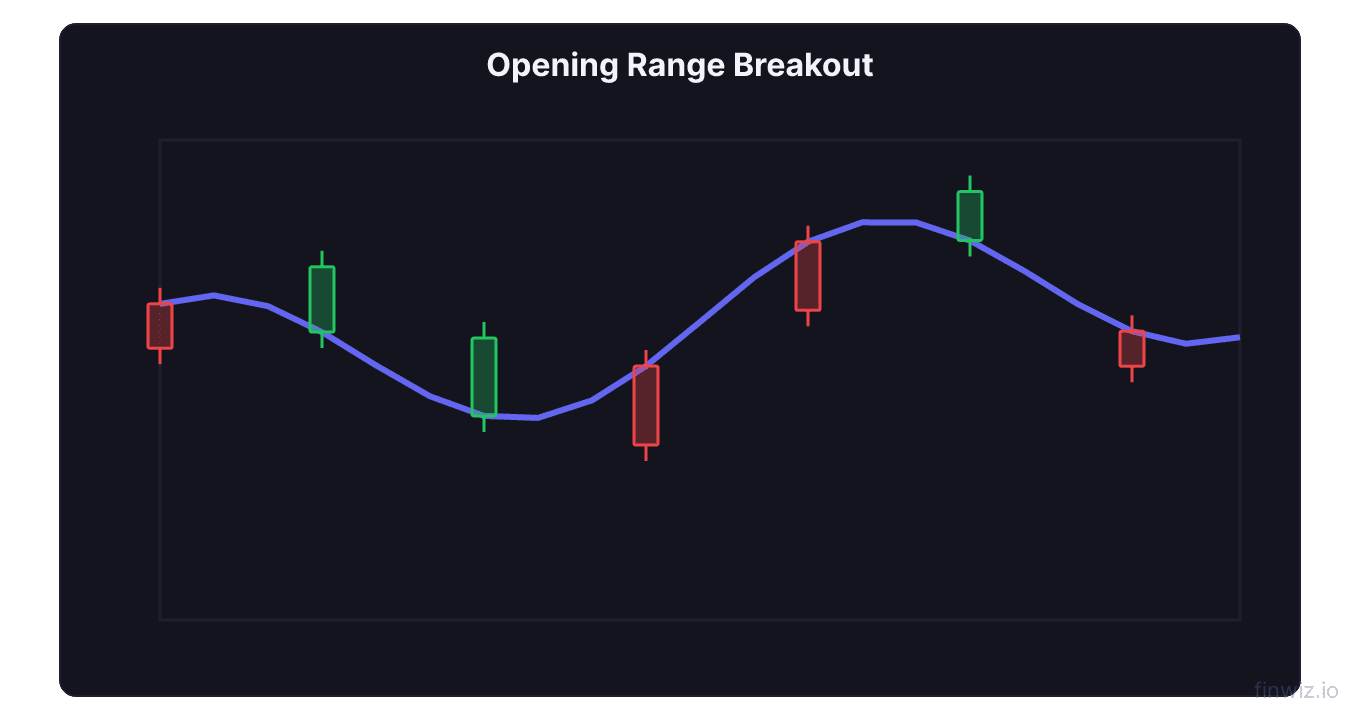
The theory behind ORB is rooted in price discovery. When the market opens, all the overnight information (news, earnings, global market movements) is processed by participants simultaneously. The first 15-30 minutes represent a period of intense price discovery as buyers and sellers negotiate the stock's fair value in light of new information.
Once this negotiation phase settles and a range is established, a breakout from that range signals that one side (buyers or sellers) has won. The breakout direction often predicts the stock's trend for the remainder of the session.
Defining the Opening Range
The opening range is simply the high and low prices achieved during a specified time window at the start of the trading day. The most common windows are:
5-minute ORB uses the high and low of the first 5 minutes (9:30-9:35 AM ET). This produces the tightest range and the earliest signals but also the most false breakouts. Best for aggressive traders in highly volatile stocks.
15-minute ORB uses the first 15 minutes (9:30-9:45 AM ET). This is the most popular variant, balancing early entry with sufficient price data to establish a meaningful range. Many professional day traders use the 15-minute ORB as their primary strategy.
30-minute ORB uses the first 30 minutes (9:30-10:00 AM ET). This produces the widest range and fewer false breakouts but reduces profit potential since you enter later. Best for conservative traders or markets with extreme opening volatility.
| ORB Variant | Time Window | Range Width | False Breakout Risk | Best For |
|---|---|---|---|---|
| 5-minute | 9:30 - 9:35 | Narrow | High | Volatile stocks, aggressive traders |
| 15-minute | 9:30 - 9:45 | Medium | Moderate | Most traders, standard approach |
| 30-minute | 9:30 - 10:00 | Wide | Low | Conservative traders, choppy markets |
How to Trade the ORB: Step by Step
Here is a complete walkthrough of executing an Opening Range Breakout trade.
Step 1: Identify candidate stocks. During premarket, use your stock screener to build a watchlist. Look for stocks with a news catalyst, high relative volume, and a price range that offers sufficient movement potential. Stocks gapping on earnings or news are ideal ORB candidates.
Step 2: Wait for the opening range to form. Do not trade during the opening range formation period. Simply watch and let the range define itself. Mark the high and low of the range on your chart once the period ends.
Step 3: Set alerts. Place price alerts at the opening range high and low. This allows you to monitor multiple stocks simultaneously without staring at every chart.
Step 4: Enter on the breakout. When the stock breaks above the opening range high, enter long. When it breaks below the opening range low, enter short (or avoid longs). The breakout candle should close above (or below) the range level, not just wick through it.
Step 5: Confirm with volume. The breakout must be accompanied by increasing volume. A breakout on declining or average volume is suspect and has a higher failure rate. Volume confirms that new participants are committing capital in the breakout direction.
Step 6: Set your stop loss. Place your stop at the opposite side of the opening range (if long at the high, stop at the low) or at VWAP if it falls within the range.
Entry Refinements
The basic ORB entry is straightforward, but several refinements improve the probability of success.
Break-and-retest entry: Instead of entering immediately on the breakout, wait for the stock to break above the range, pull back to the range high (now support), and bounce. This retest confirms that the breakout level holds as support and provides a lower-risk entry with a tighter stop.
VWAP alignment: The strongest ORB trades occur when the breakout direction aligns with VWAP positioning. A breakout above the opening range high that is also above VWAP has double confirmation. A breakout below the range low with VWAP acting as resistance above is similarly strong.
Relative strength filter: Compare the stock's movement to the broader market (SPY or QQQ). A stock breaking out above its opening range while the market is also trending higher has tailwind support. A stock breaking out against a declining market shows exceptional relative strength.
Pro Tip
Stop Loss and Risk Management
The ORB strategy has a natural stop loss level built into the setup, making risk management straightforward.
Opposite side of the range stop: If you enter long on a break above the opening range high, your stop is at the opening range low. This gives the trade maximum room to work but creates a wider stop distance, requiring smaller position size.
VWAP stop: If VWAP falls between the range high and low, use VWAP as your stop for long entries. This creates a tighter stop and better risk-reward, but it also increases the chance of being stopped out on normal pullbacks.
Half-range stop: Some traders place their stop at the midpoint of the opening range rather than the full opposite side. This tightens risk but reduces the amount of noise the trade can absorb.
Opening Range: $48.50 (low) to $50.50 (high)Profit Targets
The ORB strategy offers several approaches for setting profit targets.
Range extension targets are the most popular method. Measure the width of the opening range and project that distance from the breakout point. A 1x extension means the target is one range-width above the high (for longs). A 2x extension doubles the distance.
For example, if the opening range is $2 wide (high of $50, low of $48), the 1x target for a long breakout is $52 ($50 + $2), and the 2x target is $54 ($50 + $4).
Prior day levels (prior day high, prior day close, prior support/resistance) provide natural targets where selling pressure may emerge.
Fibonacci extensions from the opening range provide mathematically derived target levels. The 1.272x and 1.618x extensions are commonly used.
Trailing stop exit works well on strong trending days. Trail your stop below each new 5-minute candle low (for longs) to ride extended moves while locking in gains as the trade progresses.
ORB Variants and Modifications
The basic ORB framework has been adapted into several variants by different traders and trading educators.
Narrow Range ORB: Some traders filter specifically for stocks with narrow opening ranges relative to their average daily range. The theory is that narrow ranges represent compressed energy that produces more explosive breakouts. If a stock's 15-minute opening range is 30% narrower than its average 15-minute range, the breakout may have more power.
Multi-Timeframe ORB: Combine the 5-minute and 15-minute ORB. If the stock breaks the 5-minute range in one direction but fails to break the 15-minute range, it may be a false breakout. If both ranges are broken in the same direction, confidence increases.
ORB with Premarket Levels: Integrate the premarket high and low as additional reference points. A stock that breaks its opening range high AND its premarket high has broken two resistance levels, providing stronger confirmation.
Failed ORB: When a breakout above the opening range fails and the stock reverses back into the range, this failed breakout often signals a strong move in the opposite direction. Entering short when a long breakout fails (and vice versa) can be a powerful counter-trend setup.
Market Conditions and ORB Performance
The ORB strategy's effectiveness varies with market conditions. Understanding when ORB works best helps you allocate your trading capital appropriately.
Trending markets produce the best ORB results. When the overall market is trending higher (or lower), individual stock ORB breakouts tend to have better follow-through because the broader trend provides a tailwind.
Range-bound markets are more challenging for ORB. Breakouts in choppy, directionless markets are more likely to fail and reverse. In these conditions, consider using wider opening ranges (30-minute ORB) or tighter profit targets.
High-volatility events (FOMC days, CPI releases, earnings season) can produce unusually wide opening ranges and powerful breakouts. However, the initial volatility can also create whipsaws, so wider stops may be necessary.
Low-volume days (holiday weeks, summer months) produce less reliable ORB signals because the thin volume makes breakouts more susceptible to false moves.
Frequently Asked Questions
Can I use ORB on any stock?
ORB works best on stocks with sufficient volume and volatility to produce meaningful opening ranges and follow-through breakouts. Stocks with average daily volume above 1 million shares and average daily ranges above 2% are good candidates. Very low-volume stocks produce unreliable ORB signals.
What timeframe chart should I use for ORB?
Most ORB traders use the 5-minute chart as their primary chart, with the 1-minute chart for fine-tuning entries. The 5-minute chart clearly displays the opening range and subsequent breakout candles without excessive noise.
How many ORB trades should I take per day?
Quality over quantity is the rule. Most ORB traders take 1-3 trades per day, focusing on the highest-conviction setups. Taking too many ORB trades dilutes your focus and often leads to trading lower-quality setups.
Does ORB work for ETFs like SPY or QQQ?
Yes. ORB on major ETFs can be effective, particularly on days with scheduled economic data releases or significant news events. The opening range on SPY or QQQ captures the market's reaction to overnight developments and provides a framework for the day's trend.
Can I combine ORB with other strategies?
Absolutely. ORB combines naturally with VWAP trading (VWAP confirms the breakout direction), gap-and-go (ORB provides structure for trading morning gaps), and momentum trading (ORB identifies the start of momentum moves). Using multiple confirming signals increases trade quality.
Disclaimer
This is educational content, not financial advice. Trading involves risk, and you should consult a qualified financial advisor before making any investment decisions. Past performance does not guarantee future results.
Related Articles
12 chapters covering charts, indicators, risk management & more. Plus weekly trading insights.