
Buy Stop Orders: How to Enter Above the Current Price
⚡ Key Takeaways
- A buy stop order triggers a market buy when the stock rises to your specified price, placing your entry above the current market price
- Buy stops are the primary order type for breakout trading, automatically entering you when price clears resistance
- Unlike a buy limit order, a buy stop guarantees execution but not price — slippage can occur in fast-moving markets
- A buy stop-limit order adds price control by converting to a limit order instead of a market order once triggered
What Is a Buy Stop Order?
A buy stop order is an instruction to your broker to purchase a stock once it reaches a specified price above the current market price. When the stock hits your stop price, the order converts to a market order and fills at the best available price.
This is the opposite of how most people think about buying. Instead of buying low and hoping for higher prices, a buy stop order deliberately buys higher — after the stock has proven it can reach a certain level. The logic is simple: you only want to own the stock if it breaks through a key price, confirming a move you have been anticipating.
Buy stop orders are used almost exclusively for breakout entries. If NVDA is trading at $890 and consolidating below resistance at $900, you can place a buy stop at $900.50. If NVDA breaks out, your order triggers automatically. If it never reaches $900, you never buy — and you never take a losing trade on a failed setup.
How Buy Stop Orders Work
The mechanics follow a straightforward sequence:
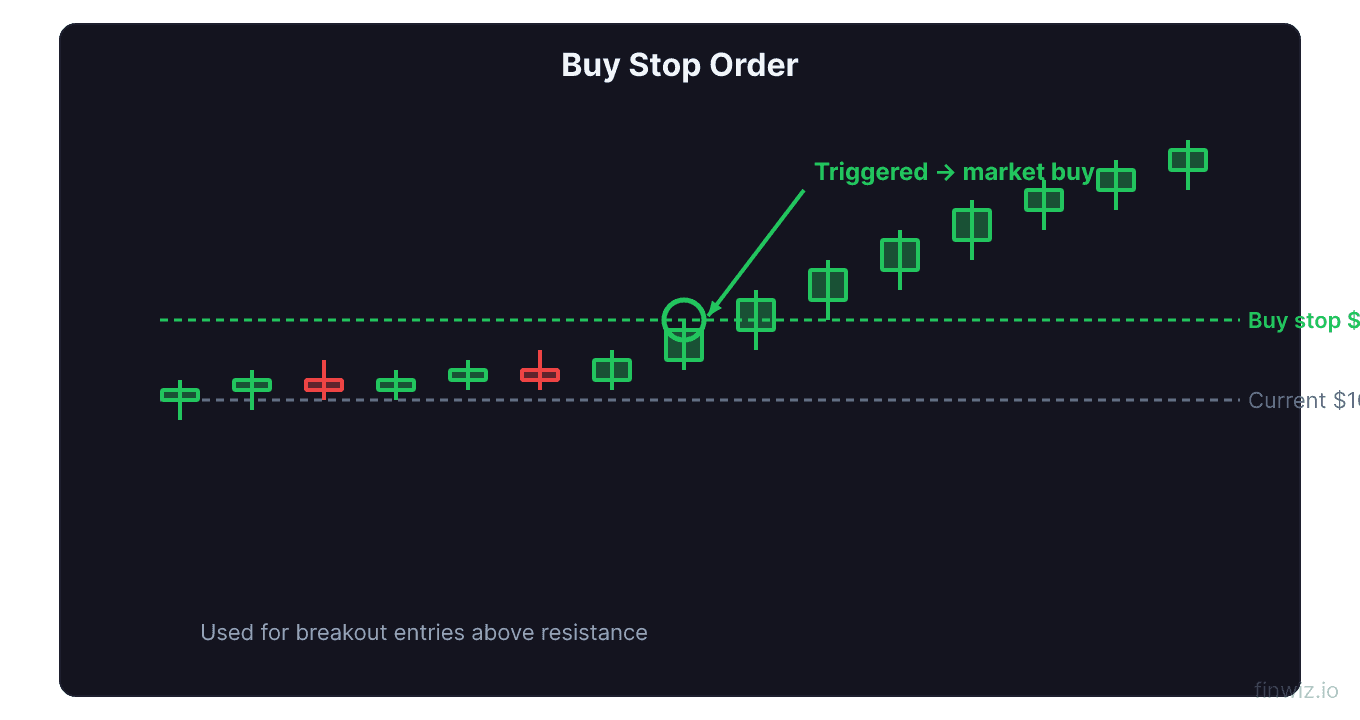
- AAPL is trading at $185. You identify resistance at $188.
- You place a buy stop order at $188.25 for 100 shares.
- AAPL rises throughout the day and hits $188.25.
- Your buy stop converts to a market order.
- The market order fills at the best available price — likely $188.25 to $188.40 depending on liquidity.
The critical point: once triggered, a buy stop becomes a market order. You are guaranteed a fill, but not a specific price. In fast-moving breakout trading scenarios where price surges through resistance on heavy volume, your fill might be several cents or more above your stop price.
Pro Tip
Buy Stop Orders for Breakout Trading
Breakout trading and buy stop orders are natural partners. Breakout traders wait for price to clear a defined resistance level on volume, confirming that buyers have overwhelmed sellers at that price. A buy stop automates this entry so you do not have to watch every tick.
Common breakout setups using buy stops:
- Horizontal resistance breakout: Stock has tested a price ceiling multiple times. Buy stop sits just above the ceiling.
- Bull flag breakout: After a strong run-up, the stock pulls back in a tight channel. Buy stop sits above the flag's upper trendline.
- Ascending triangle: Higher lows compress into a flat resistance level. Buy stop triggers when the flat top breaks.
Consider META in late 2023. The stock consolidated between $320 and $340 for weeks. A buy stop at $341 would have triggered on the breakout that eventually carried the stock above $500. The buy stop ensured entry only if the breakout occurred — no guessing, no premature buying.
Buy Stop vs. Buy Stop-Limit
A stop-limit order adds a second price to control your fill. When the stop price is reached, the order converts to a limit order instead of a market order.
| Feature | Buy Stop | Buy Stop-Limit |
|---|---|---|
| Trigger price | Yes | Yes |
| Converts to | Market order | Limit order |
| Fill guaranteed | Yes (after trigger) | No |
| Price guaranteed | No | Yes (if filled) |
| Best for | Liquid stocks, normal volatility | Fast-moving or illiquid stocks |
| Risk | Slippage on fill | Order may not fill at all |
Example: You set a buy stop-limit with a stop at $188.25 and a limit at $188.75. When AAPL hits $188.25, the order becomes a limit order to buy at $188.75 or better. If the stock rockets past $188.75 before your order fills, you miss the trade entirely.
The choice between them comes down to what risk you prefer. A buy stop risks a worse price. A buy stop-limit risks missing the breakout altogether. For highly liquid stocks like AAPL, MSFT, and NVDA, standard buy stops work well because spreads are tight and slippage is minimal.
Buy Stop vs. Sell Stop
Buy stops and sell stops are mirror images. A buy stop order triggers above the current price to initiate a long position or cover a short. A sell stop triggers below the current price to protect a long position or initiate a short.
- Buy stop at $100 when stock is at $95: "Buy if the stock proves it can reach $100."
- Sell stop at $90 when stock is at $95: "Sell if the stock drops to $90 to limit my loss."
Both convert to market orders when triggered. Both are essential tools in active trading. Most traders encounter sell stops first through stop-loss orders, but buy stops are equally important for systematic breakout entries.
Managing Risk with Buy Stop Orders
Placing a buy stop is only half the equation. You need a plan for what happens after the fill.
Position Size = Account Risk / (Entry Price - Stop Loss Price)Before placing the buy stop, determine where your protective stop loss will go. For breakout trades, the stop typically sits just below the breakout level — the logic being that if price falls back below resistance, the breakout has failed and you should exit.
Many brokers support bracket orders that attach a stop loss and profit target to your buy stop automatically. This means your risk management is in place before the entry even triggers.
Common Mistakes with Buy Stop Orders
- Setting the stop too close to resistance: Triggers on noise and false breakouts. Add a buffer above the level.
- Forgetting to cancel: If you place a buy stop for a breakout setup that expires (the pattern breaks down), cancel the order. Stale buy stops can fill on random price spikes days later.
- Ignoring volume: A breakout on low volume is unreliable. Consider only placing buy stops on setups where you have confirmed increasing volume into the resistance level.
- No exit plan: A buy stop without a corresponding stop loss is an incomplete trade. Always define your risk before the entry triggers.
Frequently Asked Questions
When should I use a buy stop order instead of a limit order?
Use a buy stop when you want to enter only if the stock reaches a higher price — typically for breakout entries. A limit order buys at or below a specified price, which is better for pullback entries or value buying. If you are waiting for TSLA to break above $250 resistance, a buy stop at $250.50 is the right tool. If you want to buy TSLA on a dip to $230 support, use a limit order.
Can a buy stop order fill at a price much higher than my stop price?
Yes. Once triggered, a buy stop becomes a market order with no price ceiling. In extremely volatile moments — earnings gaps, news-driven spikes — the fill can be significantly above your stop price. For stocks with wide spreads or low liquidity, consider a buy stop-limit order to cap your maximum entry price.
Do buy stop orders work in pre-market and after-hours trading?
This depends on your broker. Most standard buy stop orders are active only during regular market hours (9:30 AM - 4:00 PM ET). Some brokers allow extended-hours stop orders, but liquidity is thin outside regular hours, increasing slippage risk. Check your broker's order routing rules and consider whether the thin liquidity justifies using a stop order in extended sessions.
12 chapters covering charts, indicators, risk management & more. Plus weekly trading insights.