
Stop Orders: How They Work & When to Use Them
⚡ Key Takeaways
- A stop order triggers when a stock reaches a specified price, then converts to a market order for immediate execution
- Sell stop orders protect existing positions by automatically selling when the price drops to your stop level
- Buy stop orders enter new positions when the price rises to a level that confirms a breakout or uptrend
- Stop orders guarantee execution after triggering but not the exact fill price — slippage is possible in fast markets
- Stop orders are the foundation of disciplined risk management and systematic trade entries
What Is a Stop Order?
A stop order is a conditional order that remains dormant until the stock reaches a price you specify (the stop price). Once that price is hit, the stop order activates and becomes a market order, executing at the next available price.
Stop orders come in two forms: sell stops and buy stops. A sell stop is placed below the current price to limit losses or lock in profits on a long position. A buy stop is placed above the current price to enter a trade when a stock breaks through resistance.
The key distinction from a limit order: a limit order controls price but not execution. A stop order controls execution but not price. Once triggered, a stop order will fill — you just cannot control the exact price of that fill.
How Sell Stop Orders Work
Sell stop orders are the most common type of stop order, primarily used as protective stop losses. Here is the sequence:
- You own 200 shares of MSFT bought at $420.
- You place a sell stop at $410.
- MSFT declines and hits $410.
- The sell stop converts to a market order.
- Your 200 shares sell at the best available price, likely near $410.
Your maximum planned loss is $10 per share, or $2,000 total. Without the stop, you would need to manually decide to sell during the decline — a decision that emotions often prevent.
Sell stops are the backbone of stop-loss strategies. Every trade plan should define a sell stop level before entry. Placing the stop simultaneously with the entry (or using a bracket order) ensures you are never exposed without protection.
Pro Tip
How Buy Stop Orders Work
A buy stop order is placed above the current market price. It triggers when the stock rises to your stop price, entering you into a long position (or covering a short position).
Buy stops serve two primary purposes:
Breakout entries. AMZN is consolidating at $185 with resistance at $190. You place a buy stop at $190.50. If the stock breaks out, you are automatically long. If it never reaches $190, you never enter a trade that did not confirm your thesis.
Short covering. You are short 100 shares of a stock at $50. You place a buy stop at $53 as your stop loss. If the stock rises against your short, the buy stop triggers and closes your position, limiting the loss to $3 per share.
Buy stops ensure that you only enter breakout trades when the breakout actually happens. This eliminates the costly habit of buying before confirmation and sitting through failed setups.
Stop Order Mechanics: What Happens Behind the Scenes
When you submit a stop order, your broker holds it in their order management system. The order is not visible in the market's order book — it does not appear on Level 2 quotes. Only when the stop price is reached does the broker inject a market order into the market.
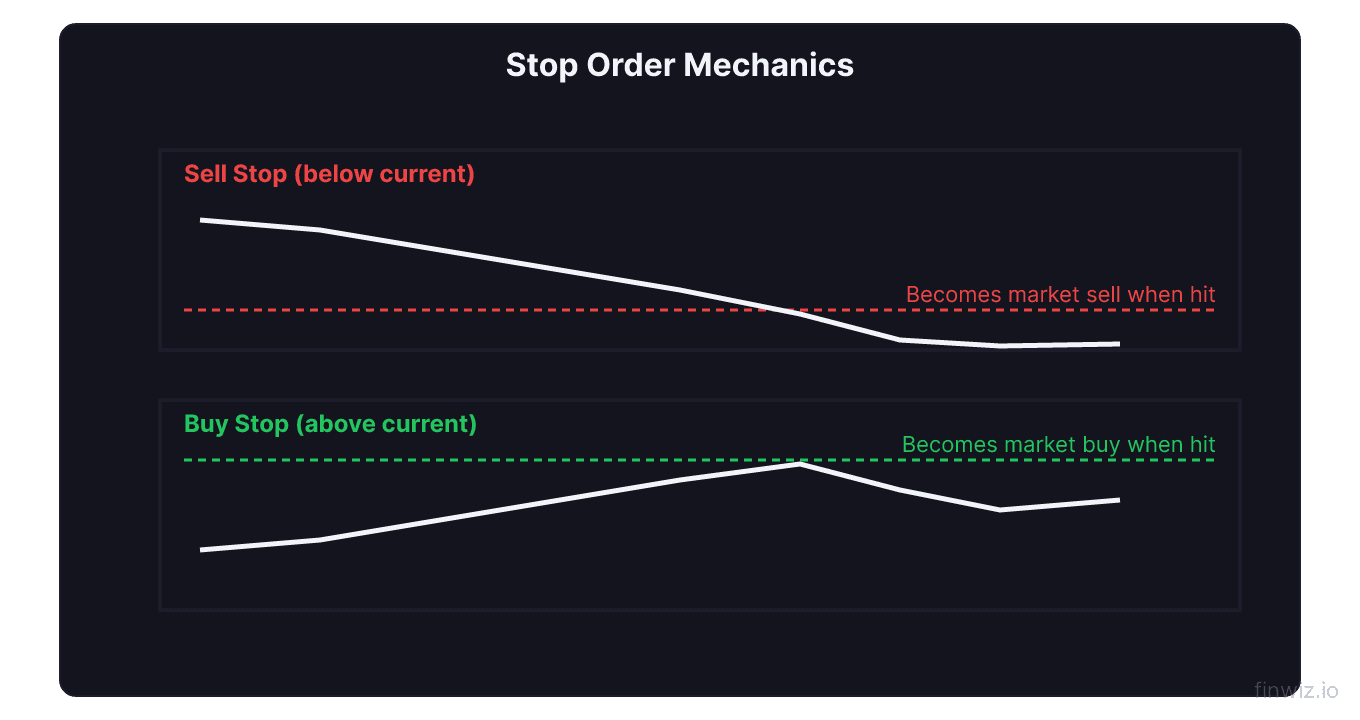
This has important implications:
- Stop orders do not add liquidity. They consume it when triggered, just like any market order.
- Cascading stops can accelerate a decline. When a stock drops to a level where many sell stops are clustered, those stops trigger simultaneously, creating a surge of sell market orders that can push the price sharply lower.
- Stop hunts occur when large players push price briefly to a known stop cluster to trigger those orders, then reverse direction after accumulating shares at lower prices.
Stop Order vs. Stop-Limit Order
A stop-limit order adds price control to the stop order structure. Instead of converting to a market order at the stop price, it converts to a limit order.
| Feature | Stop Order | Stop-Limit Order |
|---|---|---|
| Trigger | At stop price | At stop price |
| Converts to | Market order | Limit order |
| Execution guaranteed | Yes | No |
| Price control | None after trigger | Full control |
| Gap risk | Fills at market price | May not fill at all |
| Best use case | Guaranteed exits | Controlled entries |
When to use a stop order: When you absolutely need to exit the position — protective stop losses, risk management situations, and trades where missing the exit is worse than getting a bad price.
When to use a stop-limit: When you want to control your entry or exit price and are willing to accept the risk of no fill — breakout entries in illiquid stocks, or situations where you would rather miss the trade than get an extreme fill.
Stop Orders and Gaps
The most significant limitation of stop orders is their behavior during price gaps. If a stock closes at $100 and opens at $92 due to overnight news, a sell stop at $95 triggers at the open and fills near $92 — not at $95.
This gap risk affects overnight holders and swing traders. In October 2022, META gapped down over 20% after earnings. Any sell stop placed within that gap filled at the opening price, far below the stop level.
Strategies to manage gap risk:
- Keep position sizes small enough that even a worst-case gap is survivable
- Avoid holding through known catalysts (earnings, FDA decisions) unless it is part of your strategy
- Use stop-limit orders if you prefer the risk of no fill over a catastrophic fill price
- Diversify across multiple positions so a single gap cannot devastate your account
Stop Orders and Trailing Stops
A trailing stop is a dynamic version of a stop order that adjusts automatically as the stock moves in your favor. Instead of a fixed price, you set a trailing distance (in dollars or percentage).
If you buy GOOGL at $170 and set a $5 trailing stop, the initial stop is at $165. If GOOGL rises to $180, the stop adjusts to $175. If GOOGL then drops $5 from any subsequent high, the trailing stop triggers.
Trailing Stop Price = Highest Price Since Entry - Trail AmountTrailing stops lock in profits while giving the trade room to run. They are particularly useful in trending markets where you want to capture as much of the move as possible without setting a fixed profit target.
Common Stop Order Mistakes
- Placing stops at obvious levels: Round numbers and well-known support levels attract stop hunters. Offset your stop by a few cents beyond the obvious level.
- Setting stops too tight: A stop within the stock's normal daily range triggers on noise. Use the ATR to gauge appropriate stop distance.
- Moving stops further away: When a trade goes against you, widening the stop turns a planned small loss into an unplanned large loss. Never move a stop in the losing direction.
- Not using stops at all: The single most damaging habit in trading. Every position needs a defined exit for loss.
Frequently Asked Questions
What is the difference between a stop order and a stop-loss order?
They are functionally the same thing. Stop-loss is the colloquial term for a sell stop order used to protect a position. The order type at your broker is simply called a "stop order" or "sell stop." The "loss" part describes the purpose (limiting losses), not a different order type. Buy stops and sell stops are both stop orders — sell stops used for protection are commonly called stop losses.
Can stop orders be used for short selling?
Yes. Short sellers use buy stop orders as their stop losses. If you short a stock at $50, you place a buy stop at $53 to limit your loss. If the stock rises to $53, the buy stop triggers and covers your short. Short sellers also use sell stops to enter new short positions when a stock breaks below support.
Do stop orders work during pre-market and after-hours?
Most brokers only activate stop orders during regular market hours (9:30 AM - 4:00 PM ET). This means a stop order will not protect you from a price move that occurs in the pre-market or after-hours session. Some brokers offer extended-hours stop orders, but liquidity is thin and slippage can be significant. Check your broker's specific rules for stop order activation windows.
12 chapters covering charts, indicators, risk management & more. Plus weekly trading insights.