
3 Bar Play: A Day Trader's Momentum Continuation Setup
⚡ Key Takeaways
- The 3 Bar Play is a momentum continuation pattern consisting of a strong directional candle, an inside bar that consolidates the move, and a breakout candle that resumes the original direction.
- The pattern works because the inside bar represents a brief equilibrium pause after aggressive buying or selling — once that pause resolves, the momentum typically continues.
- The 3 Bar Play is a favorite among scalpers and intraday traders because it provides tight risk (stop below the inside bar) with defined breakout entries.
- It works on any timeframe but is most commonly traded on 1-minute to 15-minute charts during high-volume sessions.
What Is the 3 Bar Play?
The 3 Bar Play is a three-candle pattern that captures momentum continuation after a brief consolidation pause. It is one of the cleanest and most actionable setups in short-term trading because each bar has a defined role: impulse, rest, and resolution.
The pattern appears constantly on intraday charts of active stocks. Day traders favor it because it delivers a specific entry price, a tight stop loss, and a clear directional bias — all within three bars. There is no ambiguity about the setup once you learn to recognize it.
The 3 Bar Play belongs to the broader family of candlestick patterns but is more of a structural momentum setup than a traditional Japanese candle signal. It is rooted in price action mechanics rather than candle pattern lore.
The Three Bars Explained
Bar 1: The Ignition Candle
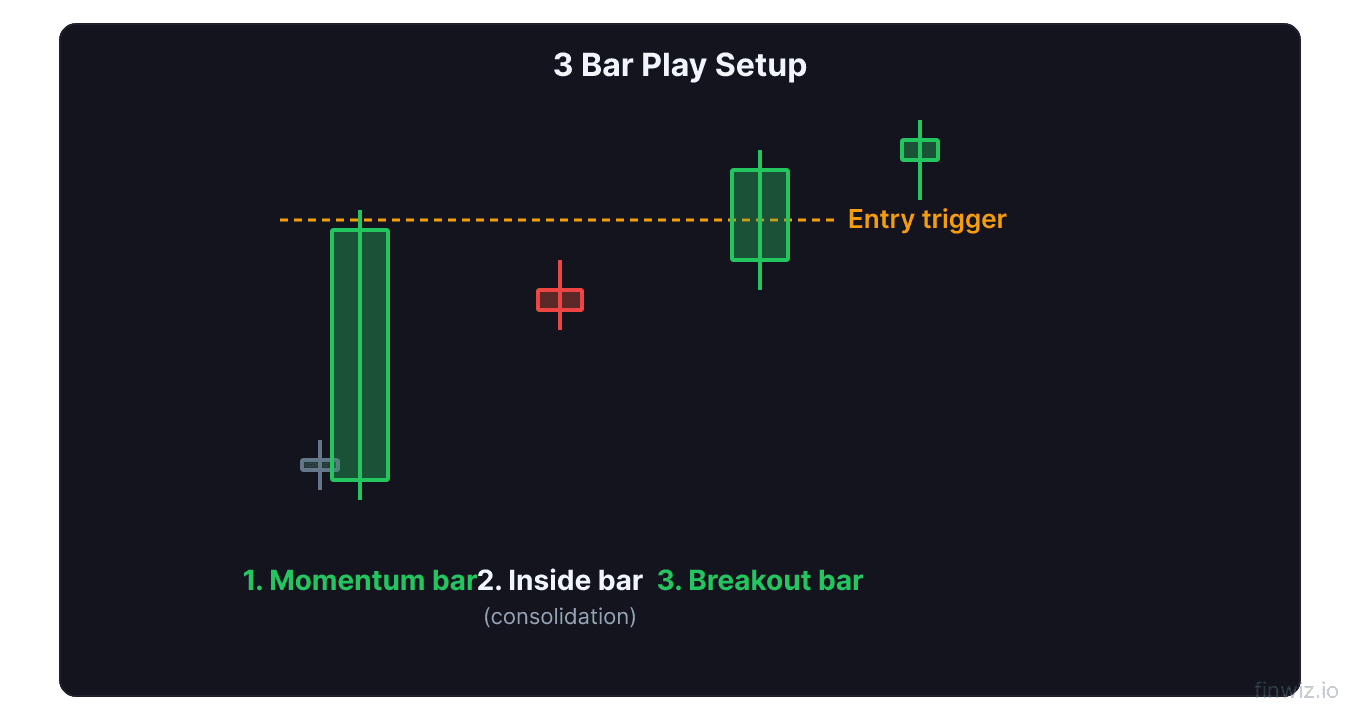
The first bar is a strong, large-range candle in the direction of the momentum move. For a bullish 3 Bar Play, this is a tall green candle closing near its high. For a bearish version, it is a tall red candle closing near its low.
This bar must stand out from surrounding price action. It should be significantly larger than the average candle on the chart — at least 1.5-2x the average range. It should close in the upper 25% of its range (bullish) or lower 25% (bearish), showing conviction rather than indecision.
Heavy volume on Bar 1 confirms institutional participation. On a stock like AMD during a momentum day, the ignition candle might be a $2 green bar on 5x average volume while surrounding candles show $0.30-$0.50 ranges.
Bar 2: The Inside Bar
The second bar is an inside bar — its entire range (high to low) fits within the range of Bar 1. This inside bar represents the market catching its breath after the strong move. Sellers are not strong enough to reverse Bar 1, but buyers need a moment to regroup before continuing.
The inside bar should have lower volume than Bar 1. Declining volume during the consolidation confirms that the pause is a natural rest rather than active distribution. If Bar 2 has higher volume than Bar 1 and closes near its low (in a bullish setup), the pattern is suspect.
The ideal inside bar is small and positioned in the upper half of Bar 1's range (bullish) or lower half (bearish). A tiny inside bar hugging the high of Bar 1 is the strongest bullish version — it shows absolutely no give-back from the initial surge.
Bar 3: The Breakout Candle
The third bar breaks above the high of Bar 2 (bullish) or below the low of Bar 2 (bearish), resuming the momentum from Bar 1. This breakout candle is your entry trigger.
Enter the trade when price crosses Bar 2's high (long) or low (short). Volume should increase on the breakout, ideally matching or exceeding Bar 1's volume. The breakout confirms that the pause is over and momentum has resumed.
Trading the Bullish 3 Bar Play
Setup identification. Scan for a strong green candle (Bar 1) followed by an inside bar (Bar 2) on declining volume. The stock should already be in an intraday uptrend or gapping up on news.
Entry. Place a buy stop order $0.01-$0.05 above the high of Bar 2. This ensures you enter only if the breakout triggers. If Bar 3 opens within Bar 2's range, the buy stop catches the breakout in real time.
Stop loss. Place the stop below the low of Bar 2 (aggressive) or below the low of Bar 1 (conservative). The Bar 2 stop is tighter and provides better reward-to-risk, but it gets stopped out more often on volatile stocks. The Bar 1 stop gives more room and survives more shakeouts.
Target. The minimum target is a move equal to Bar 1's range, measured from the Bar 2 breakout point. Many scalping traders use a 1:1 risk-reward ratio on the first half of the position and trail the second half.
Pro Tip
Trading the Bearish 3 Bar Play
The bearish version mirrors the bullish setup. Bar 1 is a strong red candle. Bar 2 is an inside bar on declining volume. Bar 3 breaks below Bar 2's low, triggering a short entry.
Bearish 3 Bar Plays are particularly effective after a stock has topped and is beginning to roll over. If META gaps down on an earnings miss and then prints a large red candle followed by an inside bar, the breakdown below Bar 2 often leads to accelerating selling as longs who held through the inside bar lose hope and exit.
Short entry goes below Bar 2's low. Stop loss above Bar 2's high or Bar 1's high. Target is a downside move equal to Bar 1's range.
Timeframe Selection
The 3 Bar Play works on any timeframe, but trade quality varies.
1-minute and 2-minute charts. Ultra-fast version used by scalpers. Produces frequent setups but more noise. Requires fast execution and tight spreads. Best for liquid names like SPY, QQQ, TSLA, and NVDA where spreads are minimal.
5-minute chart. The sweet spot for most day trading strategies. Produces clean setups with enough signal quality to filter noise. Most traders learn the 3 Bar Play on the 5-minute chart first.
15-minute chart. Fewer setups but higher reliability. Good for traders who want the 3 Bar Play concept without the intensity of scalping. Often produces multi-hour moves rather than quick scalps.
Daily chart. The 3 Bar Play on a daily chart becomes a multi-day swing trade. The inside day (Bar 2) after a strong gap day (Bar 1) is a well-documented setup in swing trading — the breakout above the inside day's high on Day 3 frequently triggers continuation runs.
Pattern Variations
Multiple inside bars. Sometimes Bar 1 is followed by two or three inside bars rather than one. This is actually a stronger setup — each additional inside bar compresses the range further and builds more tension. The breakout triggers above the high of the narrowest inside bar.
3 Bar Play at the open. When a stock gaps up significantly and the first 5-minute candle is a large green bar, the second candle prints an inside bar, and the third candle breaks above the inside bar's high — this is the opening range version. It is one of the highest-probability variations because it combines gap momentum with the 3 Bar Play structure.
Failed 3 Bar Play. If Bar 3 breaks the opposite side of Bar 2 (breaks below Bar 2's low in a bullish setup), the pattern has failed. This failure often leads to a sharp move in the opposite direction because traders positioned for the continuation are now trapped. Some traders specifically trade the failure as a reversal setup.
Combining with Other Patterns
The 3 Bar Play is powerful on its own but becomes more reliable when it forms within the context of a larger pattern.
When a 3 Bar Play triggers within a bull flag, you have macro-pattern confirmation (flag breakout) and micro-pattern confirmation (3 Bar Play) aligning on the same trade. The flag provides the structural context, and the 3 Bar Play provides the precise entry timing.
Similarly, a 3 Bar Play that triggers at the breakout point of a cup and handle or ascending triangle adds a momentum-confirmation layer to the larger pattern's signal.
Frequently Asked Questions
How often does the 3 Bar Play work?
On liquid stocks during trending sessions, the 3 Bar Play produces a win rate of approximately 55-65% on the 5-minute chart. The edge comes from the favorable risk-reward ratio — tight stops and trend-aligned entries — rather than a high hit rate. During choppy, range-bound sessions, win rates drop significantly. Always assess the broader market environment before trading the pattern.
Can the 3 Bar Play be automated?
Yes. The pattern is mechanically defined — large candle, inside bar, breakout — making it straightforward to code as a scan or alert. Most platform scripting languages (Pine Script on TradingView, ThinkScript on thinkorswim) can identify the three-bar sequence and alert you when it forms. Full automation of entries and exits requires additional filters to avoid choppy-market false signals.
What is the biggest mistake traders make with the 3 Bar Play?
Entering before the breakout confirms. Buying during Bar 2 (the inside bar) because you "know" the breakout is coming is not trading the 3 Bar Play — it is guessing. The entire edge of the pattern comes from the confirmation that Bar 3 provides. Without that breakout, the inside bar could resolve in either direction. Wait for the trigger.
12 chapters covering charts, indicators, risk management & more. Plus weekly trading insights.