
Cup and Handle Pattern: Formation, Breakout & Trading Rules
⚡ Key Takeaways
- The cup and handle is a bullish continuation pattern that signals a stock is consolidating before breaking out to new highs.
- The cup should have a rounded, U-shaped bottom rather than a sharp V-shape, indicating gradual accumulation by buyers.
- The handle forms as a shallow pullback from the cup
- s depth on declining volume.
- The breakout above the handle
What Is the Cup and Handle Pattern?
The cup and handle pattern is a bullish continuation formation identified by William O'Neil, founder of Investor's Business Daily, in his influential book on growth stock investing. It is one of the most popular patterns among breakout traders and growth investors because it signals that a stock is ready to resume its uptrend after a healthy consolidation period.
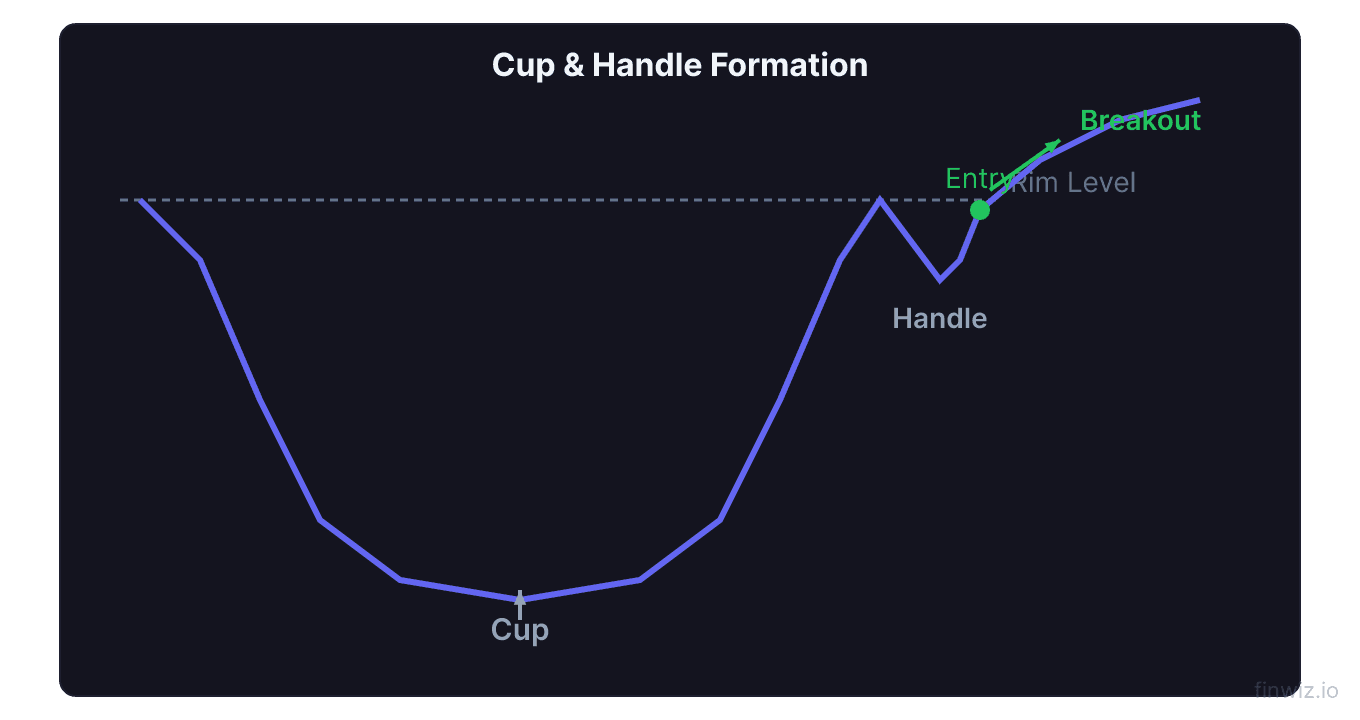
The pattern resembles a tea cup when viewed on a chart. A rounded decline and recovery forms the cup, followed by a short, shallow pullback that forms the handle. When price breaks above the handle's resistance on strong volume, it triggers a buy signal with a clearly defined target and stop level.
This pattern works because it maps a natural market cycle: a stock rises, pulls back as early buyers take profits, gradually finds support as new buyers accumulate shares, recovers to its previous high, pauses briefly as remaining sellers exit, and then breaks out to new highs.
Structure of the Cup
The cup is the larger component of the pattern and typically takes several weeks to several months to form on a daily chart.
Shape and Depth
The ideal cup has a smooth, rounded bottom that resembles a "U" shape rather than a sharp "V" shape. A rounded bottom indicates gradual, orderly accumulation as selling pressure diminishes and buying interest slowly increases. A V-shaped bottom suggests a sharp reversal driven by a single event rather than the steady shift in supply and demand that produces lasting breakouts.
The depth of the cup should generally be between 15% and 35% of the prior advance. Cups that are too shallow (less than 10%) may not represent sufficient consolidation, while cups that are too deep (more than 50%) suggest the stock experienced serious selling pressure that may be difficult to overcome.
Volume During Cup Formation
Volume should be highest during the left side of the cup as the stock declines from its prior high. As the cup bottoms and the right side forms, volume should gradually decrease, indicating that selling pressure is drying up. The right side of the cup often shows increasing volume as the stock approaches the prior high, reflecting growing buyer enthusiasm.
Pro Tip
Structure of the Handle
The handle is the final consolidation before the breakout. It forms after the right side of the cup reaches or approaches the level of the prior high (the left rim of the cup).
Handle Characteristics
The handle should be a relatively short, shallow pullback. Ideally, the handle retraces between one-third and one-half of the cup's depth. Handles that retrace more than 50% of the cup depth suggest excessive selling pressure and reduce the pattern's reliability.
The handle should slope slightly downward or move sideways. A handle that drifts upward is less ideal because it shows buyers are too eager, potentially leading to a premature and unsustainable breakout. The downward drift shakes out weak hands and nervous holders, setting up a cleaner breakout.
Handle Duration
The handle typically lasts between one and four weeks on a daily chart, though it can be shorter or longer. A handle that takes too long to form may allow the stock to lose the momentum built during the cup recovery. Handles that are too brief may not provide sufficient consolidation for a powerful breakout.
Volume During Handle Formation
Volume should contract noticeably during the handle formation. This drying up of volume indicates that selling pressure is exhausted and that the remaining holders are committed to their positions. This volume contraction sets the stage for a volume expansion on the breakout.
The Breakout
The breakout is the moment when price moves above the handle's resistance, confirming the pattern and triggering the buy signal.
Identifying the Breakout Level
The breakout level is defined by the highest point of the handle, which is typically close to the prior high (the left rim of the cup). Draw a horizontal line across this level. When price closes above this line, the breakout is confirmed.
Volume on the Breakout
This is where volume becomes absolutely critical. The breakout should occur on volume that is at least 40-50% above the stock's average daily volume. Ideally, volume on the breakout day should be the highest volume in several weeks or more. A breakout on weak volume is a red flag and often leads to a failed move.
Entry Strategies
Standard entry: Buy when price closes above the handle's resistance on strong volume. This is the most common approach and offers a good balance of confirmation and reward.
Anticipation entry: Some aggressive traders buy within the handle as volume contracts, anticipating the breakout. This approach offers better prices but carries the risk that the breakout never materializes.
Pullback entry: After a valid breakout, price sometimes pulls back to test the breakout level as support. Buying on this retest can provide an excellent entry with a tight stop, though not every breakout offers a pullback opportunity.
Measuring the Price Target
The cup and handle provides a built-in method for estimating the minimum price target after the breakout.
Price Target = Breakout Point + Cup DepthMeasure the distance from the bottom of the cup to the rim (the prior high). Add that distance to the breakout price. This gives you the measured move target.
For example, if a stock's cup bottom is at $80 and the rim is at $100, the cup depth is $20. If the breakout occurs at $100, the target is $100 + $20 = $120. This target represents the minimum expected advance; strong breakouts in trending markets often exceed the measured move.
| Component | Ideal Characteristics |
|---|---|
| Cup Shape | Rounded "U" shape, not "V" |
| Cup Depth | 15-35% of prior advance |
| Cup Duration | 6 weeks to 6 months |
| Handle Depth | 30-50% of cup depth |
| Handle Duration | 1-4 weeks |
| Handle Slope | Slight downward drift |
| Breakout Volume | 40-50%+ above average |
Stop Loss Placement
Proper risk management requires clearly defined stop levels.
The most common stop loss location is below the lowest point of the handle. This makes logical sense because if price drops below the handle low, the consolidation has failed and the breakout thesis is invalidated.
A tighter stop can be placed just below the breakout level after a confirmed breakout. This reduces risk per share but increases the chance of being stopped out by normal volatility. The choice depends on your risk tolerance and the stock's typical price fluctuations.
For position sizing, calculate the dollar distance between your entry price and your stop loss, then determine how many shares you can buy while keeping your total risk within 1-2% of your trading account value.
Common Mistakes When Trading the Cup and Handle
Even experienced traders make errors with this pattern. Here are the most frequent mistakes and how to avoid them.
Buying before the breakout. Impatient traders often buy during the handle formation, anticipating the breakout. While this can work, it exposes you to the risk of a failed pattern. The handle could break down instead of breaking out. Waiting for confirmation is generally the wiser approach.
Ignoring volume. A breakout on weak volume is one of the most common reasons cup and handle trades fail. Volume is the fuel that drives breakouts. Without it, the move lacks conviction and is likely to reverse. Always verify that breakout volume is significantly above average.
Trading cups with V-shaped bottoms. Sharp V-shaped recoveries do not provide the same gradual accumulation base as rounded bottoms. While V-shaped formations can sometimes produce successful breakouts, the failure rate is noticeably higher than for properly rounded cups.
Buying overextended breakouts. If you miss the initial breakout, do not chase the stock after it has already moved 5-10% above the breakout point. Wait for a pullback to the breakout level, or look for the next pattern setup.
Pro Tip
Cup and Handle Variations
Several variations of the standard cup and handle appear in the markets.
Cup Without Handle
Sometimes the cup forms and breaks out directly without forming a handle. While this is a valid pattern, it lacks the final consolidation phase that tightens the price action. Breakouts without handles can work but may be more prone to immediate pullbacks because there was no handle to shake out weak holders.
High Handle
A high handle forms when the handle pulls back only slightly from the cup's right rim, barely retracing any of the cup's depth. This pattern is often seen in the strongest stocks and indicates that demand is so strong that sellers cannot push the price down even during the consolidation phase.
Multi-Year Cup and Handle
On weekly or monthly charts, cup and handle patterns can span years. These massive formations produce some of the most significant breakouts in the stock market. When a stock consolidates for years in a cup shape and then breaks out, the resulting advance can be hundreds of percent.
Combining with Other Analysis
The cup and handle pattern works best when confirmed by additional analysis tools.
Check the stock's relative strength compared to the broader market. Stocks that show the cup and handle pattern while outperforming the S&P 500 during the handle formation are more likely to produce successful breakouts.
Examine moving averages. The best breakouts occur when the stock is trading above its 50-day and 200-day moving averages. The 50-day moving average often acts as dynamic support during the handle formation, adding a confluence of support.
Review the stock's fundamentals. Cup and handle breakouts are most powerful in stocks with accelerating earnings growth, increasing revenue, and expanding margins. The combination of a strong technical setup with strong fundamentals creates the conditions for significant price advances.
Look for sector strength. When multiple stocks in the same sector are forming cup and handle patterns simultaneously, it suggests broad institutional interest in the group, increasing the odds of individual breakouts succeeding.
Cup and Handle in Different Markets
While the cup and handle was originally developed for stock analysis, it appears in other markets as well.
In forex markets, the pattern forms on various timeframes but lacks the gap dynamics seen in stocks. Currency pairs can form valid cups and handles, particularly on the 4-hour and daily charts. Volume analysis in forex requires using tick volume as a proxy since centralized volume data is not available.
In cryptocurrency markets, cup and handle patterns are common due to the extreme volatility and trending nature of digital assets. Crypto traders should be aware that the higher volatility means handles can be deeper and more erratic while still remaining valid.
In commodity markets and futures, the pattern works well, particularly in trending environments. Gold, silver, and oil frequently form cup and handle patterns on the weekly chart during major bull markets.
Frequently Asked Questions
How long does a cup and handle pattern take to form?
On a daily chart, the cup typically takes 6 weeks to 6 months to form, while the handle takes 1 to 4 weeks. The entire pattern from the left rim to the breakout can range from about 7 weeks to over 6 months. On weekly charts, the pattern can take much longer, sometimes spanning a year or more. Shorter timeframes produce faster-forming patterns, but they are generally less reliable. The most powerful cup and handle breakouts tend to come from patterns that took at least 2-3 months to form, as this indicates thorough consolidation.
What is the success rate of the cup and handle pattern?
Research suggests that well-formed cup and handle patterns have a success rate of approximately 60-65% when properly confirmed with volume. However, the success rate varies significantly based on market conditions, the quality of the formation, and the trader's entry and exit discipline. In strong bull markets, the success rate is higher, while in choppy or bearish markets, the failure rate increases. The key to improving your success rate is strict adherence to the pattern's rules, particularly the volume confirmation on breakout.
Can the cup and handle be a bearish pattern?
The standard cup and handle is exclusively a bullish continuation pattern. However, an inverted cup and handle (a rounded top followed by a small upward handle) can serve as a bearish pattern, signaling a breakdown. This inverted version is less commonly discussed in trading literature and is generally considered less reliable than its bullish counterpart. If you see a rounded top forming, you may also want to evaluate it as a potential head and shoulders or double top pattern.
What makes a cup and handle pattern fail?
Cup and handle patterns fail for several common reasons: the breakout occurs on insufficient volume, the handle retraces too deeply into the cup, the overall market turns bearish during the breakout attempt, or the stock has weakening fundamentals. A breakout that occurs on volume less than 40% above average is particularly prone to failure. The stock can also fail if it encounters overhead resistance from a prior significant price level just above the breakout point. Always use a stop loss below the handle low to protect against failed patterns.
Disclaimer
This is educational content, not financial advice. Trading involves risk, and you should consult a qualified financial advisor before making any investment decisions. Past performance does not guarantee future results.
Related Articles
12 chapters covering charts, indicators, risk management & more. Plus weekly trading insights.