
Hull Moving Average (HMA): Faster Signals, Less Lag
⚡ Key Takeaways
- The Hull Moving Average (HMA) was developed by Alan Hull to dramatically reduce the lag inherent in traditional moving averages while maintaining a smooth curve.
- The HMA uses a combination of Weighted Moving Averages (WMAs) of different periods and a square root transformation to achieve its speed: HMA = WMA(2 x WMA(n/2) - WMA(n), period = sqrt(n)).
- Compared to the EMA and SMA of the same period, the HMA turns direction significantly sooner, often capturing trend changes days earlier.
- The most common HMA periods are 9, 16, and 25, though the choice depends on your trading timeframe and the asset's volatility.
- The HMA's responsiveness makes it excellent for trend identification and crossover systems, but it can produce more whipsaw signals in choppy, range-bound markets.
What Is the Hull Moving Average?
The Hull Moving Average (HMA) is a technical indicator created by Australian mathematician and trader Alan Hull in 2005. Hull designed the HMA to solve the fundamental trade-off that plagues all moving averages: the tension between smoothness and responsiveness. Traditional moving averages like the SMA and EMA must sacrifice speed to achieve smoothness, or sacrifice smoothness to achieve speed. The HMA attempts to deliver both.
The result is a moving average that turns direction faster than the EMA while producing a smoother curve than most short-period moving averages. For traders who rely on moving average signals for entry and exit timing, the HMA can shave several candles off the delay between a trend reversal and the indicator's response — a meaningful advantage in fast-moving markets.
The HMA achieves this by combining multiple Weighted Moving Averages (WMAs) in a specific formula that effectively "overshoots" the current price trend to compensate for the inherent lag.
The HMA Formula
Alan Hull's formula uses three steps to construct the HMA.
Step 1: Calculate WMA with period n/2Why This Formula Works
The formula's elegance lies in its use of difference and smoothing.
Step 1 and Step 2 calculate two WMAs — one fast (half-period) and one slow (full-period). The fast WMA tracks price more closely, while the slow WMA lags behind.
The subtraction (2 x WMA_half - WMA_full) is the critical innovation. By taking twice the fast WMA and subtracting the slow WMA, Hull creates a value that overshoots the current price slightly. This overshoot compensates for the lag that would otherwise exist. The logic is similar to how a navigator might aim ahead of a moving target.
The final WMA with period sqrt(n) smooths the raw overshooting value. Using the square root of the original period as the smoothing length keeps the final result smooth without reintroducing significant lag. The square root relationship ensures that longer periods still produce manageable smoothing lengths.
Pro Tip
Step-by-Step Example: 16-Period HMA
Using a 16-period HMA:
- Calculate the 8-period WMA (n/2 = 16/2 = 8) of closing prices.
- Calculate the 16-period WMA (n = 16) of closing prices.
- Compute the raw value: 2 x WMA(8) - WMA(16).
- Calculate the 4-period WMA (sqrt(16) = 4) of the raw values from Step 3.
The result is the 16-period Hull Moving Average. Notice that the final smoothing uses only a 4-period WMA — much shorter than the original 16-period input. This short smoothing period is what allows the HMA to maintain its speed advantage.
HMA vs. EMA: A Direct Comparison
The EMA is the most widely used weighted moving average, featured in indicators like MACD and as the default moving average on most platforms. How does the HMA compare?
| Characteristic | HMA | EMA |
|---|---|---|
| Lag | Very low | Low (but higher than HMA) |
| Smoothness | Smooth | Smooth |
| Turn speed | Fastest among popular MAs | Moderate |
| Overshoot tendency | Slight | None |
| Whipsaw frequency | Higher in ranges | Moderate |
| Popularity | Niche | Very widely used |
| Built into standard indicators | Rarely | MACD, Bollinger Bands, etc. |
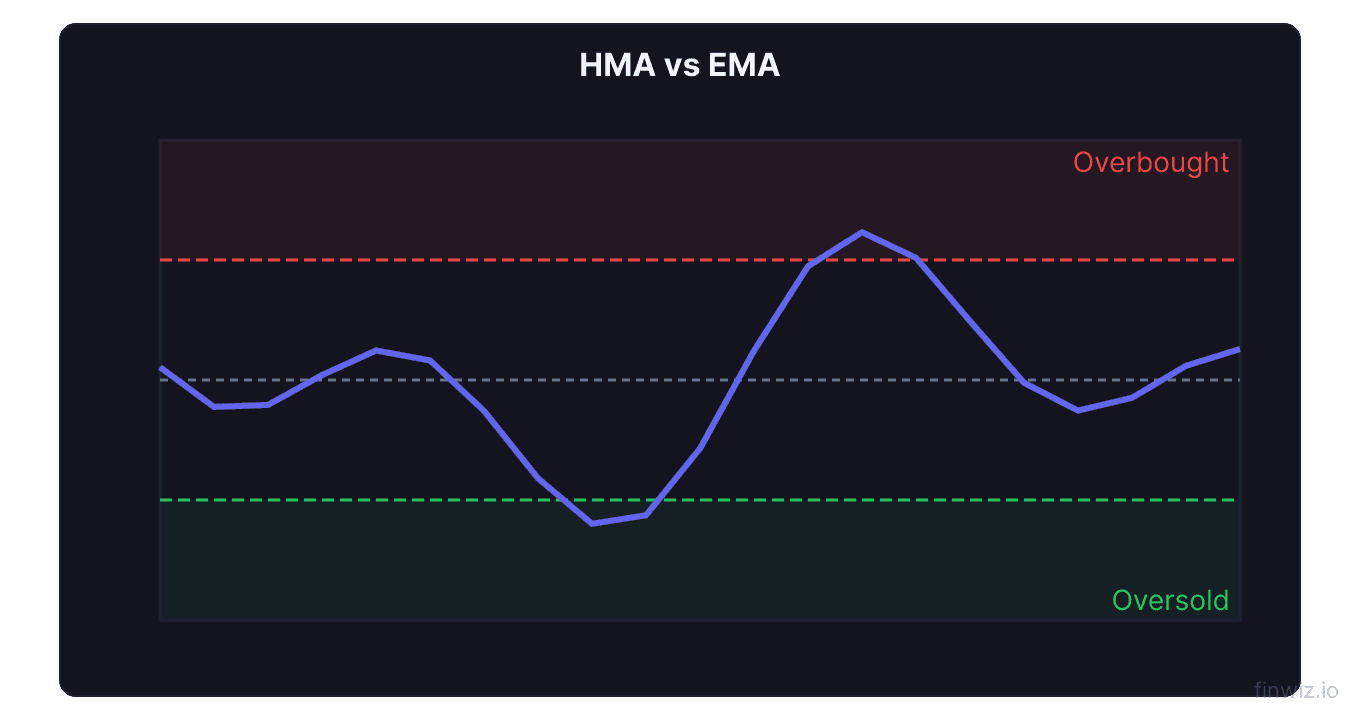
In trending markets, the HMA's advantage is clear. When a stock transitions from an uptrend to a downtrend, the HMA will turn downward several bars before the EMA. This earlier signal allows traders to exit long positions sooner and potentially enter short positions earlier.
In range-bound markets, the HMA's speed becomes a liability. It generates more frequent direction changes, producing false signals that lead to whipsaw losses. This is the fundamental trade-off — the same responsiveness that catches real trend changes also catches noise during consolidation.
Practical Comparison
Consider a stock that drops sharply after a sustained uptrend. On a daily chart:
- The 20-period SMA might not turn downward for 8-10 days after the reversal begins.
- The 20-period EMA might turn downward in 5-7 days.
- The 16-period HMA might turn downward in 2-4 days.
Those extra days matter. In a fast-moving decline, the difference between exiting on day 3 and day 8 can be significant in dollar terms.
Common HMA Settings
| Period | sqrt(n) | Best Timeframe | Use Case |
|---|---|---|---|
| 9 | 3 | Intraday, daily | Fast signals, scalping, short-term swing |
| 16 | 4 | Daily | Most popular all-purpose setting |
| 25 | 5 | Daily, weekly | Medium-term trend following |
| 36 | 6 | Weekly | Longer-term trend identification |
| 49 | 7 | Weekly, monthly | Position trading, major trend direction |
The 16-period HMA is the most commonly referenced setting and a good starting point for daily chart analysis. It provides a responsive trend line that works well for swing trading entries and exits.
The 9-period HMA is popular among day traders on 5-minute and 15-minute charts. Its extreme responsiveness suits the fast decision-making required in intraday trading.
For weekly charts and longer-term analysis, the 25-period or 36-period HMA provides trend identification without excessive noise.
Pro Tip
Trading Strategies with the HMA
HMA Direction as Trend Filter
The simplest use of the HMA is as a trend direction indicator. When the HMA is rising, the trend is bullish — only look for long entries. When the HMA is falling, the trend is bearish — only look for short entries or stay in cash.
This directional filter can be applied to any strategy:
- Only take RSI oversold signals when the HMA is rising
- Only take MACD bullish crossovers when the HMA is rising
- Only buy pullbacks to support when the HMA is rising
HMA Color Change System
Many charting platforms display the HMA with color coding — green when rising and red when falling. Some traders use the color change as a direct entry and exit signal:
- Enter long when the HMA changes from red to green (turns upward)
- Exit long and enter short when the HMA changes from green to red (turns downward)
This is a pure trend-following system. It catches major moves but produces losses during extended consolidation periods. Filtering with the ADX indicator — only taking HMA signals when ADX is above 20-25 — significantly reduces false signals.
Dual HMA Crossover
Use two HMAs of different periods to generate crossover signals:
- Bullish crossover: Fast HMA (e.g., 9-period) crosses above slow HMA (e.g., 25-period)
- Bearish crossover: Fast HMA crosses below slow HMA
This is analogous to the golden cross and death cross concepts but with dramatically reduced lag. HMA crossovers will trigger days or even weeks before equivalent SMA crossovers.
HMA as Dynamic Support/Resistance
In strong trends, price tends to bounce off the HMA. During uptrends, the HMA acts as dynamic support — pullbacks to the HMA often present buying opportunities. During downtrends, rallies to the HMA often fail, making it dynamic resistance.
Combine HMA bounces with candlestick patterns for higher-probability entries. A hammer candlestick forming right at a rising HMA is a strong bullish signal. A shooting star at a falling HMA is a strong bearish signal.
Limitations of the HMA
Overshoot. The HMA's formula intentionally overshoots price to reduce lag. In some cases, this overshoot can position the HMA slightly beyond the current price, creating a misleading impression of where support or resistance lies.
Whipsaw in ranges. The HMA's greatest weakness is choppy, range-bound markets. Its quick direction changes generate frequent false signals in environments where price is oscillating without trending. Always confirm HMA signals with a trend-strength indicator like ADX.
Less community support. The HMA is not as widely used as the SMA or EMA, meaning fewer published strategies, backtests, and educational resources are available. Most built-in platform indicators (MACD, Bollinger Bands) use the SMA or EMA, not the HMA.
Not a prediction tool. Like all moving averages, the HMA is a lagging indicator based on past prices. It follows price action rather than predicting it. Its reduced lag makes it closer to real-time than other MAs, but it still reacts to moves that have already begun.
Frequently Asked Questions
Is the Hull Moving Average better than the EMA?
The HMA is faster than the EMA at detecting trend changes, which is an advantage in trending markets. However, this speed comes at the cost of more false signals in range-bound conditions. Neither is universally better — the right choice depends on your trading style and the market environment.
What is the best period for the HMA?
The 16-period HMA is the most commonly used setting for daily charts and serves as a good default. For intraday trading, try 9-period. For weekly charts, try 25 or 36-period. The ideal period depends on the asset's volatility and your trading timeframe.
Can I use the HMA in place of the SMA in Bollinger Bands?
Some platforms allow you to substitute the HMA for the SMA in Bollinger Bands. The result is bands that respond more quickly to volatility changes. However, this is a non-standard configuration that may produce different signal characteristics than traditional Bollinger Bands.
Does the HMA work on all timeframes?
Yes, the HMA works on any timeframe — from 1-minute intraday charts to monthly charts. However, its lag-reduction advantage is most noticeable on daily and intraday timeframes where a few bars of earlier signal detection translates to meaningful price difference. On monthly charts, the lag difference between the HMA and EMA is less significant.
Why is the square root used in the HMA formula?
The square root creates a proportional relationship between the lookback period and the final smoothing period. Using sqrt(n) ensures that as you increase the HMA period, the smoothing step grows sub-linearly — keeping the final output smooth without reintroducing too much lag. It is an elegant mathematical solution to the smoothness-responsiveness trade-off.
Can the HMA be used for automated trading systems?
Yes. The HMA's mathematically precise formula makes it straightforward to code into algorithmic trading systems. Its clear direction changes (rising vs. falling) provide unambiguous signals. However, any automated HMA system should include a filter for market regime (trending vs. ranging) to avoid excessive whipsaw trades.
Disclaimer
This is educational content, not financial advice. Trading involves risk, and you should consult a qualified financial advisor before making any investment decisions. Past performance does not guarantee future results.
Related Articles
12 chapters covering charts, indicators, risk management & more. Plus weekly trading insights.