
EMA: Exponential Moving Average Explained
⚡ Key Takeaways
- The Exponential Moving Average (EMA) gives more weight to recent prices, making it more responsive to new information than the Simple Moving Average (SMA)
- The EMA multiplier formula is 2 / (period + 1), giving a 20-period EMA a multiplier of 0.0952 (9.52% weight on the latest price)
- Common EMA periods are 9, 20, 50, and 200 — shorter periods react faster while longer periods identify major trends
- The 9/20 EMA crossover is a popular short-term trading signal: bullish when the 9 EMA crosses above the 20 EMA, bearish when it crosses below
- EMA crossovers combined with volume confirmation and trend filters like ADX produce more reliable signals than crossovers alone
What Is the Exponential Moving Average (EMA)?
The Exponential Moving Average (EMA) is a type of moving average that places greater weight on the most recent price data, making it more responsive to new price changes than the Simple Moving Average (SMA). While an SMA calculates a straight average of prices over a specified number of periods, the EMA applies a multiplier that exponentially decreases the weight of older data points. This weighting mechanism allows the EMA to react faster to price reversals and new trends, which is why it is the preferred moving average among active traders and short-term market participants.
The EMA is one of the most widely used technical indicators in stock, forex, and cryptocurrency trading. It serves as dynamic support and resistance, generates crossover signals, and helps traders identify trend direction and strength. Understanding how to calculate, interpret, and combine EMAs is fundamental to technical analysis.
The EMA Formula Explained
The EMA calculation has two components: the multiplier (also called the smoothing factor or weighting factor) and the recursive formula that applies it.
Step 1 — Calculate the Multiplier:The multiplier determines how much weight the latest price receives. A shorter period produces a larger multiplier, giving more weight to the latest price and making the EMA more responsive. A longer period produces a smaller multiplier, smoothing the line and making it more stable.
| EMA Period | Multiplier | Weight on Latest Price | Responsiveness |
|---|---|---|---|
| 9 | 2/10 = 0.2000 | 20.0% | Very responsive |
| 12 | 2/13 = 0.1538 | 15.4% | Responsive |
| 20 | 2/21 = 0.0952 | 9.5% | Moderate |
| 50 | 2/51 = 0.0392 | 3.9% | Slow |
| 200 | 2/201 = 0.00995 | 1.0% | Very slow |
Step-by-Step EMA Calculation
Let's walk through a complete EMA calculation using a 5-period EMA to keep the math manageable.
Starting data (closing prices):
| Day | Closing Price |
|---|---|
| 1 | $100.00 |
| 2 | $102.00 |
| 3 | $101.50 |
| 4 | $103.00 |
| 5 | $104.00 |
| 6 | $103.50 |
| 7 | $105.00 |
Step 1: Calculate the multiplier for a 5-period EMA.
Multiplier = 2 / (5 + 1) = 2 / 6 = 0.3333Step 2: The first EMA value (Day 5) is the simple average of the first 5 periods.
SMA for Days 1-5 = ($100 + $102 + $101.50 + $103 + $104) / 5 = $102.10
Step 3: Apply the EMA formula for each subsequent day.
Day 6: EMA = ($103.50 x 0.3333) + ($102.10 x 0.6667) = $34.50 + $68.07 = $102.57
Day 7: EMA = ($105.00 x 0.3333) + ($102.57 x 0.6667) = $35.00 + $68.38 = $103.38
Notice how the EMA on Day 7 ($103.38) is closer to the current price ($105.00) than the 5-period SMA for Days 3-7 would be ($103.40). This demonstrates the EMA's core characteristic: it responds more quickly to recent price changes.
EMA vs. SMA: Key Differences
Understanding when to use an EMA versus an SMA helps you select the right tool for your trading approach.
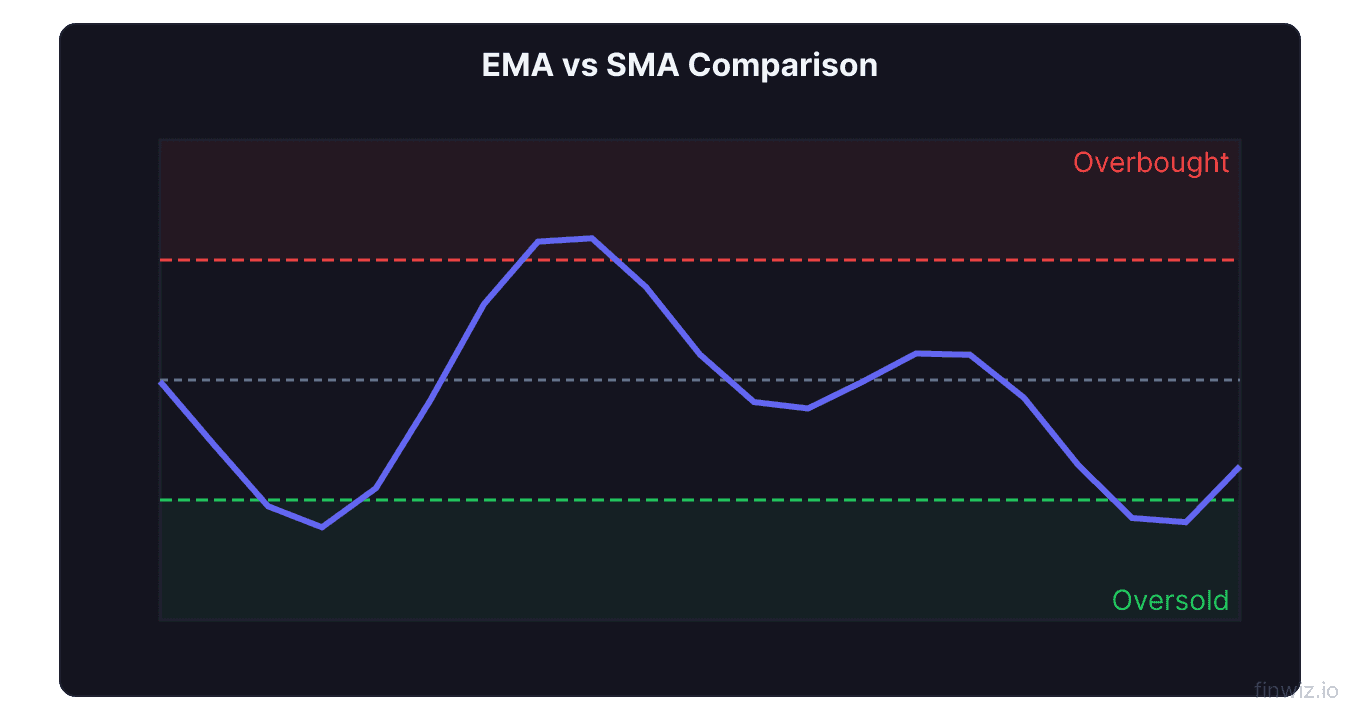
| Feature | EMA | SMA |
|---|---|---|
| Weighting | Exponentially weighted toward recent data | Equal weight to all data points |
| Responsiveness | Faster reaction to price changes | Slower, smoother reaction |
| Whipsaw risk | Higher (reacts to noise) | Lower (filters noise) |
| Lag | Less lag | More lag |
| Best for | Active trading, short-term signals | Trend identification, support/resistance |
| Popular periods | 9, 12, 20, 50 | 20, 50, 100, 200 |
Use EMA when you need faster signals and are willing to accept more false signals (whipsaws) in exchange for earlier entries and exits. Day traders and short-term swing traders typically prefer EMAs.
Use SMA when you want smoother, more reliable signals and can tolerate later entries. The 200-day SMA is the most widely watched moving average in investing and serves as the dividing line between bull and bear markets for many institutional investors.
Pro Tip
Common EMA Periods and Their Uses
Each EMA period serves a different purpose in technical analysis.
9-period EMA is the fastest commonly used EMA. It hugs price closely and is favored by day traders and short-term momentum traders for capturing quick moves. On daily charts, it represents roughly two weeks of trading data. The 9 EMA is also used in the MACD calculation (fast line).
20-period EMA represents approximately one month of trading data on daily charts. It is the most popular EMA for swing traders, serving as dynamic support in uptrends and resistance in downtrends. Many traders consider a stock "healthy" in an uptrend as long as it holds above the 20 EMA on pullbacks.
50-period EMA captures roughly one quarter of trading data. It identifies intermediate-term trends and is often the last line of defense before a trend is considered broken. Institutional traders watch the 50 EMA closely for re-entry points during corrections within larger uptrends.
200-period EMA tracks nearly one year of data and identifies the long-term trend. Stocks trading above the 200 EMA are generally considered in a bullish long-term trend, while stocks below it are in a bearish trend. The 200 EMA is widely followed by institutional investors and fund managers.
| Period | Timeframe Focus | Typical Use | Trader Profile |
|---|---|---|---|
| 9 | Very short-term | Quick momentum signals, scalping | Day traders |
| 20 | Short-term | Swing trade entries, dynamic support | Swing traders |
| 50 | Intermediate | Trend health, institutional support | Position traders |
| 200 | Long-term | Bull/bear market definition | Investors, institutions |
The 9/20 EMA Crossover Strategy
The 9/20 EMA crossover is one of the most popular short-term trading signals. It uses the intersection of the fast 9-period EMA and the slower 20-period EMA to generate buy and sell signals.
Bullish signal (Golden Cross): The 9 EMA crosses above the 20 EMA, indicating that short-term momentum is turning positive and the stock may be starting an uptrend. Traders enter long positions when this crossover occurs, especially if confirmed by rising volume.
Bearish signal (Death Cross): The 9 EMA crosses below the 20 EMA, signaling that short-term momentum is fading and the stock may be entering a downtrend. Traders exit long positions or enter short positions on this crossover.
Example with Tesla (TSLA): In early 2024, TSLA's daily 9 EMA crossed above the 20 EMA near $180, triggering a bullish signal. Traders who entered on the crossover with a stop-loss below the 20 EMA at $175 captured a move to $200 over the following weeks. When the 9 EMA later crossed back below the 20 EMA near $195, the exit signal preserved the bulk of the gain.
Improving crossover reliability:
- Volume confirmation: Only take crossovers accompanied by above-average volume. Low-volume crossovers are more likely to be false signals.
- ADX filter: Only trade crossovers when the ADX is above 20-25, confirming a trending environment. Crossovers in range-bound markets (low ADX) produce frequent whipsaws.
- Higher timeframe alignment: Only take bullish 9/20 crossovers when the stock is above the 50 EMA or 200 EMA. This ensures you are trading in the direction of the larger trend.
EMA Crossover Strategies
Beyond the 9/20, several EMA crossover combinations are widely used.
12/26 EMA crossover is the basis of the MACD indicator. When the 12 EMA crosses above the 26 EMA, MACD turns positive (bullish). When the 12 crosses below the 26, MACD turns negative (bearish). Traders who prefer to watch the raw EMAs rather than the MACD histogram can apply these directly on the price chart.
50/200 EMA crossover generates longer-term signals. The bullish 50/200 crossover is called the Golden Cross and has historically preceded significant bull runs. The bearish 50/200 crossover is called the Death Cross and has preceded major declines. These signals are slow but carry significant weight among institutional investors.
| Crossover Pair | Signal Speed | Best Timeframe | Whipsaw Risk |
|---|---|---|---|
| 9/20 EMA | Fast | Daily, 1-hour | Higher |
| 12/26 EMA | Moderate | Daily, 4-hour | Moderate |
| 20/50 EMA | Slower | Daily, weekly | Lower |
| 50/200 EMA | Very slow | Daily, weekly | Lowest |
Using EMA as Dynamic Support and Resistance
Beyond crossover signals, EMAs serve as dynamic support and resistance levels that move with price.
In a strong uptrend, price frequently pulls back to the 20 EMA or 50 EMA before bouncing higher. These pullbacks to the EMA represent opportunities to enter in the direction of the trend at a favorable price. The key is to wait for the stock to touch or slightly penetrate the EMA and then show a reversal candle (such as a doji or hammer) before entering.
In a downtrend, rallies often stall at the 20 EMA or 50 EMA before turning lower. Short sellers and put buyers watch for price to reach these levels and show rejection (such as a shooting star candle) before entering bearish positions.
The EMA stack provides additional context. When the 9 EMA is above the 20 EMA, which is above the 50 EMA, which is above the 200 EMA — all moving averages are stacked in bullish order. This alignment indicates a strong, healthy uptrend. When the order is reversed (9 below 20 below 50 below 200), the downtrend is firmly entrenched. Mixed or tangled EMAs suggest a trendless, choppy market best avoided.
Pro Tip
EMA on Different Chart Timeframes
EMAs can be applied to any chart timeframe, and the interpretation remains consistent.
On intraday charts (1-minute to 15-minute), the 9 and 20 EMAs are staples for day traders. The VWAP often takes precedence as the primary trend indicator intraday, but EMAs provide supplementary support/resistance and crossover signals.
On daily charts, the 20, 50, and 200 EMAs are the most significant levels. Daily EMA analysis is the backbone of swing trading and position trading.
On weekly charts, EMAs smooth out daily noise and identify major trend shifts. The 10-week EMA (equivalent to the 50-day EMA) and the 40-week EMA (equivalent to the 200-day EMA) are watched by institutional investors for allocation decisions.
Common EMA Mistakes
Using too many EMAs. Cluttering your chart with five or six EMAs creates confusion and conflicting signals. Stick to two or three EMAs that serve distinct purposes (e.g., one short-term, one intermediate, one long-term).
Trading crossovers in choppy markets. EMA crossovers generate numerous false signals when the market is range-bound. Filter crossovers with ADX or Bollinger Bands to confirm trending conditions before acting.
Ignoring the larger trend. Taking a bullish 9/20 EMA crossover on a daily chart while the stock is well below the 200-day EMA means you are trading against the major trend. The probability of success is significantly lower when shorter-term signals conflict with the dominant long-term trend.
Expecting precision. EMAs are guides, not exact levels. Price may overshoot an EMA by a few percent before reversing, or it may bounce before reaching the EMA. Use EMAs to identify zones of interest, not precise prices for limit orders.
Frequently Asked Questions
Which EMA period is best for day trading?
The 9 EMA and 20 EMA are the most popular for day trading, applied on 1-minute, 5-minute, or 15-minute charts. The 9 EMA provides fast signals for scalping, while the 20 EMA identifies the intraday trend. Many day traders use the 9/20 EMA crossover as their primary entry and exit signal, combined with VWAP for bias confirmation. The specific period matters less than consistency — pick a combination and learn how it behaves on your chosen instrument and timeframe.
Is EMA better than SMA?
Neither is universally better — they serve different purposes. The EMA is better for short-term trading because its faster response captures momentum shifts earlier. The SMA is better for identifying long-term trends and major support/resistance levels because its smoothness filters out noise. Most professional traders use both: EMAs for timing and SMAs for trend context. The 200-day SMA remains the gold standard for defining bull and bear markets, while the 9 and 20 EMAs are preferred for short-term signal generation.
How do you use the 200 EMA?
The 200 EMA serves as the long-term trend dividing line. Stocks trading above the 200 EMA are in a bullish long-term trend, and traders should prioritize long positions. Stocks below the 200 EMA are in a bearish trend, favoring short positions or cash. The 200 EMA also acts as major dynamic support in bull markets — significant pullbacks to the 200 EMA often represent buying opportunities if the level holds. A decisive break below the 200 EMA on heavy volume is a serious bearish signal that often precedes extended declines.
What does it mean when EMAs converge?
When multiple EMAs converge (come close together), it signals that the stock is in a consolidation phase and that a significant move may be imminent. Converging EMAs represent a compression of momentum across timeframes. Watch for a decisive separation (fanning out) of the EMAs after convergence — the direction of the fan-out often indicates the direction of the next major trend. Combining EMA convergence with a volume breakout and ADX rising above 25 provides strong confirmation of a new trend.
Can EMA be used for cryptocurrency trading?
Yes, EMAs are widely used in cryptocurrency markets. Due to crypto's 24/7 trading and higher volatility, many traders use slightly shorter EMA periods (8/21 instead of 9/20) to compensate for the extended trading hours. The 50 and 200 EMAs remain effective for identifying major trends in Bitcoin, Ethereum, and other large-cap cryptocurrencies. The same crossover and dynamic support/resistance principles apply, though crypto's higher volatility means wider stops are necessary to avoid being shaken out by normal price swings.
Disclaimer
This is educational content, not financial advice. Trading involves risk, and you should consult a qualified financial advisor before making any investment decisions. Past performance does not guarantee future results.
Related Articles
12 chapters covering charts, indicators, risk management & more. Plus weekly trading insights.