
WMA: Weighted Moving Average Explained
⚡ Key Takeaways
- The Weighted Moving Average (WMA) assigns greater weight to recent prices and less weight to older prices, making it more responsive to current price action than the Simple Moving Average (SMA).
- Each data point is multiplied by a linearly decreasing weight — the most recent price gets the highest weight, and the oldest gets the lowest.
- The WMA reduces the lag inherent in the SMA while avoiding the complexity of exponential smoothing used by the EMA.
- WMA is preferred by traders who want a balance between the SMA's smoothness and the EMA's responsiveness, particularly for short-term trend identification.
- Common WMA periods include 10, 20, and 50, with shorter periods providing faster signals and longer periods providing smoother trend identification.
What Is the Weighted Moving Average?
The Weighted Moving Average (WMA) is a type of moving average that assigns linearly decreasing weights to each data point in the calculation period. The most recent price receives the highest weight, the second most recent receives the second highest, and so on, with the oldest price receiving the smallest weight. This weighting scheme ensures that the WMA reacts more quickly to recent price changes than the Simple Moving Average (SMA).
Moving averages are among the most fundamental tools in technical analysis, used to smooth out price noise and identify trends. The SMA treats all prices equally, which creates a lag because old prices have the same influence as current prices. The WMA addresses this weakness by systematically prioritizing recent data, producing a line that tracks current price action more closely.
For traders who find the SMA too slow and the EMA too reactive, the WMA offers a middle ground with transparent, intuitive math.
How the WMA Is Calculated
The WMA formula multiplies each price by a position-based weight, sums the results, and divides by the sum of the weights.
WMA = (P1 x n + P2 x (n-1) + P3 x (n-2) + ... + Pn x 1) / (n + (n-1) + (n-2) + ... + 1)The denominator — the sum of all weights — is calculated using the formula n x (n + 1) / 2. For a 5-period WMA, the sum of weights is 5 x 6 / 2 = 15. For a 10-period WMA, it is 10 x 11 / 2 = 55.
Step-by-Step Example: 5-Period WMA
Suppose the last five closing prices for a stock are:
| Day | Closing Price | Weight | Price x Weight |
|---|---|---|---|
| Day 5 (most recent) | $52.00 | 5 | $260.00 |
| Day 4 | $51.00 | 4 | $204.00 |
| Day 3 | $50.50 | 3 | $151.50 |
| Day 2 | $49.00 | 2 | $98.00 |
| Day 1 (oldest) | $48.00 | 1 | $48.00 |
| Totals | 15 | $761.50 |
5-Period WMA = $761.50 / 15 = $50.77Notice that the WMA ($50.77) is closer to the most recent price ($52.00) than the SMA ($50.10). This is the core advantage of the WMA — it is more responsive to the latest data because the most recent price contributes proportionally more to the average.
Pro Tip
WMA vs. SMA: When Equal Weights Fall Short
The Simple Moving Average gives equal weight to every price in the lookback period. In a 20-period SMA, the closing price from 20 days ago has exactly the same influence as today's closing price. This equal weighting creates a well-known problem: lag.
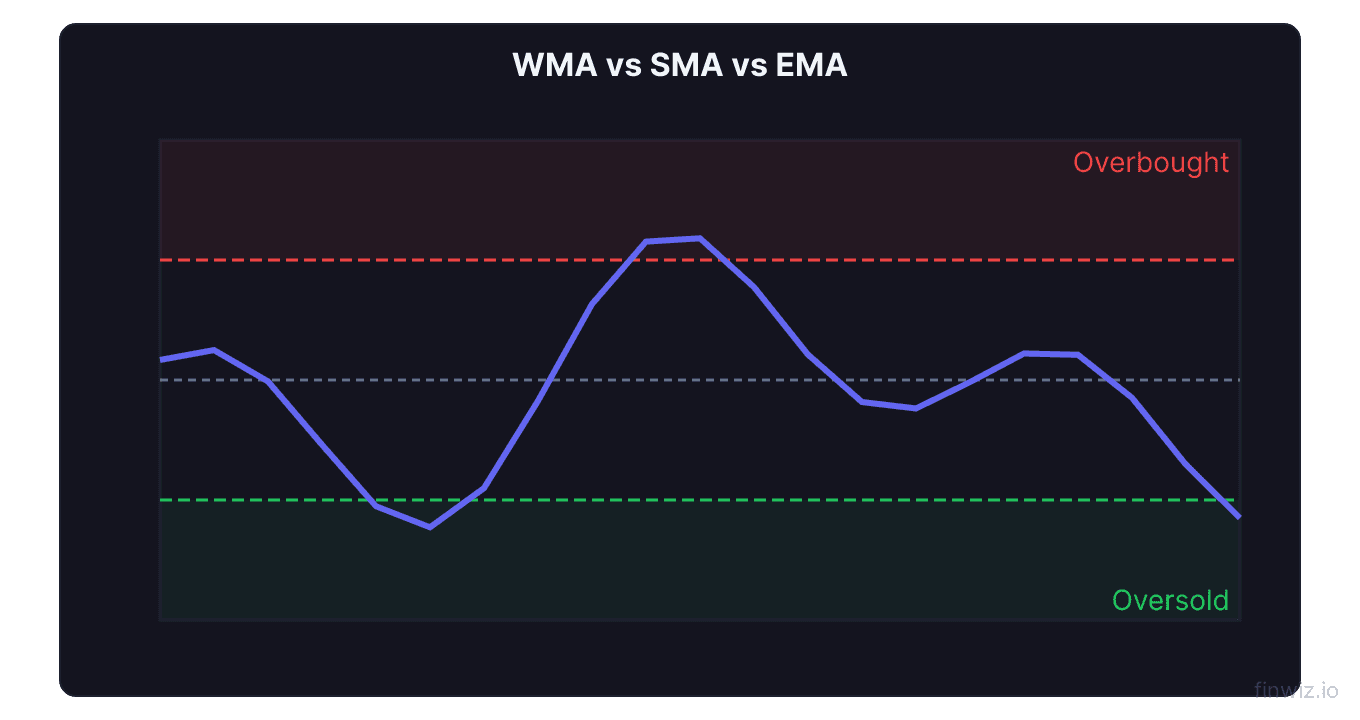
When a stock makes a sharp move, the SMA is slow to reflect the new price level because old prices drag the average toward the prior trend. The WMA mitigates this by ensuring that old prices have progressively less influence.
| Characteristic | SMA | WMA |
|---|---|---|
| Weight distribution | Equal across all periods | Linear: highest for recent, lowest for oldest |
| Lag | Higher | Lower |
| Smoothness | Smoother | Slightly less smooth |
| Responsiveness | Slower | Faster |
| Calculation complexity | Simple | Moderate |
| False signal frequency | Lower | Slightly higher |
The SMA remains useful for identifying long-term trends where lag is acceptable — the 200-day SMA is the classic long-term trend indicator. But for short-term trading where catching trend changes early matters, the WMA provides an advantage.
WMA vs. EMA: Two Approaches to Weighting
The Exponential Moving Average (EMA) also prioritizes recent prices, but it uses an exponential decay function rather than linear weights. This means the EMA assigns a specific percentage weight to the most recent price and applies an exponentially decreasing weight to all prior prices.
| Characteristic | WMA | EMA |
|---|---|---|
| Weighting method | Linear decrease | Exponential decay |
| Recent price emphasis | Moderate | Higher |
| Influence of old data | Drops to zero after n periods | Never fully drops to zero |
| Lag | Low | Lower |
| Smoothness | Moderate | Moderate |
| Popularity | Less common | Very common |
The EMA is more popular than the WMA because it is the default moving average type in most popular indicators like MACD and because the exponential weighting provides even faster response to price changes. However, the WMA has a distinct advantage: transparency. The linear weights are intuitive and easy to understand, and old data is completely excluded after n periods. The EMA technically never fully drops old data — it just makes it infinitesimally small.
Some traders prefer the WMA specifically because it provides a cleaner cutoff. A 20-period WMA uses exactly the last 20 data points and nothing else. A 20-period EMA technically incorporates all historical data, though the influence of data beyond 20 periods is negligible.
When to Use the WMA
Short-Term Trend Identification
The WMA excels at identifying short-term trend changes. A 10-period or 20-period WMA on a daily chart will turn higher or lower sooner than the equivalent SMA when a trend shift occurs. This early signal allows traders to enter trends closer to the start of the move.
Dynamic Support and Resistance
Like all moving averages, the WMA can act as dynamic support and resistance. In uptrends, price tends to bounce off the WMA from above. In downtrends, price tends to find resistance at the WMA. The WMA's closer tracking of price makes it a tighter support/resistance level than the SMA.
Crossover Signals
WMA crossovers work similarly to SMA and EMA crossovers:
- Bullish crossover: A shorter-period WMA (e.g., 10-period) crosses above a longer-period WMA (e.g., 50-period), signaling upward momentum.
- Bearish crossover: A shorter-period WMA crosses below a longer-period WMA, signaling downward momentum.
These crossovers can be filtered with the ADX indicator to ensure the trend has strength behind it, reducing false signals in choppy markets.
Combining with Other Indicators
The WMA works well in combination with other technical tools:
- WMA + RSI: Use the WMA for trend direction and RSI for overbought/oversold conditions. Enter long when price is above a rising WMA and RSI pulls back to 40-50 (not overbought).
- WMA + Bollinger Bands: Replace the SMA in Bollinger Bands with a WMA for bands that respond faster to volatility changes.
- WMA + Volume: Confirm WMA crossover signals with above-average volume to filter out false signals.
Pro Tip
Common WMA Settings
| Period | Timeframe | Use Case |
|---|---|---|
| 5-10 | Intraday | Scalping, very short-term momentum |
| 10-20 | Daily | Short-term swing trading, entry timing |
| 20-50 | Daily | Medium-term trend following |
| 50-100 | Daily/Weekly | Longer-term trend identification |
| 100-200 | Weekly | Major trend direction |
The most common WMA period is 20, which balances responsiveness and smoothness for daily chart analysis. For intraday day trading, 9 and 14-period WMAs on 5-minute and 15-minute charts are popular.
Limitations of the WMA
More false signals. The WMA's increased responsiveness is a double-edged sword. In choppy, range-bound markets, it generates more crossover signals that lead to losses. Use trend-strength filters like the ADX to avoid trading WMA signals in non-trending environments.
Less popular. Because the EMA is the industry standard for weighted moving averages, far fewer trading systems and strategies are built around the WMA. This means less community research, fewer published backtests, and less consensus around optimal settings.
Not a standalone system. Like all moving averages, the WMA is a lagging indicator. It follows price rather than predicting it. It should be used as one component of a broader trading strategy that includes price action, volume analysis, and risk management.
Frequently Asked Questions
Is the WMA better than the EMA?
Neither is objectively better — they serve slightly different purposes. The WMA uses linear weights and provides a clean cutoff at n periods, while the EMA uses exponential weights and theoretically considers all historical data. The EMA is more responsive and more widely used. The WMA is more transparent and easier to understand. Test both on your specific strategy to determine which produces better results.
What is the best WMA period for day trading?
For intraday trading, 9 to 14-period WMAs on 5-minute or 15-minute charts are popular. These periods provide fast enough response to capture intraday trends while filtering out some noise. The optimal period depends on the volatility of the instrument and your holding period.
Can I use the WMA for long-term investing?
While you can use the WMA for longer-term analysis, most long-term investors prefer the SMA or EMA for periods of 50 days or more. The WMA's responsiveness advantage diminishes at longer periods because the difference between linear and equal weighting becomes less pronounced when spread across many data points.
How does the WMA handle gaps?
The WMA handles price gaps the same way as other moving averages — the gap is incorporated into the average. Because the WMA gives higher weight to the most recent data, a large gap will influence the WMA more immediately than it would influence the SMA of the same period.
Is the Hull Moving Average based on the WMA?
Yes. The Hull Moving Average (HMA) uses WMAs in its calculation. It combines multiple WMAs of different periods to further reduce lag while maintaining smoothness. The HMA is essentially an advanced derivative of the WMA concept.
Disclaimer
This is educational content, not financial advice. Trading involves risk, and you should consult a qualified financial advisor before making any investment decisions. Past performance does not guarantee future results.
Related Articles
12 chapters covering charts, indicators, risk management & more. Plus weekly trading insights.