
Options Greeks: Delta, Gamma, Theta & Vega Explained
⚡ Key Takeaways
- The options Greeks (delta, gamma, theta, vega, and rho) quantify how an option's price responds to changes in stock price, time, volatility, and interest rates, making them essential for managing options risk.
- Delta measures directional exposure per $1 stock move and doubles as a rough probability estimate of the option finishing in the money, while portfolio delta reveals your total directional risk across all positions.
- Theta (time decay) accelerates as expiration approaches and is the primary edge for option sellers, with the 30-45 day-to-expiration window offering the best balance of meaningful decay without extreme gamma risk.
- Gamma is the friend of option buyers and the enemy of option sellers: long gamma positions benefit from large moves as delta shifts favorably, while short gamma positions suffer as delta moves against them during big price swings.
- Vega measures sensitivity to implied volatility changes, making it critical to check IV rank before entering trades, as buying options when IV is high leaves you vulnerable to IV crush while selling when IV is elevated captures inflated premium.
What Are the Options Greeks?
The options Greeks are a set of risk measures that describe how an option's price responds to changes in various market factors. They are named after Greek letters (with one exception) and are essential tools for understanding, managing, and hedging options positions.
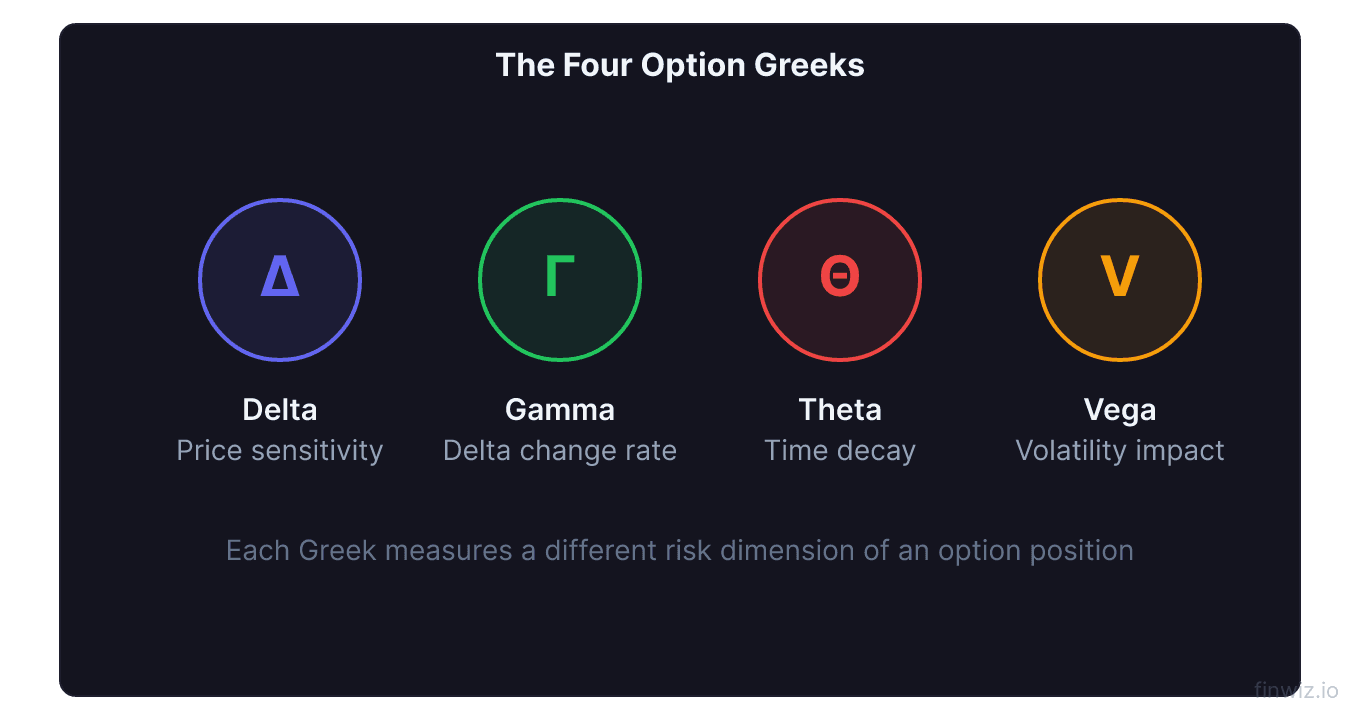
Every serious options trader monitors the Greeks because they reveal the hidden risks and opportunities within a position. A trade might look profitable based on direction alone, but the Greeks can show you whether time decay, volatility changes, or acceleration effects will help or hurt you.
The five primary Greeks are:
| Greek | Measures | Range |
|---|---|---|
| Delta | Price change per $1 move in stock | -1.0 to +1.0 |
| Gamma | Rate of change of delta | 0 to ~0.10 |
| Theta | Daily time decay | Negative for buyers |
| Vega | Sensitivity to 1% IV change | Always positive |
| Rho | Sensitivity to 1% interest rate change | Small value |
Delta: Directional Exposure
Delta is the most important Greek for most traders. It measures how much an option's price changes for every $1 move in the underlying stock.
A call option with a delta of 0.50 will gain $0.50 in value for every $1 the stock rises (and lose $0.50 for every $1 decline). A put option with a delta of -0.40 will gain $0.40 for every $1 the stock falls.
Key delta properties:
- Call deltas range from 0 to +1.0
- Put deltas range from -1.0 to 0
- ATM options have deltas near ±0.50
- Deep ITM options have deltas near ±1.0 (behave like stock)
- Far OTM options have deltas near 0 (barely move with stock)
| Moneyness | Call Delta | Put Delta |
|---|---|---|
| Deep ITM | 0.85 to 0.99 | -0.85 to -0.99 |
| ITM | 0.60 to 0.85 | -0.60 to -0.85 |
| ATM | 0.45 to 0.55 | -0.45 to -0.55 |
| OTM | 0.15 to 0.45 | -0.15 to -0.45 |
| Far OTM | 0.01 to 0.15 | -0.01 to -0.15 |
Delta as probability proxy. A useful approximation: delta roughly equals the market's estimated probability that the option will expire in the money. A 0.30 delta call has approximately a 30% chance of finishing ITM.
Portfolio delta. You can sum the deltas of all your options to find your total directional exposure. If you hold calls with a combined delta of +200, your portfolio behaves like 200 shares of stock. This helps you understand and manage your overall market risk.
Pro Tip
Gamma: The Rate of Change
Gamma measures how quickly delta changes as the stock price moves. It is the second derivative of the option price with respect to the stock price — the "acceleration" of your position.
New Delta ≈ Old Delta + (Gamma × Stock Price Change)If a call has a delta of 0.50 and a gamma of 0.05, and the stock rises $1, the new delta becomes approximately 0.55. The option now moves faster with the stock than before.
Key gamma characteristics:
- Gamma is highest for ATM options and decreases as you move ITM or OTM
- Gamma increases as expiration approaches for ATM options (gamma risk)
- Long options have positive gamma — delta moves in your favor as the stock trends
- Short options have negative gamma — delta moves against you as the stock trends
Gamma is the friend of option buyers and the enemy of option sellers. When you are long gamma, big moves help you. When you are short gamma, big moves hurt you.
Gamma risk near expiration. In the final days before expiration, ATM options have enormous gamma. A $100 stock's ATM call might go from a 0.50 delta to a 0.90 delta on a $2 move. This is why many professional traders close positions before expiration week — the gamma risk is simply too unpredictable.
Theta: Time Decay
Theta measures how much value an option loses each day from the passage of time, assuming all other factors remain constant. It is expressed as a dollar amount per day.
A theta of -$0.05 means the option loses $5 per contract per day (0.05 × 100 shares). Over a week, that is $35 in time decay alone.
Key theta characteristics:
- All options lose value over time (theta is negative for long options)
- ATM options have the highest theta — they lose the most value per day
- Theta accelerates as expiration approaches — the decay curve is not linear
- Option sellers benefit from theta — they collect the decaying premium
| Days to Expiration | Daily Theta (ATM, $100 stock) | Cumulative Decay |
|---|---|---|
| 90 | -$0.03 | Slow |
| 60 | -$0.04 | Moderate |
| 30 | -$0.06 | Accelerating |
| 14 | -$0.09 | Fast |
| 7 | -$0.13 | Very fast |
| 1 | -$0.35 | Extreme |
Approximate Theta Relationship: Theta is proportional to 1 / √(Days to Expiration)Practical applications of theta:
For option buyers, theta is your enemy. Every day the stock does not move in your direction, you lose money. This is why timing is critical — buy options only when you expect a move soon.
For option sellers, theta is your edge. Strategies like covered calls, iron condors, and credit spreads profit from the daily erosion of option value. The ideal timeframe for capturing theta is 30-45 DTE, where decay is meaningful but not yet extreme.
Pro Tip
Vega: Volatility Sensitivity
Vega measures how much an option's price changes for every 1 percentage point change in implied volatility. Unlike the other Greeks, vega is not actually a Greek letter.
A vega of 0.10 means the option gains $0.10 per share ($10 per contract) for every 1% increase in IV, and loses $10 for every 1% decrease.
Key vega characteristics:
- All options have positive vega — higher IV means higher option prices
- ATM options have the highest vega — they are most sensitive to IV changes
- Longer-dated options have higher vega — more time means more impact from IV changes
- Vega decreases as expiration approaches — short-term options are less affected by IV shifts
| Days to Expiration | Vega (ATM, $100 stock) | IV Change Impact (5% move) |
|---|---|---|
| 90 | $0.20 | ±$100 per contract |
| 45 | $0.14 | ±$70 per contract |
| 14 | $0.08 | ±$40 per contract |
| 7 | $0.05 | ±$25 per contract |
Practical applications of vega:
Option buyers want vega working in their favor. Buying options when IV is low means you pay less and can benefit from subsequent IV expansion. Buying options when IV is high (like before earnings) means you are vulnerable to IV crush — the sharp drop in IV after the event.
Option sellers want IV to decline after they enter a trade. Selling options when IV is elevated captures inflated premium, and the subsequent IV contraction accelerates profits beyond what theta alone would provide.
The relationship between vega and the VIX is important. When the VIX is high, all options across the market tend to have elevated IV, creating opportunities for sellers. When the VIX is low, options are cheap, favoring buyers.
Rho: Interest Rate Sensitivity
Rho measures how much an option's price changes for a 1% change in interest rates. It is the least impactful Greek for most short-term traders, but it becomes relevant for LEAPS and other long-dated options.
Key rho characteristics:
- Call options have positive rho — higher rates increase call values
- Put options have negative rho — higher rates decrease put values
- Longer-dated options have larger rho — more time for rates to matter
- Rho is generally small — a 1% rate change might affect a 90-day option by $0.02-$0.05
For most traders, rho can be safely ignored for options with less than 90 days to expiration. However, if you trade LEAPS with 1-2 years until expiration, a significant interest rate change can meaningfully impact your position.
Using Greeks Together in Practice
The real power of the Greeks comes from using them together. Here is how they interact in common scenarios:
Scenario 1: You buy an ATM call, 30 DTE.
- Delta: +0.50 (moderate bullish exposure)
- Gamma: +0.04 (delta will increase if stock rises)
- Theta: -$0.06 (losing $6/day to time decay)
- Vega: +0.12 (benefits from IV increase)
You need the stock to rise fast enough to overcome $6/day in time decay. If IV drops, you lose even more.
Scenario 2: You sell an iron condor, 45 DTE.
- Delta: ~0 (neutral)
- Gamma: -0.02 (big moves hurt)
- Theta: +$0.08 (collecting $8/day)
- Vega: -0.15 (benefits from IV decline)
You profit $8/day as long as the stock stays in your range. An IV drop helps. A big move in either direction hurts because of negative gamma.
Greek Hedging Strategies
Professional traders actively hedge their Greeks:
Delta hedging. Buy or sell stock to offset your delta. If your options portfolio has a delta of +300, selling 300 shares of stock makes you delta-neutral. You then profit from gamma, theta, or vega without directional risk.
Gamma scalping. Maintain a delta-neutral position and repeatedly adjust as the stock moves. Positive gamma means your delta tilts in the right direction after each move. You sell when delta gets too positive, buy when it gets too negative, locking in small profits from each swing.
Vega hedging. Use options at different expirations to offset vega. Selling a near-term option (low vega) and buying a longer-term option (high vega) can create a vega-positive position that profits from IV expansion.
Frequently Asked Questions
Which Greek is most important for option buyers?
Delta is the most important for determining your directional exposure, but theta is the most dangerous for buyers. Every day that passes costs you money. Successful option buyers need the stock to move fast enough and far enough to overcome theta decay. Monitoring both delta and theta gives you the clearest picture of your position.
How do the Greeks change as expiration approaches?
As expiration nears, gamma increases dramatically for ATM options, theta accelerates (more decay per day), and vega decreases (less sensitivity to IV). This combination makes the final week before expiration extremely volatile for option positions, which is why many professionals close trades well before expiration.
Can I trade based solely on the Greeks?
Many professional traders do exactly this. Volatility trading strategies focus on vega — buying options when IV is low and selling when it is high. Gamma scalping strategies profit from gamma by continuously delta-hedging. These approaches require sophisticated tools and real-time data, but they demonstrate that the Greeks are not just risk metrics — they are tradable edges.
What does it mean to be "short gamma"?
Being short gamma means big moves hurt your position. This happens when you sell options (covered calls, iron condors, credit spreads). If the stock makes a large, sudden move, your delta shifts against you faster than expected, amplifying losses. Short gamma positions are most vulnerable in the final week before expiration when gamma is at its peak.
How often should I check the Greeks on my positions?
At minimum, check daily. Professional traders monitor Greeks in real time. The most critical times to check are: at market open (overnight changes), after significant stock moves (delta and gamma shifts), and before earnings or events (vega changes). If you sell options, monitoring theta daily helps you decide when to close profitable positions.
Disclaimer
This is educational content, not financial advice. Trading involves risk, and you should consult a qualified financial advisor before making any investment decisions. Past performance does not guarantee future results.
Related Articles
12 chapters covering charts, indicators, risk management & more. Plus weekly trading insights.