
Cash-Secured Puts: Getting Paid to Buy Stocks at Your Price
⚡ Key Takeaways
- A cash-secured put involves selling a put option while holding enough cash to buy the stock if assigned
- You collect premium upfront and either keep it as profit or buy the stock at a discount to the current price
- The strategy is often described as "getting paid to wait" for a stock you want to own at a lower price
- Maximum profit is the premium collected, and maximum loss occurs if the stock drops to zero
- Cash-secured puts are the entry point of the popular wheel strategy, which combines put selling with covered calls
What Is a Cash-Secured Put?
A cash-secured put is an options strategy where you sell a put option and set aside enough cash to purchase the underlying stock if the put is assigned. You collect the option premium upfront, and in return, you accept the obligation to buy 100 shares at the strike price if the stock falls below that level.
This strategy works best when you genuinely want to own a stock but think the current price is too high. Instead of placing a limit order and waiting, you sell a put at your target buy price and get paid while you wait. If the stock drops to your strike, you buy it at a discount. If it stays above the strike, you keep the premium as pure profit.
Cash-secured puts require a margin or options-approved brokerage account but do not require margin borrowing because you hold the full cash amount to cover potential assignment.
How Cash-Secured Puts Work
You like stock XYZ at $100 but would prefer to buy it at $95. Instead of placing a limit order at $95, you sell a cash-secured put.
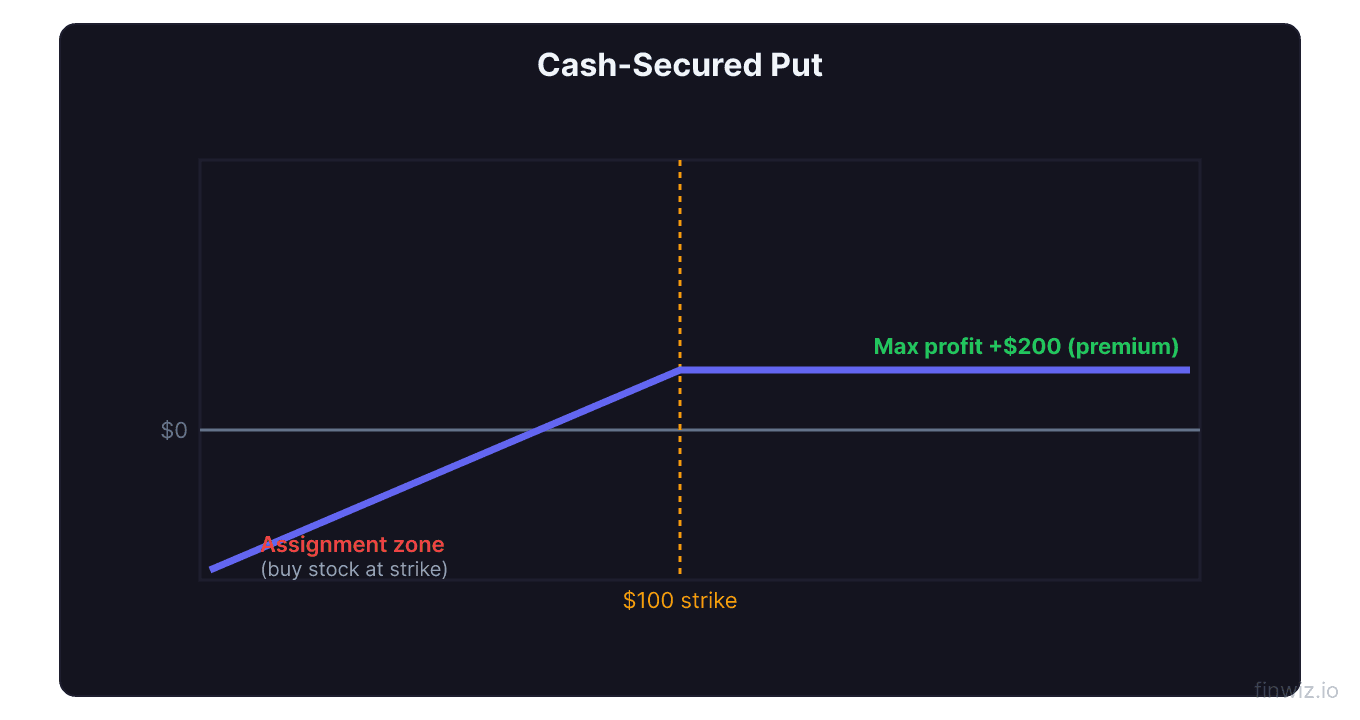
Trade setup:
- Stock XYZ trades at $100
- Sell 1 XYZ $95 put, 30 DTE, for $2.00
- Set aside $9,500 in cash (the amount needed to buy 100 shares at $95)
Premium collected: $200
Two outcomes are possible at expiration:
Scenario 1: Stock stays above $95. The put expires worthless. You keep the $200 premium. Your $9,500 in cash is released. Your return is $200 / $9,500 = 2.1% in 30 days (25.6% annualized).
Scenario 2: Stock drops below $95. You are assigned and buy 100 shares at $95. But you collected $2.00 in premium, so your effective purchase price is $93 per share. You wanted the stock at $95 and got it at $93. Even better.
Getting Paid to Wait
This is the core appeal of cash-secured puts. Compare the two approaches to buying a stock you want at a lower price:
| Approach | If Stock Stays Above $95 | If Stock Drops to $90 |
|---|---|---|
| Limit order at $95 | Nothing happens, no profit | Buy at $95 |
| Cash-secured put at $95 | Keep $200 premium | Buy at $93 effective ($95 - $2 premium) |
The cash-secured put wins in both scenarios. If the stock never drops, you earn income. If it does drop, you buy at an even lower effective price than the limit order.
You can repeat this. If the put expires worthless, sell another one next month. Over three months of selling $2.00 puts, you collect $600. If you are finally assigned on the fourth month, your effective purchase price is $95 - $8 = $87 per share, a 13% discount from the original $100 price.
Pro Tip
The Assignment Scenario
Understanding assignment is critical for cash-secured put sellers. Assignment means the put buyer exercises their right to sell you 100 shares at the strike price.
When does assignment happen?
- Most commonly at expiration if the stock is below the strike price
- Early assignment is rare for puts but can happen, especially deep ITM near expiration
- Your broker handles the mechanics automatically
What happens when assigned:
- Your cash reserve ($9,500 in our example) is used to purchase 100 shares
- You now own 100 shares at the strike price ($95)
- The premium you collected ($200) is yours to keep regardless
- Your effective cost basis is the strike price minus the premium ($93)
After assignment, you transition. You are no longer a put seller. You are a stockholder. From here, you can hold the shares, sell a covered call against them (the wheel strategy), or simply manage the stock position.
Cash-Secured Put vs. Buying Stock Outright
| Factor | Cash-Secured Put | Buying Stock Now |
|---|---|---|
| Entry price | Strike price minus premium | Current market price |
| Upside participation | None until assigned | Immediate and unlimited |
| Downside risk | Strike minus premium to $0 | Current price to $0 |
| Income while waiting | Yes (premium collected) | No (unless dividends) |
| Capital requirement | Full cash for 100 shares | Full cost of shares |
| Best when | Stock is above your target price | Stock is at or below fair value |
The catch: If the stock rallies from $100 to $130, the limit order buyer and the cash-secured put seller both miss the move. The put seller keeps $200 in premium but misses $3,000 in stock gains. Cash-secured puts are not a substitute for buying stocks you are urgently bullish on. They work when you are patient and price-sensitive.
The Wheel Strategy Connection
The wheel strategy is a systematic approach that combines cash-secured puts and covered calls in a repeating cycle:
Step 1: Sell cash-secured puts. Collect premium while waiting for assignment. If the put expires worthless, sell another one. Repeat until assigned.
Step 2: Get assigned. You now own 100 shares at a discounted price (strike minus accumulated premiums).
Step 3: Sell covered calls. With 100 shares, sell calls above your cost basis to collect additional premium. If the call expires worthless, sell another one. If assigned, you sell the shares at a profit.
Step 4: Repeat. After selling shares via call assignment, go back to Step 1 and start selling puts again.
The wheel generates income at every stage. You collect put premiums while waiting, buy at a discount, collect call premiums while holding, and sell at a premium. In a sideways or mildly bullish market, the wheel can generate 20-40% annualized returns.
Choosing Strike Prices
ATM puts ($100 strike on a $100 stock): Highest premium but highest probability of assignment. Use when you are ready to own the stock at the current price and want maximum income.
Slightly OTM puts ($95 strike on a $100 stock): The sweet spot for most traders. Good premium, reasonable assignment probability, and you buy at a discount if assigned.
Deep OTM puts ($85 strike on a $100 stock): Low premium but low probability of assignment. The stock needs to drop 15% for you to be assigned. These are more of an income trade than a stock acquisition strategy.
| Strike | Premium | Assignment Probability | Effective Buy Price |
|---|---|---|---|
| $100 ATM | $4.00 | ~50% | $96.00 |
| $95 (5% OTM) | $2.00 | ~25% | $93.00 |
| $90 (10% OTM) | $0.80 | ~12% | $89.20 |
| $85 (15% OTM) | $0.30 | ~5% | $84.70 |
Delta as a guide: The put delta roughly approximates the probability of expiring ITM. A -0.25 delta put has approximately a 25% chance of assignment.
Choosing Expiration Dates
30-45 DTE is the most popular timeframe for cash-secured puts. This balances premium income with time decay efficiency.
Theta decay is your friend. As a put seller, time decay works in your favor. Options lose value fastest in their final 30 days. By selling 30-45 DTE puts, you capture the steepest part of the theta curve.
Shorter expirations (7-14 DTE) generate less premium per trade but allow more frequent selling. Over time, selling four weekly puts may generate more total premium than one monthly put, though transaction costs increase.
Longer expirations (60-90 DTE) capture more total premium but tie up your capital longer and expose you to more price risk. The premium per day is typically lower than shorter-dated puts.
Premium per Day = Put Premium / Days to ExpirationManaging Cash-Secured Put Positions
Close early at 50% profit. If the put has lost half its value in the first week (stock moved up), close it and sell a new one. This captures profit faster and reduces the time your capital is tied up.
Roll down and out if tested. If the stock drops toward your strike, you can close the current put and sell a new one at a lower strike and later expiration. This collects additional premium and moves your assignment price lower, but it extends your commitment.
Let assignment happen if you want the stock. If the stock drops below your strike and you genuinely want to own it, do nothing. Take assignment and transition to covered calls. Do not panic or try to avoid assignment on a stock you want to own.
Close if the thesis changes. If the company reports terrible earnings or the fundamental picture deteriorates, close the put even at a loss. You do not want to be assigned shares of a stock you no longer want to own.
Risk Analysis
Maximum profit: Premium collected. This occurs when the stock stays above the strike price at expiration.
Maximum loss: (Strike Price - Premium) x 100. This occurs if the stock drops to zero. On a $95 put sold for $2.00, max loss is ($95 - $2) x 100 = $9,300.
Breakeven: Strike price minus premium received. In our example: $95 - $2 = $93.
The risk profile is identical to owning the stock with a slightly lower cost basis. You have full downside exposure below your effective purchase price. This is not a limited-risk strategy.
Real-World Example: Selling Puts on Apple
Apple (AAPL) trades at $185. You want to own it at $175 or lower.
Trade: Sell AAPL $175 put, 35 DTE, for $2.50 Cash required: $17,500 Premium collected: $250
Month 1: AAPL stays at $183. Put expires worthless. You keep $250. Return: 1.43% (14.9% annualized).
Month 2: Sell another $175 put for $2.80. AAPL drops to $178. Put expires worthless. You keep $280. Running total: $530.
Month 3: Sell another $175 put for $3.20. AAPL drops to $168 after earnings. You are assigned at $175. Effective cost basis: $175 - $2.50 - $2.80 - $3.20 = $166.50. You now own AAPL at a 10% discount from where it was when you started. Begin selling covered calls.
Common Mistakes
Selling puts on stocks you do not want to own. This is the most dangerous mistake. If you sell puts purely for income on a stock you would never buy, assignment turns into a nightmare.
Oversizing positions. Selling puts on five different stocks simultaneously requires five times the cash reserve. Make sure you can cover all potential assignments at once, because market crashes assign all your puts simultaneously.
Ignoring earnings dates. Implied volatility spikes before earnings, making put premiums attractive. But the risk of a gap down also increases. Sell puts through earnings only on stocks you would happily own at the strike price after a bad quarter.
Chasing premium on volatile stocks. High premiums exist because the stock is risky. A $50 stock with a $5 put premium might seem like easy money, but that premium reflects a real probability of a large decline.
Frequently Asked Questions
How much cash do I need for a cash-secured put?
You need enough cash to buy 100 shares at the strike price. If you sell a $95 put, you need $9,500 in your account. This cash is held as collateral until the put expires or is closed.
What if I get assigned and the stock keeps dropping?
You own the stock, so you experience further losses just like any other shareholder. However, your cost basis is lower because of the premium collected. You can sell covered calls to generate additional income and lower your cost basis further, or set a stop-loss on the stock position.
Can I sell cash-secured puts in an IRA?
Yes. Most brokers allow cash-secured put selling in IRA accounts because the full cash collateral is held. This makes it one of the few options strategies available in retirement accounts. You cannot sell naked puts (without cash) in an IRA.
How is cash-secured put income taxed?
The premium received is treated as a short-term capital gain if the put expires worthless. If you are assigned, the premium reduces your cost basis in the stock. See our guide on options taxes for more details.
What is the difference between a cash-secured put and a naked put?
The mechanics are identical. The difference is collateral. A cash-secured put has the full cash amount set aside. A naked put uses margin and requires less capital but carries the risk of a margin call if the stock drops sharply. Cash-secured puts are safer because you always have the funds to cover assignment.
Disclaimer
This is educational content, not financial advice. Trading involves risk, and you should consult a qualified financial advisor before making any investment decisions. Past performance does not guarantee future results.
Related Articles
12 chapters covering charts, indicators, risk management & more. Plus weekly trading insights.