
How Put Options Work: Mechanics from Buy to Expiration
⚡ Key Takeaways
- A put option gives the buyer the right to sell 100 shares at the strike price before expiration
- Put buyers profit when the stock drops below the strike price by more than the premium paid
- The put lifecycle includes purchase, holding through market changes, and resolution via sale, exercise, or expiration
- Time decay works against put buyers just as it does with calls
- Puts serve both speculative and protective purposes in a portfolio
The Put Option Lifecycle
A put option is a contract that gives the buyer the right to sell 100 shares of an underlying stock at a specified strike price before the expiration date. Where call buyers profit from rising prices, put buyers profit from falling prices.
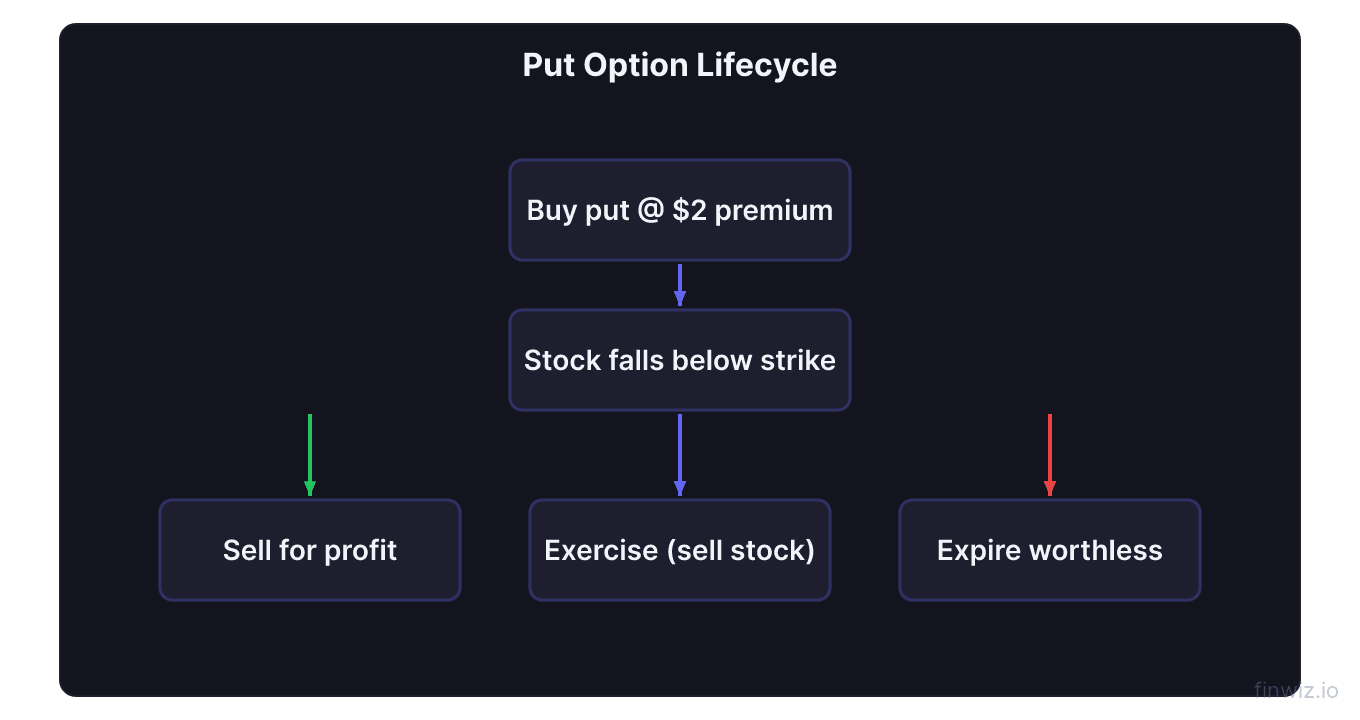
The put lifecycle mirrors the call lifecycle but in reverse. You buy the put expecting the stock to decline, hold while monitoring price and time decay, and then exit through selling the put, exercising it, or letting it expire. Each stage has unique considerations that differ from calls because of the directional difference and the way put pricing behaves.
When you purchase a put, you pay a premium that reflects the probability of the stock falling below the strike price, the time remaining, and the current level of implied volatility. Puts tend to be slightly more expensive than equivalent calls on the same stock because of volatility skew — the market's tendency to price in larger downside moves than upside moves.
Opening the Position: Buying a Put
Buying a put — a buy to open order — creates a long put position. Your broker debits the premium from your account. For example, buying one META $500 put at $12.00 costs $1,200.
At purchase, the put has both intrinsic and extrinsic value. Intrinsic value exists only when the put is in the money — meaning the stock price is below the strike price.
Put Intrinsic Value = Max(Strike Price − Stock Price, 0)Put Premium = Intrinsic Value + Extrinsic ValueIf META trades at $490 and you buy the $500 put for $12.00, intrinsic value is $10.00 and extrinsic value is $2.00. That extrinsic value compensates the seller for the risk and time remaining on the contract.
Understanding options moneyness is essential here. An in-the-money put has the stock below the strike. An out-of-the-money put has the stock above the strike. This is the opposite of calls, and mixing it up is a common beginner mistake.
Holding Period: Forces Acting on Your Put
Three primary forces shape your put's value while you hold it:
Stock price movement. Put delta is negative, typically between -0.01 and -1.00. An at-the-money put with a delta of -0.50 gains $50 per contract for every $1 the stock drops. As the stock falls further below the strike, delta approaches -1.00 and the put behaves like a short stock position.
Time decay. Theta erodes your put's extrinsic value daily, just as it does with calls. A put with 45 days to expiration decays slowly, but inside the final two weeks, time decay accelerates sharply. This is why experienced put buyers give themselves enough time for their thesis to play out.
Implied volatility. Puts are particularly sensitive to volatility changes. When fear spikes and the VIX rises, put premiums inflate. If you buy a put before a market selloff and volatility expands, you benefit from both the stock decline and the IV increase — a double tailwind.
Pro Tip
Exercise: Selling Shares at the Strike Price
Exercising a put means you invoke your right to sell 100 shares at the strike price. If you own a TSLA $250 put and exercise it, you sell 100 shares of TSLA at $250 per share regardless of the current market price.
There are two scenarios for put exercise:
You own the shares. This is a straightforward transaction. Your 100 shares transfer out of your account, and you receive $25,000 (100 shares at $250). This is how a protective put works — it sets a floor price for shares you already own.
You do not own the shares. You sell 100 shares short at the strike price. Your account now has a short stock position, requiring margin. Most retail traders avoid this and instead sell the put in the market to capture the profit.
Put Buyer Profit = (Strike Price − Stock Price at Expiration − Premium Paid) × 100Put Breakeven = Strike Price − Premium PaidUsing the META example: breakeven is $500 − $12 = $488. META must fall below $488 for the put to profit at expiration.
Assignment: What Put Sellers Face
When a put buyer exercises, a put seller gets assigned. Assignment means the seller must buy 100 shares at the strike price regardless of the current market price. If you sold a GOOG $170 put and get assigned, you purchase 100 shares at $170 even if GOOG trades at $150 — an immediate $2,000 unrealized loss.
Put sellers who specifically want to acquire shares at lower prices use cash-secured puts, keeping enough cash in the account to cover the purchase. This is a defined strategy covered in depth in the selling puts guide.
Assignment on puts can happen at any time with American-style options, but it is most likely when the put is deep in the money and has little extrinsic value remaining.
Expiration: How Puts Resolve
At expiration, every put resolves in one of three ways:
| Outcome | Stock vs. Strike | Auto-Exercise? | Result for Buyer |
|---|---|---|---|
| In the money | Stock < Strike | Yes | Sell 100 shares at strike |
| At the money | Stock = Strike | No | Expires worthless |
| Out of the money | Stock > Strike | No | Expires worthless |
In-the-money puts are auto-exercised by most brokers. If you hold the underlying shares, they are sold at the strike price. If you do not hold shares, a short stock position is created. Make sure you understand the implications before letting an ITM put reach expiration.
Out-of-the-money puts expire worthless. Your loss equals the premium paid, and the position disappears from your account.
Puts as Portfolio Insurance
Beyond speculation, puts serve a critical role as portfolio insurance. Buying puts on stocks or indexes you own creates a floor for your downside.
For instance, if you own 100 shares of AMZN at $190 and buy a $180 put for $4.00, your maximum loss on the stock position is limited to $10 per share (from $190 to $180) plus the $4.00 premium, totaling $14 per share or $1,400 per contract. Without the put, a crash to $150 would cost you $4,000.
The tradeoff is cost. Continuously buying protective puts creates a drag on returns — similar to paying insurance premiums on your home. Strategies like collars offset this cost by simultaneously selling calls, but they cap your upside.
Pro Tip
Frequently Asked Questions
How much can I make buying a put option?
Your maximum profit on a long put occurs if the stock drops to zero. The profit would be (Strike Price − $0 − Premium Paid) times 100. In practice, stocks rarely go to zero, so your realistic profit depends on how far the stock falls. A $100 put bought for $3.00 earns $7.00 per share if the stock drops to $90.
What is the difference between buying a put and short selling stock?
Buying a put gives you bearish exposure with defined risk limited to the premium paid. Short selling stock gives you bearish exposure with theoretically unlimited risk because the stock can rise indefinitely. Puts also have an expiration date, while short stock positions can be held indefinitely (subject to borrowing costs). Puts require less capital upfront but lose value from time decay.
Can I buy a put on a stock I do not own?
Yes. You do not need to own shares to buy a put option. This is a purely speculative bearish bet. If the stock drops below your breakeven, you profit by selling the put at a higher price than you paid. Most traders close their put positions before expiration rather than exercising, avoiding the complexity of a short stock position.
12 chapters covering charts, indicators, risk management & more. Plus weekly trading insights.