
Bull Call Spread: Limited-Risk Bullish Options Strategy
⚡ Key Takeaways
- A bull call spread involves buying a call at a lower strike and selling a call at a higher strike with the same expiration
- Maximum profit is the difference between strikes minus the net debit paid
- Maximum loss is limited to the net debit, making it a defined-risk strategy
- Bull call spreads reduce cost compared to buying calls outright by sacrificing unlimited upside
- This strategy works best with a moderately bullish outlook and elevated implied volatility
What Is a Bull Call Spread?
A bull call spread (also called a long call vertical or call debit spread) is a two-leg options strategy that profits when the underlying stock rises moderately. You buy a call at a lower strike price and simultaneously sell a call at a higher strike price, both with the same expiration date.
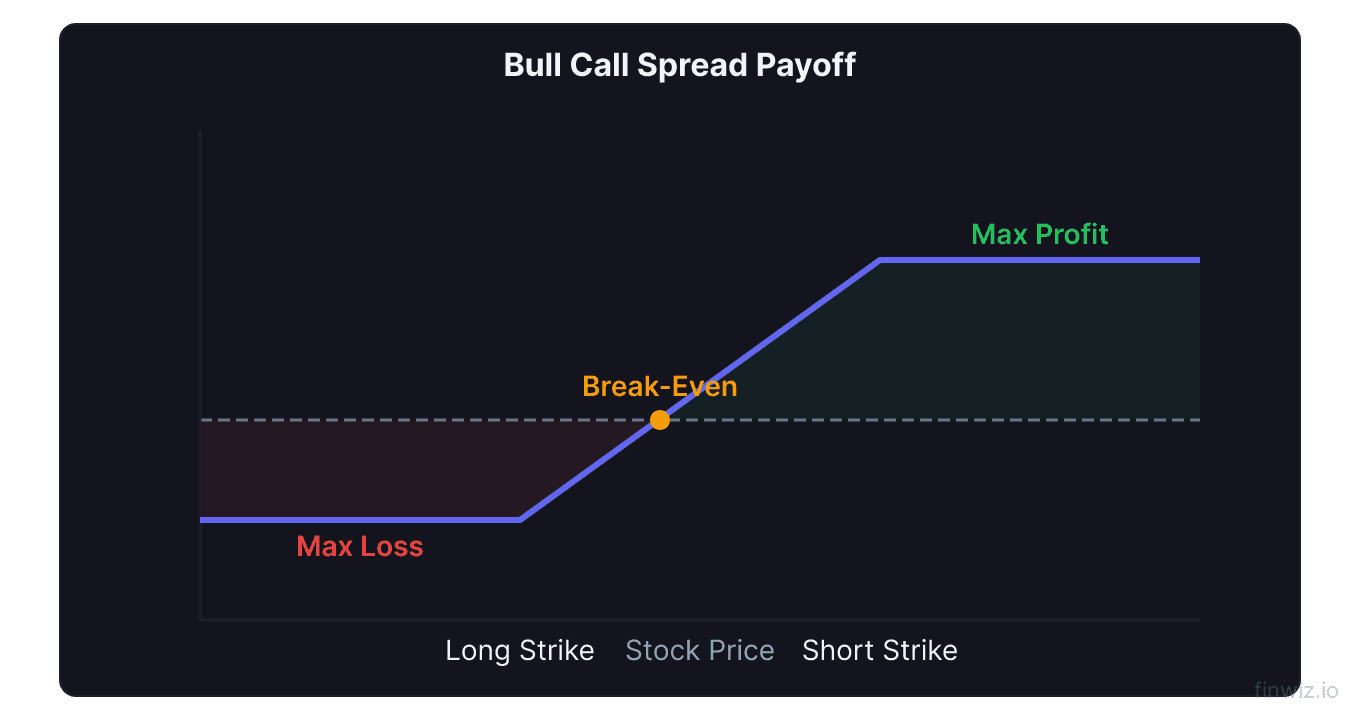
The sold call partially offsets the cost of the bought call, reducing your total investment. In exchange, your profit potential is capped at the higher strike price. This trade-off makes the bull call spread one of the most efficient ways to express a moderately bullish view.
This strategy is a staple for traders who want bullish exposure but find outright call options too expensive, particularly when implied volatility is elevated.
How to Construct a Bull Call Spread
A bull call spread has two legs, both with the same expiration:
- Buy 1 call at the lower strike (typically ATM or slightly OTM)
- Sell 1 call at the higher strike (further OTM)
Example: Stock XYZ trades at $100. You expect it to rise to around $110 over the next 30 days.
| Leg | Action | Strike | Premium |
|---|---|---|---|
| 1 | Buy call | $100 | -$4.00 |
| 2 | Sell call | $110 | +$1.50 |
| Net | -$2.50 (debit) |
Your total cost (net debit) is $2.50 per share, or $250 per contract. This is both your total investment and your maximum possible loss.
Pro Tip
Maximum Profit, Maximum Loss, and Breakeven
The math for a bull call spread is clean and simple:
Maximum Profit = (Higher Strike − Lower Strike − Net Debit) × 100Using our example:
| Metric | Calculation | Result |
|---|---|---|
| Max Profit | ($110 − $100 − $2.50) × 100 | $750 |
| Max Loss | $2.50 × 100 | $250 |
| Breakeven | $100 + $2.50 | $102.50 |
| Risk-Reward Ratio | $750 ÷ $250 | 3:1 |
The stock needs to rise just 2.5% to break even, compared to 4% for a standalone $100 call. The maximum profit is achieved when the stock reaches $110 or higher at expiration.
Payoff at Expiration
Here is how the bull call spread performs at various stock prices:
| Stock Price | Long $100 Call Value | Short $110 Call Value | Net P/L |
|---|---|---|---|
| $95 | $0 | $0 | -$250 |
| $100 | $0 | $0 | -$250 |
| $102.50 | $2.50 | $0 | $0 (breakeven) |
| $105 | $5.00 | $0 | +$250 |
| $107.50 | $7.50 | $0 | +$500 |
| $110 | $10.00 | $0 | +$750 (max profit) |
| $115 | $15.00 | -$5.00 | +$750 (max profit) |
| $120 | $20.00 | -$10.00 | +$750 (max profit) |
Notice that once the stock reaches $110, additional gains on the long call are offset by losses on the short call. Your profit is capped at $750 regardless of how high the stock goes.
When to Use a Bull Call Spread
Bull call spreads are ideal under these conditions:
Moderately bullish outlook. You expect the stock to rise but not skyrocket. If you think the stock will surge well beyond your upper strike, a plain long call might be better despite the higher cost.
Elevated implied volatility. When IV is high, individual options are expensive. The bull call spread reduces your net cost because the sold call offsets some of the inflated premium. The short call also gives you negative vega, partially protecting you from an IV decline.
Defined risk desired. Your maximum loss is always the net debit paid, regardless of what happens. This makes position sizing simple and risk management straightforward.
Capital efficiency. A bull call spread costs significantly less than buying shares or even a single call. This frees up capital for other trades and reduces portfolio concentration.
Bull Call Spread vs. Long Call
| Factor | Bull Call Spread | Long Call |
|---|---|---|
| Cost | Lower (net debit) | Higher (full premium) |
| Max profit | Capped (width − debit) | Unlimited |
| Max loss | Net debit | Full premium |
| Breakeven | Lower (easier to reach) | Higher |
| Theta impact | Partially offset | Full negative theta |
| Vega impact | Partially offset | Full positive vega |
| Best IV environment | High IV | Low IV |
The spread outperforms the long call when the stock rises moderately (to or near the upper strike). The long call outperforms when the stock rises dramatically beyond the upper strike. The spread also outperforms in declining IV environments.
Percentage Return Comparison:Choosing Strikes
Lower strike (long call): Most traders buy the ATM or slightly ITM call. This strike has the highest delta and captures the most of the stock's initial move. Buying an OTM lower strike reduces cost but increases the breakeven distance.
Upper strike (short call): This defines your profit target. Place it where you believe the stock will be at expiration. Common approaches:
- $5 wide spread: Lower cost, lower max profit, tighter risk-reward
- $10 wide spread: Moderate cost, good risk-reward, most popular width
- $20+ wide spread: Higher cost, higher max profit, more capital at risk
| Spread Width | Net Debit | Max Profit | Risk-Reward | Prob. of Max Profit |
|---|---|---|---|---|
| $5 ($100/$105) | $2.00 | $300 | 1.5:1 | Higher |
| $10 ($100/$110) | $2.50 | $750 | 3:1 | Moderate |
| $20 ($100/$120) | $3.00 | $1,700 | 5.7:1 | Lower |
Pro Tip
Expiration Selection
Short-term (7-14 DTE): Maximum gamma but rapid time decay on the long leg. Use for trades with immediate catalysts.
Medium-term (30-45 DTE): The sweet spot. Enough time for the thesis to play out without excessive time decay. The sold call helps offset theta.
Long-term (60-90+ DTE): More time for the trade to work but higher cost. Less theta decay concern. Best when the catalyst has an uncertain timeline.
Most bull call spread traders target 30-45 DTE because this balances cost, time decay, and the probability of the stock reaching the upper strike.
Managing the Trade
Take profits at 50-75% of max profit. If your $250 spread reaches $187-$562 in profit, consider closing. Waiting for the last 25-50% of profit requires the stock to be at or above the upper strike at expiration, which becomes increasingly uncertain.
Cut losses at 50% of max loss. If the spread is worth only $1.25 (lost half its value), close and redeploy capital elsewhere.
Roll up if the stock surges. If the stock quickly reaches your upper strike, you can sell the existing spread and open a new one with higher strikes. This extends your profit potential but resets your cost.
Close before expiration. If both options are ITM near expiration, close the spread to avoid assignment risk on the short call and potential issues with the long call auto-exercise.
Real-World Example
Stock ABC trades at $145. The company reports earnings in 3 weeks, and you are moderately bullish.
Trade: Buy $145/$155 bull call spread, 28 DTE
- Buy $145 call: $5.20
- Sell $155 call: $1.80
- Net debit: $3.40 ($340 per contract)
- Max profit: ($155 − $145 − $3.40) × 100 = $660
- Breakeven: $148.40
Outcome 1: Stock rises to $158 after earnings beat. Spread value at expiration: $10.00. Profit: ($10 − $3.40) × 100 = $660 (194% return).
Outcome 2: Stock drops to $138 after earnings miss. Both options expire worthless. Loss: $340 (100% of investment).
Outcome 3: Stock rises modestly to $150. Spread value: $5.00. Profit: ($5 − $3.40) × 100 = $160 (47% return).
Frequently Asked Questions
What is the maximum I can lose on a bull call spread?
Your maximum loss is the net debit paid — the total cost of the spread. If you paid $2.50 for the spread ($250 per contract), that is the most you can lose, regardless of how far the stock falls. This defined-risk feature makes bull call spreads safer than buying naked calls.
When does a bull call spread reach maximum profit?
Maximum profit occurs when the stock is at or above the higher strike at expiration. At that point, your long call is deep ITM and your short call offsets further gains. You do not need the stock to go far above the upper strike — reaching it is enough.
Can I close a bull call spread early?
Yes. You can close both legs simultaneously at any time by selling the long call and buying back the short call. Most platforms allow you to close the spread as a single order. Closing early is recommended when you have captured 50-75% of the maximum profit.
What happens if only the long call is in the money at expiration?
If the stock is between the two strikes at expiration, the long call is ITM (and may be auto-exercised) while the short call expires worthless. This results in you buying 100 shares at the lower strike. To avoid this, close the spread before expiration when possible.
Is a bull call spread better than a bull put spread?
Both strategies profit from a stock rising, but the mechanics differ. A bull call spread (debit spread) pays upfront and profits later. A bull put spread (credit spread) collects premium upfront and keeps it if the stock stays above the short put strike. The choice depends on whether you prefer paying debit or collecting credit, and the relative pricing of puts versus calls for your target stock.
Disclaimer
This is educational content, not financial advice. Trading involves risk, and you should consult a qualified financial advisor before making any investment decisions. Past performance does not guarantee future results.
Related Articles
12 chapters covering charts, indicators, risk management & more. Plus weekly trading insights.