
Option Contracts: Size, Expiration, Strike Price & Mechanics
⚡ Key Takeaways
- Each standard options contract represents 100 shares of the underlying stock, meaning a call option at $2.00 actually costs $200 (100 x $2.00) to purchase.
- Options expire on specific dates following monthly (third Friday), weekly (every Friday), and quarterly (end of calendar quarter) expiration cycles.
- Strike price selection determines your risk/reward profile — in-the-money options cost more but have higher probability of profit, while out-of-the-money options are cheaper but more likely to expire worthless.
- Exercise is when an option holder uses their right to buy (call) or sell (put) shares; assignment is when an option seller is obligated to fulfill the other side of that transaction.
- U.S. equity options settle on a T+1 basis after exercise, meaning shares are delivered the business day following the exercise date.
What Are Option Contracts?
An option contract is a financial agreement that gives the buyer the right — but not the obligation — to buy or sell 100 shares of an underlying stock at a specified price (the strike price) on or before a specified date (the expiration date). The buyer pays a premium to the seller for this right.
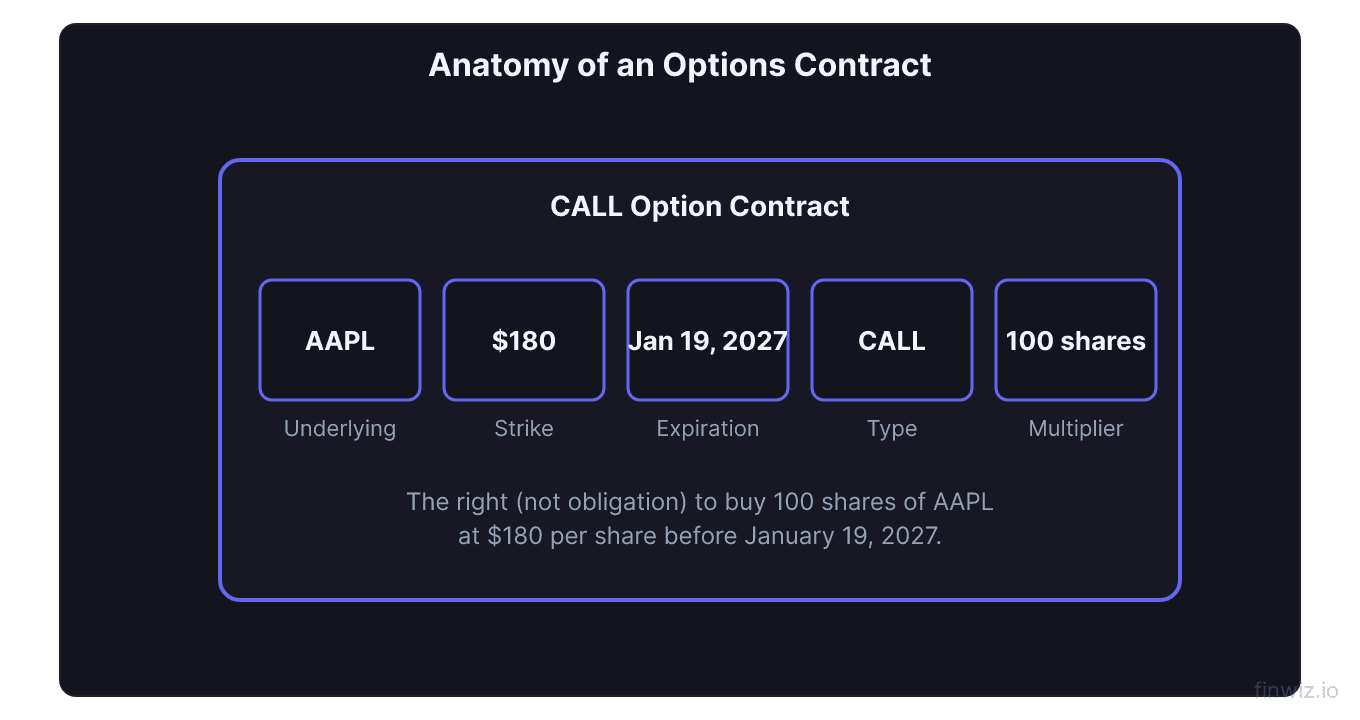
This is the foundational building block of all options trading. Every options strategy, from simple long calls to complex calendar spreads and iron condors, is constructed from these basic contracts. Understanding the mechanics of how contracts work — their size, expiration cycles, exercise procedures, and settlement — is essential before you trade a single option.
There are two types of option contracts:
- Call options: Give the buyer the right to buy 100 shares at the strike price
- Put options: Give the buyer the right to sell 100 shares at the strike price
The seller (also called the writer) of the option takes on the obligation to fulfill the contract if the buyer exercises their right.
The 100-Share Multiplier
Every standard equity option contract controls exactly 100 shares of the underlying stock. This is the single most important number in options trading, and misunderstanding it is the most common mistake beginners make.
Why 100 Shares Matters
When you see an option quoted at $3.50, that is the price per share. Since the contract controls 100 shares, the total cost (premium) you pay is:
Total Option Premium = Quoted Price x 100This multiplier effect works in both directions. If the option price increases from $5.25 to $8.00, your profit is not $2.75 — it is $2.75 x 100 = $275 per contract. If you bought 3 contracts, your profit is $275 x 3 = $825.
The Leverage Effect
Because each contract controls 100 shares, options provide inherent leverage. Consider this comparison:
Buying 100 shares of a $200 stock:
- Capital required: $20,000
- If stock rises 5% to $210: Profit = $1,000 (5% return)
Buying 1 call option at $5.25:
- Capital required: $525
- If stock rises 5% to $210 (option now worth approximately $12.00): Profit = $675 (129% return)
The option produced a much higher percentage return on a much smaller capital outlay. However, if the stock does not move or declines, the option can lose 100% of its value — something that virtually never happens with stock ownership.
Pro Tip
Expiration Cycles
Options do not last forever — they have a defined expiration date after which they cease to exist. Understanding the different expiration cycles helps you select the right timeframe for your trade thesis.
Monthly Options (Standard)
Monthly options expire on the third Friday of each month. These are the original and most liquid expiration cycle, available for virtually every optionable stock and ETF.
- Expiration date: Third Friday of the month
- Last trading day: Third Friday (same day, regular trading hours)
- If the third Friday is an exchange holiday, expiration moves to the preceding Thursday
- Available for at least 2-3 months out, often 6-12 months or more
Monthly options are the default choice for most strategies. They have the tightest bid-ask spreads, highest open interest, and most consistent pricing.
Weekly Options (Weeklys)
Weekly options expire every Friday (except the third Friday, which is covered by monthlies). They were introduced in 2005 and have become extremely popular with short-term traders.
- New weeklys are typically listed on Thursdays, expiring the following Friday
- Available for major stocks and ETFs (not all optionable securities have weeklys)
- Offer 5-7 days to expiration when first listed
- Time decay (theta) is most aggressive in the final week, making weeklys attractive for option sellers
Weeklys are popular for earnings trades, short-term directional bets, and premium-selling strategies. However, they carry higher risk due to rapid time decay — a weekly option can lose 30-50% of its value in a single day if the underlying stock does not move.
Quarterly Options (End-of-Quarter)
Quarterly options expire on the last business day of each calendar quarter (March 31, June 30, September 30, December 31 — adjusted if the date falls on a weekend or holiday).
- Used primarily by institutional investors for portfolio hedging aligned with quarter-end reporting
- Available for major indices and ETFs
- Less popular with retail traders
LEAPS (Long-Term Options)
LEAPS (Long-Term Equity Anticipation Securities) are options with expiration dates more than one year out. They follow the standard monthly cycle but extend 2-3 years into the future.
- Expire in January of the expiration year
- Useful for long-term directional views and stock replacement strategies
- Higher premiums due to the extended time value
- Lower theta decay rate per day compared to shorter-term options
Learn more about LEAPS strategies in our LEAPS options guide.
Strike Price Selection
The strike price is the price at which the option holder can buy (call) or sell (put) the underlying shares. Choosing the right strike price is one of the most critical decisions in options trading.
In-the-Money (ITM)
An option is in-the-money when it has intrinsic value:
- ITM call: Stock price is ABOVE the strike price (e.g., stock at $210, strike at $200)
- ITM put: Stock price is BELOW the strike price (e.g., stock at $190, strike at $200)
ITM options cost more because they have intrinsic value. They have a higher probability of profit but lower percentage returns.
At-the-Money (ATM)
An option is at-the-money when the stock price equals (or is very close to) the strike price. ATM options have no intrinsic value — their entire premium consists of time value (extrinsic value).
ATM options are the most liquid and have the highest time value (theta), making them popular for both buyers and sellers.
Out-of-the-Money (OTM)
An option is out-of-the-money when it has no intrinsic value:
- OTM call: Stock price is BELOW the strike price (e.g., stock at $190, strike at $200)
- OTM put: Stock price is ABOVE the strike price (e.g., stock at $210, strike at $200)
OTM options are cheaper but have a lower probability of profit. They require the stock to make a significant move in the right direction to become profitable.
Strike Selection Quick Reference (for a $200 stock):Choosing the Right Strike
Your strike selection should align with your market outlook and risk tolerance:
| Outlook | Call Strategy | Put Strategy |
|---|---|---|
| Strongly bullish | OTM calls (higher leverage) | Sell OTM puts (collect premium) |
| Moderately bullish | ATM or slightly ITM calls | ATM puts as hedge |
| Neutral-bullish | Sell OTM calls (covered calls) | Buy ITM puts for protection |
| Stock replacement | Deep ITM calls (delta ~0.80+) | Deep ITM puts (delta ~-0.80) |
Pro Tip
Exercise and Assignment
Exercise and assignment are the mechanisms by which options contracts are converted into actual stock transactions.
Exercise (Option Buyer's Action)
When an option holder decides to use their right, they exercise the option:
- Exercising a call: The holder buys 100 shares from the option seller at the strike price
- Exercising a put: The holder sells 100 shares to the option seller at the strike price
American-style options (which include virtually all U.S. equity options) can be exercised at any time before expiration. European-style options (common for index options like SPX) can only be exercised at expiration.
Assignment (Option Seller's Obligation)
When an option buyer exercises, the option seller is assigned — they must fulfill the obligation:
- Assigned on a short call: Must sell 100 shares at the strike price (or buy them at market price if they do not own them)
- Assigned on a short put: Must buy 100 shares at the strike price
Assignment can happen at any time for American-style options, though it most commonly occurs:
- At expiration (automatic exercise for ITM options)
- When the option is deep ITM and has very little time value remaining
- Just before an ex-dividend date (for calls on dividend-paying stocks)
Automatic Exercise at Expiration
The Options Clearing Corporation (OCC) automatically exercises any option that is $0.01 or more in-the-money at expiration. This means:
- If you hold an ITM option at expiration and do nothing, it will be exercised automatically
- If you hold an ITM short option at expiration, you may be assigned automatically
- You can instruct your broker to NOT exercise an ITM option if you prefer (a "do not exercise" instruction), but this is uncommon
Settlement: T+1
When an option is exercised, the resulting stock transaction settles on a T+1 basis — one business day after the exercise date. This aligns with the standard stock settlement cycle that took effect in 2024.
Settlement Mechanics
| Action | Day | What Happens |
|---|---|---|
| Exercise/Assignment | T (trade date) | Option converted to stock transaction |
| Settlement | T+1 | Shares and cash are exchanged |
For example, if you exercise a call option on Monday, you will receive 100 shares in your account by Tuesday. Cash settlement for index options (like SPX) also follows T+1.
Cash Settlement vs. Physical Settlement
Most equity options (options on individual stocks and ETFs) are physically settled, meaning actual shares change hands. Some index options (SPX, NDX, RUT) are cash-settled, meaning no shares are exchanged — the difference between the strike price and the settlement value is paid in cash.
Physical Settlement Example (Call Exercise):The Option Chain
The option chain is the table that displays all available option contracts for a given stock, organized by expiration date and strike price. Learning to read the option chain is essential for identifying and executing trades.
Key columns in a standard option chain:
- Strike: The exercise price
- Bid: The highest price a buyer will pay
- Ask: The lowest price a seller will accept
- Last: The price of the most recent trade
- Volume: Number of contracts traded today
- Open Interest: Total number of outstanding contracts
- Implied Volatility (IV): The market's expectation of future price movement
High open interest and volume at a particular strike and expiration indicate liquidity — you will get better fills and tighter spreads at these strikes.
Common Mistakes with Option Contracts
Mistake 1: Forgetting the 100x Multiplier
New traders sometimes buy 10 contracts thinking they are committing $500 when they are actually committing $5,000. Always calculate total premium before clicking "submit."
Mistake 2: Holding Until Expiration
Most profitable options trades should be closed before expiration. As expiration approaches, time decay accelerates dramatically and small price moves can have outsized impacts on the option's value. A common guideline is to close profitable trades at 50-75% of maximum profit.
Mistake 3: Ignoring Assignment Risk
If you sell options (especially naked calls or puts), you can be assigned at any time. Make sure you have the capital or shares to fulfill the obligation. Being assigned on a naked call when you do not own the shares creates a short stock position — potentially with unlimited risk.
Mistake 4: Trading Illiquid Options
Options with low volume and wide bid-ask spreads cost you money on every entry and exit. Stick to options with open interest of at least 100 contracts and bid-ask spreads that are no more than 10% of the option's price.
FAQ
Why do options control 100 shares instead of 1?
The 100-share standard was established when options exchanges were created in 1973. It was chosen because 100 shares was the standard "round lot" for stock trading at the time. Some specialized products (like mini-options, which controlled 10 shares) have been introduced and discontinued. The 100-share standard remains universal for regular equity options.
What happens if I cannot afford to exercise my option?
If you hold an ITM option at expiration but do not have the cash or margin to take delivery of shares, your broker will typically close the option for you by selling it in the market before expiration. This captures the intrinsic value without requiring you to buy/sell the underlying shares. Contact your broker before expiration day to understand their specific policies.
Can I exercise an option early?
Yes, for American-style options (which includes virtually all U.S. equity options). However, early exercise is rarely optimal because you forfeit any remaining time value. The main exceptions are exercising deep ITM calls just before an ex-dividend date (to capture the dividend) and exercising deep ITM puts when the remaining time value is minimal.
How do I know when my options expire?
Your brokerage platform displays the expiration date for every option position you hold. Standard monthly options expire on the third Friday. Weekly options expire every Friday. You can also check expiration dates in the option chain. Most brokers send notifications as your options approach expiration.
What is the difference between closing an option and exercising it?
Closing means selling the option back into the market (if you are long) or buying it back (if you are short). You receive or pay the current market price and the position is eliminated. Exercising means converting the option into a stock transaction at the strike price. Most traders close their options rather than exercising them, because closing captures both intrinsic and any remaining time value.
Disclaimer
This is educational content, not financial advice. Trading involves risk, and you should consult a qualified financial advisor before making any investment decisions. Past performance does not guarantee future results.
Related Articles
12 chapters covering charts, indicators, risk management & more. Plus weekly trading insights.