
Buy to Open vs Buy to Close: Options Order Actions Explained
⚡ Key Takeaways
- Buy to Open (BTO) creates a new long options position, while Buy to Close (BTC) exits an existing short options position
- BTO requires paying the full premium upfront; BTC requires paying to repurchase a contract you previously sold
- Every BTO is paired with a future Sell to Close (STC), and every Sell to Open (STO) is paired with a future BTC
- BTO profits when the option gains value; BTC profits when the option loses value after you sold it
- Understanding these order actions prevents costly mistakes like accidentally doubling your position instead of closing it
Buy to Open vs. Buy to Close: What's the Difference?
Buy to Open and Buy to Close are both buying actions in options trading, but they serve opposite purposes. Buy to Open (BTO) creates a brand-new long position in a call or put contract, while Buy to Close (BTC) exits an existing short position that was previously established with a Sell to Open order. Confusing the two can result in unintended positions, unexpected margin requirements, and unnecessary losses.
The distinction matters because options brokers track whether you are opening or closing a position. Selecting the wrong action changes the trade from an exit into a new entry, which has completely different risk implications.
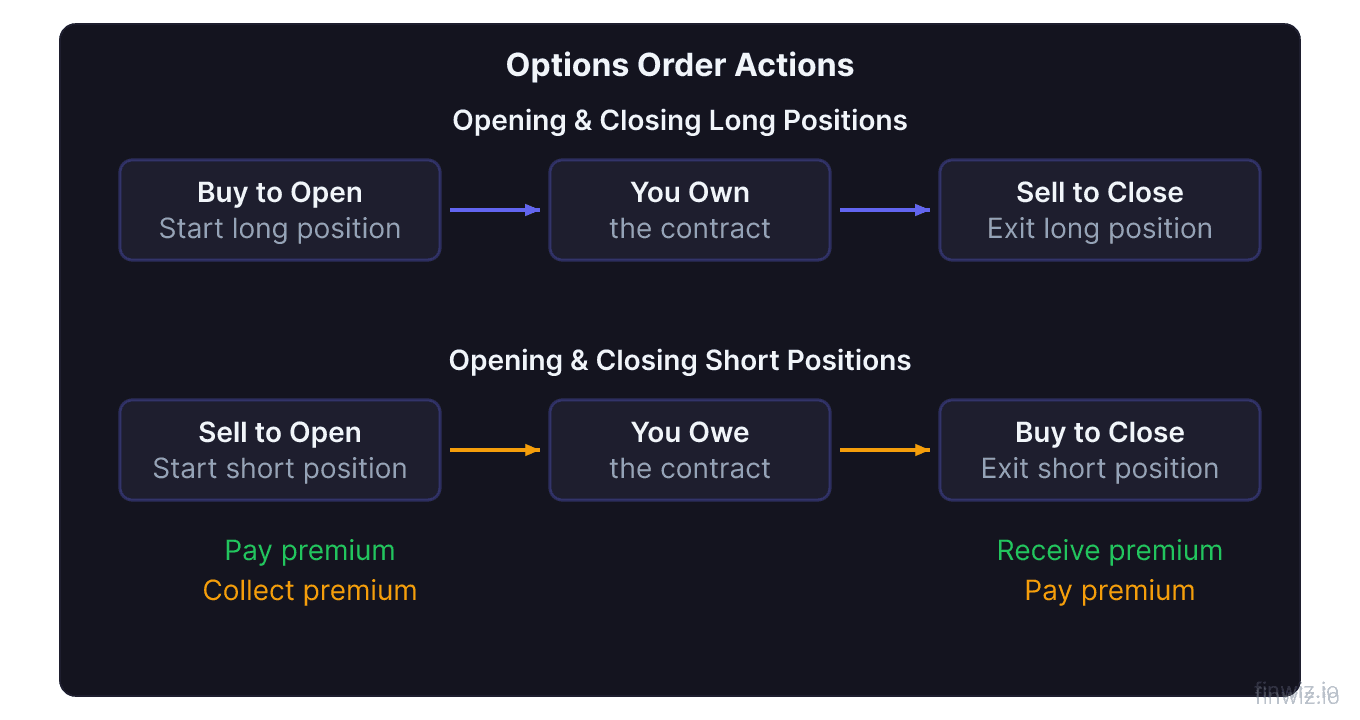
Every options trade involves one of four order actions: Buy to Open, Sell to Close, Sell to Open, or Sell to Close. These actions come in natural pairs. BTO opens a long position, and Sell to Close (STC) exits it. Sell to Open (STO) opens a short position, and Buy to Close (BTC) exits it.
What Is Buy to Open?
Buy to Open (BTO) is the order action you use when you want to establish a new long options position. You are buying a contract you do not currently hold, which means you are paying the premium to the seller.
When you BTO a call option, you are bullish on the underlying stock. You profit if the stock rises above the strike price plus the premium you paid. When you BTO a put option, you are bearish. You profit if the stock falls below the strike price minus the premium.
Key characteristics of Buy to Open:
- You pay the full premium at the time of purchase
- Your maximum loss is limited to the premium paid
- You need the option to increase in value to profit
- No margin is required because your risk is defined
- You now hold a long position that you can later Sell to Close
BTO is the most common order action for retail traders because it offers defined risk. You can never lose more than you paid for the contract, regardless of what happens to the underlying stock.
What Is Buy to Close?
Buy to Close (BTC) is the order action you use when you want to exit a short options position. You previously sold a contract using Sell to Open, and now you are buying it back to close your obligation.
When you BTC, you are essentially buying back the contract you sold. If the option has decreased in value since you sold it, you profit from the difference. If it has increased in value, you take a loss.
Key characteristics of Buy to Close:
- You are repurchasing a contract you previously sold
- You pay the current market price for the contract
- Your goal is to buy it back for less than you sold it
- Closing the position eliminates further obligation and frees up margin
- The trade ends your exposure to assignment risk
BTC is essential for short options sellers who want to lock in profits or cut losses before expiration. Without it, your only other exit is waiting for the option to expire worthless or being assigned.
Key Differences Between Buy to Open and Buy to Close
| Feature | Buy to Open (BTO) | Buy to Close (BTC) |
|---|---|---|
| Purpose | Opens a new long position | Closes an existing short position |
| When used | Starting a trade | Ending a trade |
| Direction | You are entering the market | You are exiting the market |
| Premium | You pay to acquire rights | You pay to eliminate obligations |
| Position after | Long one contract | Flat (no position) |
| Margin impact | No margin required | Frees up margin collateral |
| Paired with | Sell to Close (STC) | Sell to Open (STO) |
Buy to Open Example with AAPL Options
Suppose AAPL is trading at $185 and you are bullish heading into earnings. You decide to Buy to Open 1 AAPL $190 call expiring in 30 days for a premium of $3.50 per share, or $350 total (each contract represents 100 shares).
After the BTO:
- You hold 1 long call contract
- Your maximum risk is $350 (the premium paid)
- You need AAPL above $193.50 at expiration to profit (strike + premium)
- Your breakeven is $193.50
Two weeks later, AAPL has risen to $195 and your call is now worth $7.00. You Sell to Close the call for $700, locking in a $350 profit ($700 received minus $350 paid). The BTO initiated the trade, and the STC completed it.
Pro Tip
Buy to Close Example with AAPL Options
Now suppose you are neutral to slightly bearish on AAPL at $185 and decide to sell premium. You Sell to Open 1 AAPL $175 put expiring in 30 days for $2.00 per share, collecting $200 in premium.
After the STO:
- You hold 1 short put contract
- You collected $200 in premium
- You are obligated to buy 100 shares of AAPL at $175 if assigned
- Your broker holds margin collateral against this position
Ten days later, AAPL has risen to $192 and the $175 put has decayed to $0.30. You decide to Buy to Close the put for $30 ($0.30 x 100 shares). Your profit is $170 ($200 collected minus $30 paid to close).
You could have waited for expiration and kept the full $200 if the put expired worthless, but closing early eliminates the risk that AAPL reverses sharply in the remaining 20 days. Many experienced options sellers close positions once they have captured 50-75% of the maximum profit.
How Buy to Open and Buy to Close Affect Your P&L
The profit and loss mechanics work differently for BTO and BTC because they represent opposite sides of a trade.
Buy to Open P&L:
BTO Profit = (Sell to Close Price - Buy to Open Price) x 100 shares per contractYou want the option to increase in value after you buy it. Time decay (theta) works against you, eroding the value of your position each day. Rising implied volatility helps your position; falling IV hurts it.
Buy to Close P&L:
BTC Profit = (Sell to Open Price - Buy to Close Price) x 100 shares per contractYou want the option to decrease in value after you sell it. Time decay works in your favor, reducing the cost to buy back the contract. You profit from falling implied volatility and lose from rising IV.
The key distinction is that BTO traders need movement (the stock must move in their direction before time decay erodes their premium), while traders who eventually use BTC (short sellers) benefit from the passage of time and the absence of movement. Understanding the difference between limit orders and stop orders can also help you manage entries and exits on these positions. Proper risk management principles apply equally to both order types.
When to Use Buy to Open
Directional conviction. When you have a strong opinion that a stock will move significantly in one direction, BTO on a call (bullish) or put (bearish) gives you leveraged exposure with defined risk.
Earnings plays. Buying options before earnings announcements lets you participate in large moves while capping your downside at the premium paid.
Portfolio hedging. Buying puts via BTO protects an existing stock position against downside risk. This is the foundation of a protective put strategy.
Limited capital. BTO lets you control 100 shares of a high-priced stock for a fraction of the stock price. One AAPL call might cost $350 versus $18,500 for 100 shares.
When to Use Buy to Close
Locking in profits on short positions. When you have captured a significant portion of the premium you collected, BTC lets you exit and eliminate the risk of a reversal.
Cutting losses on short positions. If the trade moves against you and the option is now worth more than you collected, BTC stops the bleeding before losses grow further.
Before earnings or news events. If you hold a short option and the underlying has an upcoming catalyst, BTC lets you exit before a potential adverse move.
Rolling positions. When you BTC an existing short option and immediately STO a new one at a different strike or expiration, you are rolling the position. This is a common tactic in covered call management.
Pro Tip
Frequently Asked Questions
What happens if I accidentally use Buy to Open instead of Buy to Close?
Instead of closing your short position, you will create a new long position while still holding your short position. You will then hold both a long and a short contract, which may partially offset each other but still incur additional premium cost and margin. Contact your broker immediately to correct the error.
Can I Buy to Close a contract I did not Sell to Open?
No. Buy to Close is only available when you hold an existing short position in that specific contract (same underlying, strike, expiration, and type). If you do not have a short position, the broker will only allow Buy to Open.
Is Buy to Open or Buy to Close more common for retail traders?
Buy to Open is far more common because most retail traders buy options rather than sell them. Selling options (which requires BTC to exit) involves higher margin requirements and theoretically unlimited risk on certain strategies, making it less accessible for smaller accounts.
Do commissions differ between Buy to Open and Buy to Close?
No. Brokers charge the same commission per contract regardless of whether the order is BTO, BTC, STO, or STC. The standard is $0.50-$0.65 per contract at most major brokers.
Should I always Buy to Close before expiration?
Not necessarily. If you sold an option and it is deep out of the money near expiration, it will likely expire worthless, giving you the full premium. However, closing early eliminates the small risk of a last-minute move. Many traders close when the remaining value is less than 10% of the original premium collected to remove this tail risk.
Related Articles
12 chapters covering charts, indicators, risk management & more. Plus weekly trading insights.