
Iron Condor Strategy: Profiting from Low Volatility
⚡ Key Takeaways
- An iron condor combines a bull put spread and a bear call spread to profit from low volatility and range-bound stocks
- Maximum profit is the total net premium collected, earned when the stock stays between the two short strikes at expiration
- Maximum loss is the width of either spread minus the premium collected
- Iron condors have two breakeven points, one above and one below the current stock price
- This strategy benefits from time decay and declining implied volatility, making it ideal when IV is elevated
What Is an Iron Condor?
The iron condor is a four-leg options strategy designed to profit when the underlying stock trades within a defined range. It combines two vertical spreads: a bull put spread below the current price and a bear call spread above it.
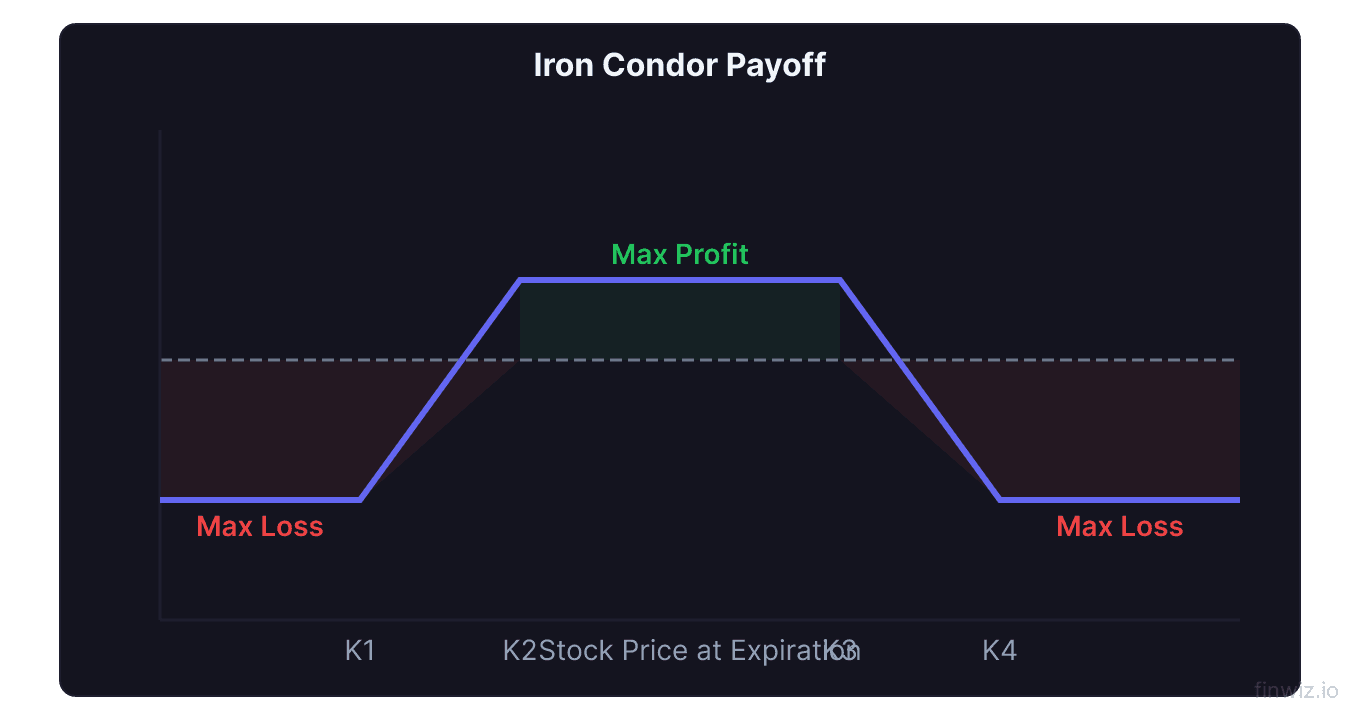
This is a market-neutral strategy. You are not betting on direction — you are betting that the stock will stay relatively flat. You collect premium upfront and keep it if the stock remains between your two short strikes at expiration.
Iron condors are one of the most popular strategies among professional options sellers because they offer high probability of profit, defined risk, and consistent income potential. They work best in range-bound markets with elevated implied volatility.
How to Construct an Iron Condor
An iron condor has four legs, all with the same expiration date:
- Buy 1 OTM put (lowest strike) — your downside protection
- Sell 1 OTM put (higher strike) — your short put
- Sell 1 OTM call (lower strike) — your short call
- Buy 1 OTM call (highest strike) — your upside protection
Example: Stock ABC trades at $100.
| Leg | Action | Strike | Premium |
|---|---|---|---|
| 1 | Buy put | $85 | -$0.60 |
| 2 | Sell put | $90 | +$1.40 |
| 3 | Sell call | $110 | +$1.50 |
| 4 | Buy call | $115 | -$0.70 |
Net credit received: ($1.40 + $1.50) − ($0.60 + $0.70) = $1.60 per share ($160 per contract)
The short strikes ($90 and $110) define your profit zone. The long strikes ($85 and $115) define your maximum risk. The distance between each pair of strikes is called the wing width — in this case, $5 on each side.
Pro Tip
Maximum Profit, Maximum Loss, and Breakevens
The math behind an iron condor is straightforward:
Maximum Profit = Net Premium Collected × 100Using our example:
| Metric | Calculation | Result |
|---|---|---|
| Max Profit | $1.60 × 100 | $160 |
| Max Loss | ($5.00 − $1.60) × 100 | $340 |
| Upper Breakeven | $110 + $1.60 | $111.60 |
| Lower Breakeven | $90 − $1.60 | $88.40 |
| Profit Range | $88.40 to $111.60 | 23.2 points wide |
The stock can move up to 11.6% in either direction before you start losing money. This wide profit zone is what makes iron condors attractive.
When to Use an Iron Condor
Iron condors perform best under specific market conditions:
Elevated implied volatility. When implied volatility is high, option premiums are inflated. This means you collect more credit, widening your profit zone and improving your risk-reward ratio. Ideally, enter iron condors when IV rank is above 50%.
Range-bound or mean-reverting stocks. Stocks that tend to trade within a range rather than trending strongly are ideal candidates. Look at the stock's historical behavior and chart patterns to assess whether it is likely to stay contained.
After a volatility spike. When a stock experiences a sharp move that inflates IV, selling an iron condor lets you profit as IV contracts back to normal levels. This is especially effective after earnings-related volatility spikes.
Neutral market outlook. If you do not have a strong directional opinion, the iron condor lets you profit from inaction rather than movement.
Payoff at Expiration
Here is how the iron condor performs at various stock prices at expiration:
| Stock Price | Put Spread P/L | Call Spread P/L | Total P/L |
|---|---|---|---|
| $80 | -$340 | +$160 | -$340 |
| $85 | -$340 | +$160 | -$340 |
| $88.40 | $0 | +$160 | $0 (breakeven) |
| $90 | +$160 | +$160 | +$160 |
| $100 | +$160 | +$160 | +$160 |
| $110 | +$160 | +$160 | +$160 |
| $111.60 | +$160 | $0 | $0 (breakeven) |
| $115 | +$160 | -$340 | -$340 |
| $120 | +$160 | -$340 | -$340 |
Note that the maximum loss only occurs on one side at a time. The stock cannot be both below $85 and above $115 simultaneously, so your maximum loss is the wing width minus the credit — not both sides combined.
Choosing Strikes and Expiration
Strike selection determines your probability of profit and risk-reward:
Wider short strikes (further from ATM) increase your probability of profit but reduce the credit collected. A typical choice is 16-delta short strikes, which correspond to approximately a 68% probability of the stock staying within the range.
Narrower short strikes (closer to ATM) collect more premium but have a lower probability of profit. This approach works when you have very high conviction that the stock will stay flat.
Wing width affects your maximum loss. Wider wings ($10 instead of $5) mean more capital at risk but also allow for more premium collection. Most traders use $5 or $10 wing widths depending on the stock price and their account size.
Expiration selection is critical. The sweet spot for iron condors is 30-45 days to expiration (DTE). This timeframe offers the best balance between premium collection and the accelerating theta decay that benefits sellers.
Pro Tip
Managing Iron Condors
Active management is essential because iron condors have limited profit but substantial risk relative to that profit. Here are the key management techniques:
Close at 50% of max profit. When the iron condor reaches 50% of its maximum profit (in our example, $80 out of $160), close the trade. Research shows this improves win rates and reduces the impact of late-expiration gamma risk.
Close the tested side. If the stock approaches one of your short strikes, you can close that spread and leave the untested side open to expire worthless.
Roll the untested side. If the stock moves toward one side, roll the opposite (safe) side closer to the current price to collect additional premium. This is called "rolling in" the untested side.
Roll out in time. If the trade is near a loss but not yet at max loss, roll the entire iron condor to a later expiration to collect more premium and give the stock more time to return to the center.
Set a max loss threshold. Close the trade if your loss reaches 1.5x to 2x the credit received. In our example, exit if the loss reaches $240-$320 rather than waiting for the full $340 max loss.
Adjustments When the Trade Goes Wrong
When the stock moves sharply in one direction, you have several adjustment options:
Adjustment 1: Roll the tested spread. If the stock drops to $91 (near your $90 short put), roll the put spread down. Buy to close the $85/$90 put spread and sell to open a $80/$85 put spread. This gives you more room but may result in a net debit.
Adjustment 2: Convert to an iron butterfly. Move both short strikes to ATM for maximum premium. This increases your credit but narrows your profit zone dramatically.
Adjustment 3: Add a directional trade. If the stock breaks below your put spread, buy shares or calls to delta-hedge and reduce your directional exposure.
Adjustment 4: Accept and close. Sometimes the best adjustment is no adjustment. Close the losing side, take the loss, and move on. Over-adjusting can turn a manageable loss into a larger one.
Iron Condor vs. Other Strategies
| Strategy | Legs | Directional Bias | Max Profit | Max Loss |
|---|---|---|---|---|
| Iron Condor | 4 | Neutral | Net credit | Wing width − credit |
| Straddle/Strangle (short) | 2 | Neutral | Premium | Unlimited |
| Iron Butterfly | 4 | Neutral | Net credit | Wing width − credit |
| Bull Call Spread | 2 | Bullish | Width − debit | Debit paid |
| Covered Call | Stock + 1 call | Slightly bullish | Premium + appreciation | Stock decline |
The iron condor's key advantage over a short strangle is defined risk. You know exactly how much you can lose before entering the trade.
Common Mistakes to Avoid
Selling too narrow. Beginners often place short strikes too close to the current price to maximize premium. This dramatically reduces the probability of profit and leads to frequent losses.
Ignoring IV rank. Selling iron condors in low-IV environments means you collect less premium and have a worse risk-reward ratio. Only enter when IV rank is at least 30-50%.
Not managing winners. Waiting for an iron condor to reach maximum profit at expiration exposes you to unnecessary gamma risk. Close at 50% profit.
Oversizing positions. Because iron condors have a high win rate, traders often size them too aggressively. One bad trade can wipe out multiple winners. Keep each iron condor to 2-5% of your account in maximum risk.
Trading illiquid underlyings. Stick to high-volume stocks and ETFs like SPY, QQQ, IWM, and AAPL. Wide bid-ask spreads on illiquid options eat into your profit.
Frequently Asked Questions
What is a good credit to aim for on an iron condor?
Aim for a credit that is at least one-third of the wing width. For $5-wide wings, target at least $1.67 in credit. For $10-wide wings, target at least $3.33. This ensures a reasonable risk-reward ratio. If you cannot achieve this, consider a different stock or expiration.
How often do iron condors win?
When constructed with 16-delta short strikes and managed at 50% of max profit, iron condors win approximately 70-80% of the time. However, the average loss is larger than the average win, so consistent position sizing and management are essential for long-term profitability.
Can I trade iron condors on earnings?
You can, but it is risky. Earnings moves can blow through your short strikes easily. If you trade iron condors around earnings, widen your strikes significantly and accept a lower credit. Many traders prefer to close iron condors before earnings and reopen them afterward.
What is the difference between an iron condor and an iron butterfly?
An iron condor has four different strikes with the short strikes spread apart, creating a wide profit zone. An iron butterfly has the same short strike for both the put and call (at the money), creating a narrow profit zone but collecting more premium. Iron butterflies have a lower probability of profit but a higher potential return when they win.
Should I let iron condors expire or close them early?
Close them early. Holding to expiration maximizes gamma risk and exposes you to pin risk (the stock finishing right at a short strike). Most professional traders close iron condors at 50% of max profit or 21 DTE, whichever comes first.
Disclaimer
This is educational content, not financial advice. Trading involves risk, and you should consult a qualified financial advisor before making any investment decisions. Past performance does not guarantee future results.
Related Articles
12 chapters covering charts, indicators, risk management & more. Plus weekly trading insights.