
How Call Options Work: Mechanics from Buy to Expiration
⚡ Key Takeaways
- A call option gives the buyer the right to purchase 100 shares at the strike price before expiration
- The call lifecycle moves through purchase, holding period, and either exercise, assignment, or worthless expiration
- Time decay erodes call value every day, accelerating as expiration approaches
- Calls finish in the money when the stock price exceeds the strike price at expiration
- Most calls are closed before expiration rather than exercised
The Call Option Lifecycle
Every call option follows a defined lifecycle from the moment you buy it to the moment it ceases to exist. Understanding each phase helps you make better decisions about when to hold, close, or exercise your position.
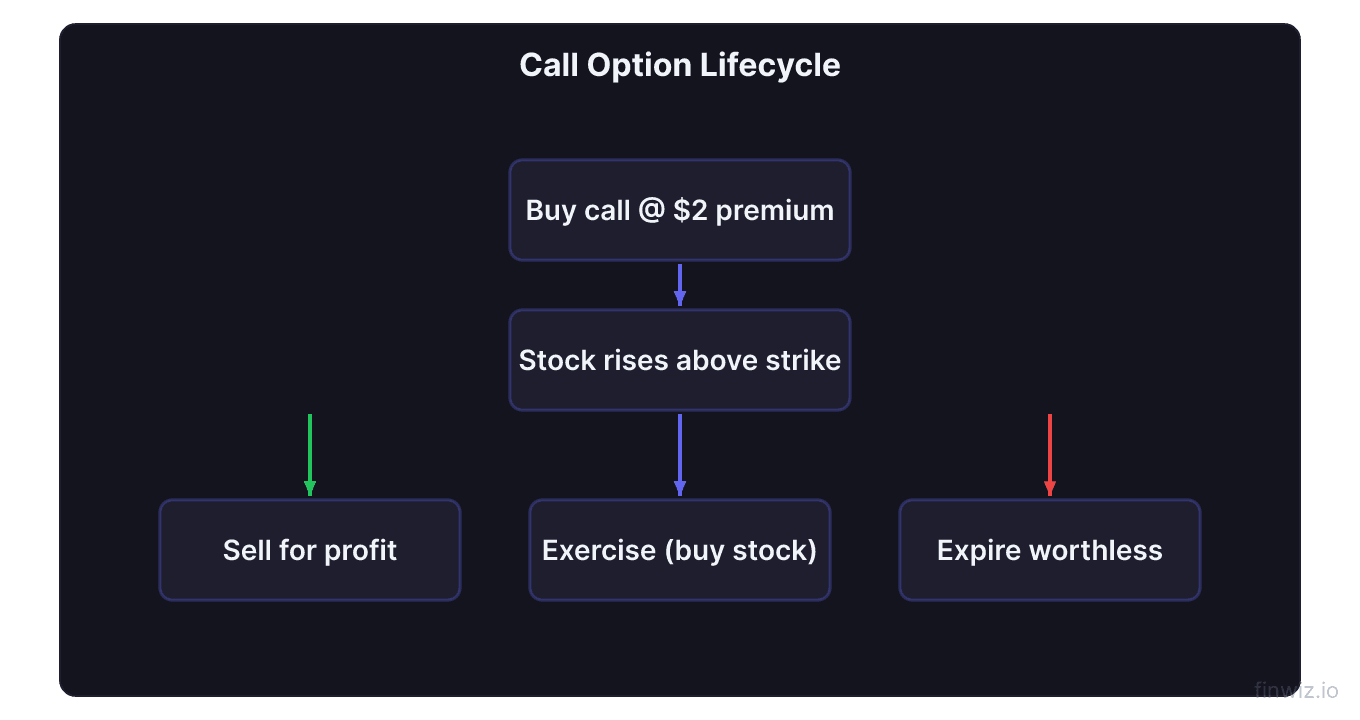
The lifecycle has four stages: opening the position, holding through price and time changes, deciding on an exit strategy, and final resolution at or before expiration. Each stage presents distinct risks and opportunities that change as the contract ages.
When you buy a call, you pay a premium to the seller. This premium reflects the market's estimate of the probability that the option will finish in the money, adjusted for time remaining and implied volatility. From this point forward, you own a depreciating asset — unless the underlying stock moves in your favor fast enough to offset time decay.
Opening the Position: What Happens When You Buy
Buying a call option — known as buy to open — creates a new long position in your account. Your broker deducts the premium from your cash balance. For example, buying one AAPL $180 call at $5.00 costs you $500 (the $5.00 per-share premium multiplied by 100 shares per contract).
At the moment of purchase, your position has both intrinsic value and extrinsic value. Intrinsic value exists only if the call is already in the money. Extrinsic value represents the time premium and volatility premium baked into the price.
Call Premium = Intrinsic Value + Extrinsic ValueIntrinsic Value = Max(Stock Price − Strike Price, 0)If AAPL trades at $183 and you buy the $180 call for $5.00, the intrinsic value is $3.00 and the extrinsic value is $2.00. That $2.00 is what you pay for the right to participate in further upside over the remaining life of the contract.
Pro Tip
Holding Period: How Your Call Changes Over Time
Once you own the call, three forces constantly push and pull its value:
Stock price movement. Delta measures how much your call gains or loses per $1 move in the stock. An at-the-money call with a delta of 0.50 gains roughly $50 per contract for every $1 the stock rises. As the stock moves deeper in the money, delta increases toward 1.00, meaning your call behaves more like stock. Understanding options moneyness is critical during this phase.
Time decay (theta). Every day that passes without a sufficient stock move costs you money. A call with 30 days to expiration might lose $0.05 per day in time value. With 7 days left, that daily decay could jump to $0.15 or more. Theta accelerates in the final two weeks before expiration.
Volatility changes (vega). If implied volatility rises after you buy, your call gains value even without a stock move. If IV drops — common after earnings announcements — your call loses value. This is the options premium component that catches many beginners off guard.
Exercise: Converting Your Call Into Stock
Exercise means you invoke your right to buy 100 shares at the strike price. If you hold an MSFT $400 call and exercise it, you purchase 100 shares of MSFT at $400 per share regardless of the current market price. Your account needs $40,000 in buying power to complete this transaction.
Most brokers auto-exercise options that are $0.01 or more in the money at expiration. This means if you forget to close or exercise your call, and it finishes in the money, you will wake up Monday morning owning 100 shares.
You can also exercise early with American-style options. However, early exercise is rarely optimal because you forfeit the remaining extrinsic value. The primary exception is when the stock is about to pay a dividend large enough to exceed the remaining extrinsic value.
Early Exercise Makes Sense When: Dividend Amount > Remaining Extrinsic ValueAssignment: The Seller's Side
While call buyers exercise, call sellers get assigned. Options assignment is the other side of the same transaction. When a call buyer exercises, the Options Clearing Corporation randomly selects a call seller with the same contract to fulfill the obligation.
If you sold a covered call on NVDA with a $900 strike and get assigned, you must deliver 100 shares at $900 per share. If you own the shares, they transfer out of your account. If you sold a naked call, your broker purchases shares at market price and delivers them, potentially generating a large loss.
Assignment can happen at any time before expiration on American-style options, though it most commonly occurs at expiration or just before an ex-dividend date.
Expiration: Three Possible Outcomes
At expiration, every call option resolves in one of three ways:
Expires in the money. The stock price is above the strike price. The option is auto-exercised, and you buy 100 shares at the strike. For an AMZN $185 call with the stock at $192, you buy shares at $185 — a $700 gain on the intrinsic value minus the premium you paid.
Expires at the money. The stock price equals the strike price exactly. The option has zero intrinsic value and expires worthless. You lose the entire premium. This scenario is uncommon but represents pin risk for sellers.
Expires out of the money. The stock price is below the strike price. The option expires worthless. Your total loss is the premium paid, and no further action is needed.
| Outcome | Stock vs. Strike | Auto-Exercise? | Result for Buyer |
|---|---|---|---|
| In the money | Stock > Strike | Yes | Buy 100 shares at strike |
| At the money | Stock = Strike | No | Option expires worthless |
| Out of the money | Stock < Strike | No | Option expires worthless |
Pro Tip
Managing Your Call Before Expiration
Smart traders rarely let calls reach expiration. Here are the standard exit strategies:
Sell to close. The most common exit. You sell the call in the open market and collect whatever value remains. This captures both intrinsic and extrinsic value, unlike exercise which captures only intrinsic value.
Roll forward. If you are still bullish but running out of time, sell your current call and buy a later-dated call. This costs additional premium but buys more time for your thesis to play out. Read more about rolling options.
Let it expire. If the call is deep out of the money with negligible value, sometimes the simplest action is to let it expire worthless rather than paying commissions to close a nearly worthless position.
Frequently Asked Questions
What happens if I hold a call option through expiration?
If the call is in the money by $0.01 or more, most brokers auto-exercise it, meaning you purchase 100 shares at the strike price. Ensure your account has sufficient buying power. If the call is out of the money, it expires worthless and disappears from your account with no further action needed.
Is it better to exercise a call or sell it before expiration?
Almost always sell the call rather than exercising. Selling captures both intrinsic and remaining extrinsic value, while exercising captures only intrinsic value. The exception is when extrinsic value is nearly zero and you want to own the shares long-term, or when you want to capture an upcoming dividend.
Can I lose more than the premium paid when buying a call?
No. Your maximum loss on a long call is strictly limited to the options premium you paid. This is true regardless of how far the stock falls. However, if you exercise the call and then the stock drops, your losses on the stock position are separate from the original option trade.
Related Articles
12 chapters covering charts, indicators, risk management & more. Plus weekly trading insights.