
Options Assignment: What Happens When You Get Assigned
⚡ Key Takeaways
- Options assignment occurs when an option seller is obligated to fulfill the terms of the contract
- Call sellers deliver 100 shares at the strike price; put sellers buy 100 shares at the strike price
- Early assignment can happen at any time on American-style options but is most common near ex-dividend dates
- Pin risk occurs when the stock closes very near the strike price at expiration
- Assignment is a normal part of options trading, not an emergency
What Is Options Assignment?
Options assignment is the process by which an option seller is required to fulfill their contractual obligation. When a call buyer exercises, the Options Clearing Corporation (OCC) randomly selects a call seller to deliver shares. When a put buyer exercises, the OCC selects a put seller to purchase shares.
Assignment only affects option sellers (writers). If you only buy options, you will never be assigned — you have rights, not obligations. But if you sell covered calls or cash-secured puts, assignment is something you must understand and prepare for.
The OCC handles assignment through a random lottery among all short option holders with matching contracts. Your broker receives the assignment notice and passes it to your account. This typically appears as an overnight transaction — you go to sleep with an options position and wake up with a stock position.
How Call Assignment Works
When you are assigned on a short call, you must sell 100 shares at the strike price. The mechanics differ depending on whether you own the underlying stock.
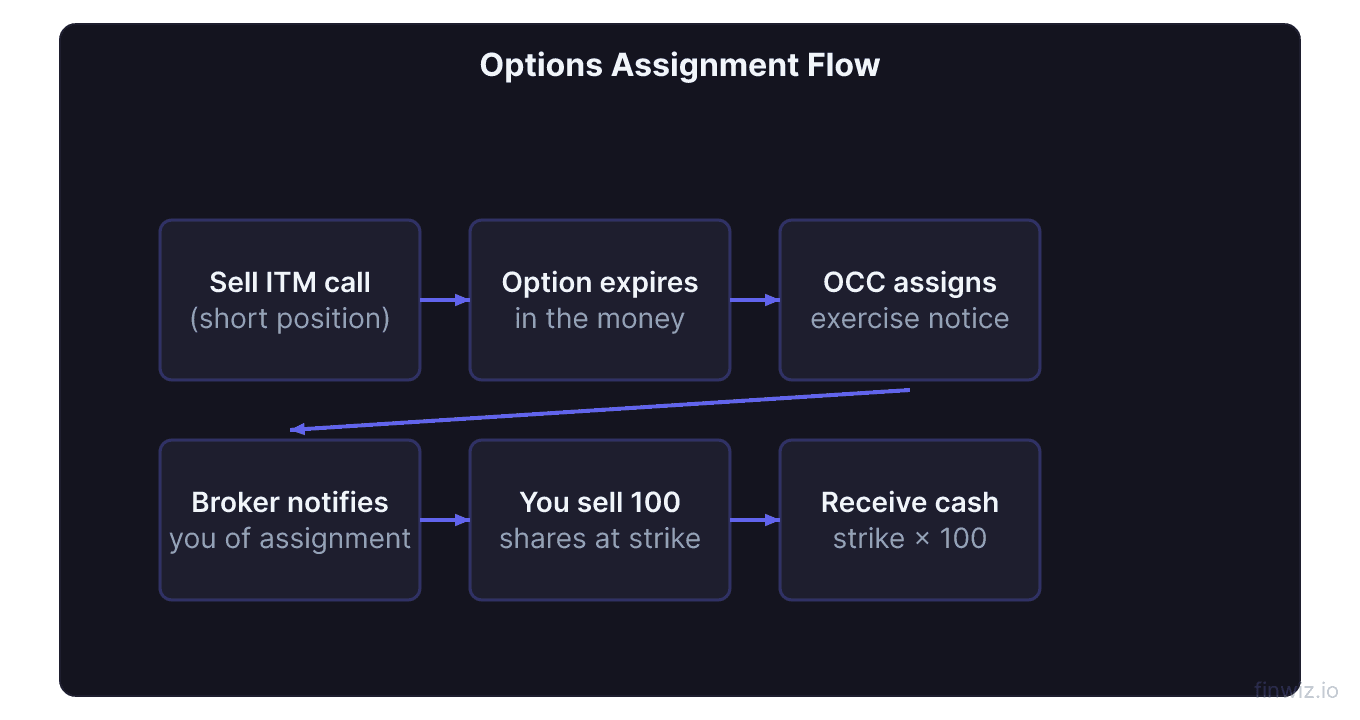
Covered call assignment. If you sold calls against shares you own, your 100 shares are sold at the strike price. The transaction settles in your account as a stock sale. Your total profit is the premium collected plus any appreciation from your purchase price to the strike price.
For example, you bought 100 shares of MSFT at $380 and sold a $400 call for $5.00. If assigned, you sell shares at $400. Total profit: ($400 − $380 + $5.00) × 100 = $2,500.
Naked call assignment. If you sold calls without owning shares, your broker buys 100 shares at market price and sells them at the strike price. If the stock is above your strike, you take a loss on the difference. This is why naked calls carry substantial risk.
Understanding how calls work gives you the full context for what happens on both sides of a call transaction.
How Put Assignment Works
When you are assigned on a short put, you must buy 100 shares at the strike price, regardless of the current market price.
If you sold an AMZN $180 put for $4.00 and the stock drops to $165, assignment means you buy 100 shares at $180. Your net cost basis is $176 ($180 strike minus $4.00 premium). You now hold shares with an unrealized loss of $11 per share ($176 cost basis minus $165 market price).
Cash-secured put sellers have the capital ready for this purchase. Margin put sellers may face a margin call if the stock drop exceeds their available margin.
Net Cost Basis (Put Assignment) = Strike Price − Premium CollectedUnrealized P&L at Assignment = (Market Price − Net Cost Basis) × 100Early Assignment: When and Why It Happens
Early assignment occurs before expiration on American-style options. While it can technically happen any time, it is uncommon on options that still have significant extrinsic value because the exerciser would forfeit that value.
Early assignment most commonly occurs in three situations:
Deep ITM options with minimal extrinsic value. When an option's extrinsic value drops to near zero, there is no financial penalty for the holder to exercise early. A call with $0.05 of extrinsic value is a prime early assignment candidate.
Before ex-dividend dates (calls). A call holder may exercise early to capture an upcoming dividend. This happens when the dividend amount exceeds the remaining extrinsic value of the call. If a stock pays a $1.50 dividend and the call has $0.80 of extrinsic value, the call holder benefits by exercising.
Deep ITM puts with high interest rates. Put holders sometimes exercise early because receiving cash now earns interest. This is more relevant in high-rate environments and for deep ITM puts on expensive stocks.
Pro Tip
Pin Risk at Expiration
Pin risk occurs when the underlying stock closes very near the strike price of your short option at expiration. The term comes from the stock being "pinned" to the strike. This creates uncertainty about whether your option will be assigned.
Suppose you sold a $150 call and the stock closes at $150.05 on expiration Friday. Your option is technically in the money by $0.05 and will likely be auto-exercised by the buyer. But after-hours trading can move the stock. If it drops to $149.90, the buyer may choose not to exercise.
The danger is not knowing your position on Monday morning. You might or might not be assigned, and you cannot take action because the market is closed.
How to manage pin risk:
- Close short options before expiration when the stock is near your strike
- Set a rule to close positions when they are within 1-2% of the strike in the final week
- Monitor options moneyness carefully as expiration approaches
- Accept that pin risk is a cost of doing business as an options seller
Handling Assignment When It Happens
Assignment is not an emergency. Here is a systematic approach:
Step 1: Confirm the assignment. Check your broker's notifications. You will see a stock position appear and the short option disappear. Verify the share quantity and price.
Step 2: Assess your new position. For call assignment, you sold shares. For put assignment, you bought shares. Calculate your net cost basis including the premium collected or paid.
Step 3: Decide your next action. You have several choices:
- Hold the shares. If you were assigned on a put and the stock is a quality long-term holding, keep it and wait for recovery.
- Sell immediately. If you do not want to hold the position, sell at market open. Accept the loss or gain.
- Sell covered calls. After put assignment, selling calls against your new shares generates income and lowers your cost basis. This is the second leg of the wheel strategy.
- Roll the option. If you are assigned early and still want the options position, you can re-establish it by selling a new option.
Avoiding Unwanted Assignment
Not all assignments are welcome. Here are strategies to reduce the likelihood:
Manage extrinsic value. Keep an eye on the extrinsic value of your short options. As long as there is meaningful extrinsic value, early assignment is unlikely. Options with more than $0.20-$0.30 of extrinsic value are generally safe.
Close before expiration. The simplest way to avoid assignment is to close your position before expiration. Buy back the short option even if it costs a small debit.
Roll in time. If you want to maintain the position, roll the option to a later expiration. This resets the extrinsic value and pushes assignment risk further out. Our options rollover guide covers rolling mechanics in detail.
Avoid short strikes near the stock price at expiration. If your short option is close to being in the money with a few days left, consider closing or rolling to avoid the uncertainty.
Pro Tip
Frequently Asked Questions
Will I always be assigned if my short option expires in the money?
Almost always, yes. The OCC auto-exercises options that are $0.01 or more in the money at expiration. However, the option holder can instruct their broker not to exercise, so there is a small chance an ITM option is not exercised. Do not count on this — assume any ITM short option at expiration will be assigned.
What happens if I do not have enough cash or shares for assignment?
If you are assigned on a put and lack sufficient cash, your broker may issue a margin call or liquidate other positions to cover the purchase. If assigned on a naked call without shares, your broker buys shares at market price, potentially creating a deficit. Always maintain sufficient capital for your worst-case assignment scenarios.
Can I be assigned on a spread?
Yes. If you trade a vertical spread or other multi-leg strategy, the short leg can be assigned independently. This is called leg risk. For example, if you sell a bull put spread and only the short put is assigned, you now own 100 shares while still holding the long put. You may need to exercise the long put or close both legs to manage the position. This is why monitoring options moneyness on spreads is essential.
12 chapters covering charts, indicators, risk management & more. Plus weekly trading insights.