
Sell to Open vs Sell to Close: Options Order Actions Explained
⚡ Key Takeaways
- Sell to Open (STO) creates a new short options position and collects premium upfront, while Sell to Close (STC) exits an existing long options position
- STO obligates you to fulfill the contract if assigned; STC simply ends your rights as a long holder
- STO typically requires margin or collateral because you are taking on an obligation with potentially significant risk
- STC is the most common way retail traders exit profitable long options positions
- Confusing these two actions can create unintended short positions with unlimited risk exposure
Sell to Open vs. Sell to Close: Understanding the Difference
Sell to Open (STO) and Sell to Close (STC) are both selling actions in options trading, but they have fundamentally different purposes and risk profiles. Sell to Open creates a new short options position where you collect premium and take on an obligation, while Sell to Close exits an existing long position that was previously established with a Buy to Open order. Choosing the wrong one can leave you with an unintended short position carrying potentially unlimited risk.
These two order actions represent opposite stages of a trade. STO is an entry that initiates a new obligation, while STC is an exit that ends your existing rights. Understanding the distinction is essential for anyone trading options beyond simple long calls and puts.
What Is Sell to Open?
Sell to Open (STO) is the order action you use to create a new short options position. You are writing a contract, selling it to a buyer, and collecting the premium. In return, you take on an obligation: if the buyer exercises, you must fulfill the terms of the contract.
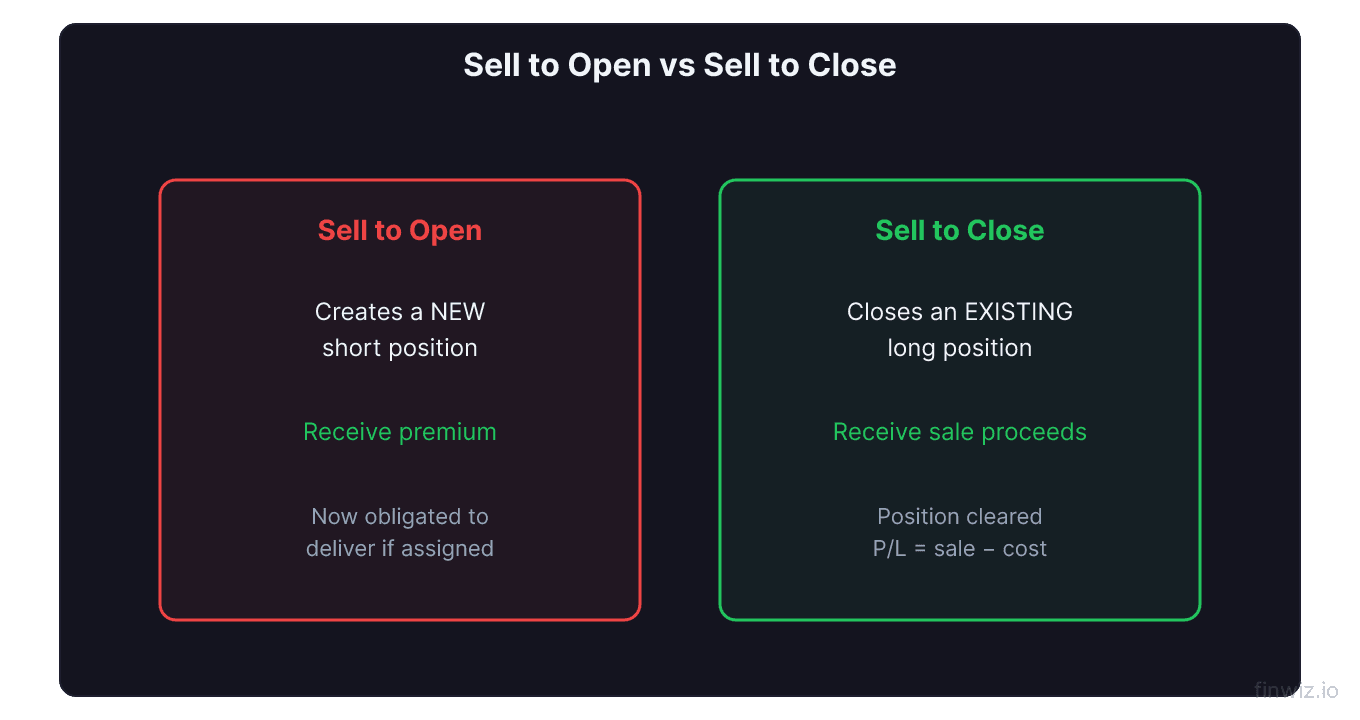
When you STO a call option, you are obligated to sell 100 shares of the underlying stock at the strike price if assigned. This is the basis of the covered call strategy when you own the shares. When you STO a put option, you are obligated to buy 100 shares at the strike price if assigned.
Key characteristics of Sell to Open:
- You receive premium immediately when the trade executes
- You take on an obligation that lasts until expiration or until you Buy to Close
- Margin or collateral is required (shares for covered calls, cash for cash-secured puts)
- Time decay works in your favor, eroding the value of the contract you sold
- Your maximum profit is the premium collected; your maximum loss can be substantial or unlimited
STO is the domain of options sellers who seek to generate income from time decay and elevated implied volatility. It requires a higher level of experience and a margin-approved account at most brokers.
What Is Sell to Close?
Sell to Close (STC) is the order action you use to exit a long options position. You previously bought a contract using Buy to Open, and now you are selling it to realize your gain or cut your loss.
When you STC, you are selling the contract you own back into the market. If the option has increased in value since you bought it, you profit from the difference. If it has decreased, you take a loss but recover whatever value remains rather than letting it expire worthless.
Key characteristics of Sell to Close:
- You are selling a contract you already own
- You receive the current market price for the contract
- The trade ends your position and eliminates all further rights
- No margin is involved because you are closing, not opening
- Any remaining time value is captured when you sell before expiration
STC is the standard exit for any trader who bought calls or puts. It is the most common way to take profits or limit losses on long options positions without exercising the contract.
Key Differences Between Sell to Open and Sell to Close
| Feature | Sell to Open (STO) | Sell to Close (STC) |
|---|---|---|
| Purpose | Opens a new short position | Closes an existing long position |
| When used | Starting a trade as a seller | Ending a trade as a buyer-turned-seller |
| Premium | You receive premium (income) | You receive proceeds (exit) |
| Position after | Short one contract | Flat (no position) |
| Risk created | Potentially unlimited (naked calls) | None (position is closed) |
| Margin impact | Requires margin or collateral | No margin impact |
| Obligation | Must fulfill if assigned | No further obligation |
| Paired with | Buy to Close (BTC) | Buy to Open (BTO) |
Sell to Open Example: Covered Call on AAPL
Suppose you own 100 shares of AAPL at $185 and want to generate income while holding the stock. You Sell to Open 1 AAPL $195 call expiring in 45 days for $3.00 per share, collecting $300 in premium.
After the STO:
- You hold 100 shares of AAPL plus 1 short call contract
- You collected $300 in premium, which is yours to keep regardless of outcome
- If AAPL stays below $195 at expiration, the call expires worthless and you keep the premium plus your shares
- If AAPL rises above $195, you may be assigned and obligated to sell your shares at $195
Three weeks later, AAPL is at $188 and the call has decayed to $0.80. You Buy to Close the call for $80, netting $220 in profit ($300 collected minus $80 paid). You still own your shares and can sell another call if desired.
This covered call example illustrates a common STO strategy. Because you own the underlying shares, the short call is "covered" and your risk is limited to missing out on gains above $195.
Pro Tip
Sell to Close Example
Suppose you bought (Buy to Open) 1 AAPL $180 call expiring in 30 days for $6.00 per share ($600 total). AAPL has risen to $192 and your call is now worth $13.50.
You Sell to Close the call for $1,350, locking in a $750 profit ($1,350 received minus $600 paid).
Why STC instead of exercising?
Exercising would give you 100 shares of AAPL at $180 (costing $18,000), but the call still had time value embedded in its price. By selling to close at $13.50, you captured both the intrinsic value ($12.00) and the remaining time value ($1.50). Exercising would have forfeited that $150 of time value.
This is why most options traders sell to close rather than exercise: you almost always get a better outcome by selling the contract than by exercising it, because selling captures any remaining time value and Greeks.
Margin Requirements for Sell to Open
Selling options requires margin or collateral because you are taking on an obligation. The margin requirements vary by strategy and significantly affect how much capital you need.
Covered calls: No additional margin is required because your shares serve as collateral. You must own at least 100 shares of the underlying stock per contract sold.
Cash-secured puts: Your broker holds cash equal to 100 x the strike price as collateral. Selling 1 AAPL $175 put requires $17,500 in cash held in reserve.
Naked calls (uncovered): This is the highest-risk STO strategy. Margin requirements are typically 20% of the underlying stock value plus the option premium, minus any out-of-the-money amount. For a naked AAPL call, this can be $3,000-$5,000 or more per contract. The risk is theoretically unlimited because the stock can rise indefinitely.
Naked puts: Margin requirements are similar to naked calls but with defined maximum risk (the stock can only fall to zero). Most brokers require the same formula: 20% of underlying value plus premium minus out-of-the-money amount.
Spreads (defined risk): When you STO one option and BTO another at a different strike (creating a spread), the margin requirement is limited to the width of the spread. A $5-wide spread requires $500 per contract in margin, regardless of the underlying stock price.
Pro Tip
When to Use Sell to Open
Income generation. STO is the foundation of options income strategies. Covered calls, cash-secured puts, iron condors, and credit spreads all begin with selling premium via STO.
High implied volatility. When IV is elevated (often before earnings), options premiums are inflated. Selling via STO captures this elevated premium, and you profit when IV contracts after the event.
Neutral market outlook. If you believe a stock will trade sideways, selling options profits from time decay without requiring directional movement. The passage of time alone generates your return.
Lowering cost basis. Selling covered calls against a stock position reduces your effective cost basis by the premium received. Over time, this can significantly enhance returns on stocks you plan to hold long term.
When to Use Sell to Close
Taking profits on long options. When your BTO position has appreciated and reached your target, STC locks in the gain before time decay or a reversal erodes it.
Cutting losses. If the trade moved against you, STC salvages whatever value remains in the contract. This is preferable to holding a losing position to zero.
Before expiration. Most brokers automatically close or exercise in-the-money options at expiration. Selling to close before expiration gives you control over the outcome and avoids unintended share assignments.
Capturing time value. If you hold an in-the-money option but there is still significant time value, STC captures that time value. Exercising would forfeit it.
Frequently Asked Questions
What happens if I use Sell to Open when I meant Sell to Close?
You will create a new short position instead of exiting your long position. You will then hold both a long and a short contract simultaneously. Depending on the strikes and expirations, this may create an unintended spread or leave you with naked short exposure. Contact your broker to correct the error promptly.
Can I Sell to Close a contract I did not Buy to Open?
No. Sell to Close requires an existing long position in the exact contract (same underlying, strike, expiration, and type). If you do not hold a long position, the broker will process the order as Sell to Open, creating a new short position.
Is Sell to Open riskier than Buy to Open?
Generally, yes. When you Buy to Open, your maximum loss is the premium paid. When you Sell to Open a naked call, your maximum loss is theoretically unlimited. Covered calls and cash-secured puts have defined risk, but the obligation remains until the position is closed. This is why most brokers require higher account approval levels for STO strategies.
Do I need special account permissions for Sell to Open?
Yes. Most brokers have tiered options approval levels. Level 1 typically allows covered calls only. Level 2 adds long calls and puts (BTO). Level 3 adds spreads. Level 4 or 5 allows naked calls and puts (unrestricted STO). You must apply for approval and meet minimum account balance and experience requirements.
When should I Sell to Close a profitable long option?
A common guideline is to Sell to Close when the option has reached 50-100% of your profit target or when it has lost more than 50% of its remaining time value. Holding too long exposes you to time decay accelerating in the final weeks before expiration, where you can lose gains quickly even if the stock does not move against you.
12 chapters covering charts, indicators, risk management & more. Plus weekly trading insights.