
LEAPS Options: Long-Term Options for Patient Traders
⚡ Key Takeaways
- LEAPS (Long-Term Equity Anticipation Securities) are options contracts with expiration dates more than 9 months out, typically 1-3 years
- LEAPS can serve as a stock replacement strategy, providing leveraged exposure at a fraction of the share price
- Deep in-the-money LEAPS calls have high delta and closely mimic stock price movement
- Time decay (theta) is minimal on LEAPS compared to short-term options, giving your thesis more time to play out
- LEAPS are available on major stocks and indices but may have wider bid-ask spreads than near-term options
What Are LEAPS Options?
LEAPS stands for Long-Term Equity Anticipation Securities. These are options contracts with expiration dates that extend more than nine months into the future, with some expiring as far as two to three years from the current date. They function identically to standard options in every way except their extended time horizon.
Every LEAPS contract gives the holder the right to buy (call) or sell (put) 100 shares of the underlying stock or ETF at a specified strike price before the expiration date. The extended time frame is what makes LEAPS unique and opens up strategies that short-term options simply cannot replicate.
LEAPS were introduced by the CBOE (Chicago Board Options Exchange) in 1990 to give investors a way to take longer-term positions using options. They are available on hundreds of individual stocks, major ETFs like SPY and QQQ, and some indices.
The longer duration changes the fundamental character of the option. While a 30-day option is primarily a short-term trading instrument, a LEAPS contract behaves more like a leveraged stock position with built-in downside protection.
Why LEAPS Have a Strategic Advantage
The extended time frame of LEAPS creates several important advantages over short-term options. Understanding these benefits is critical for using LEAPS effectively.
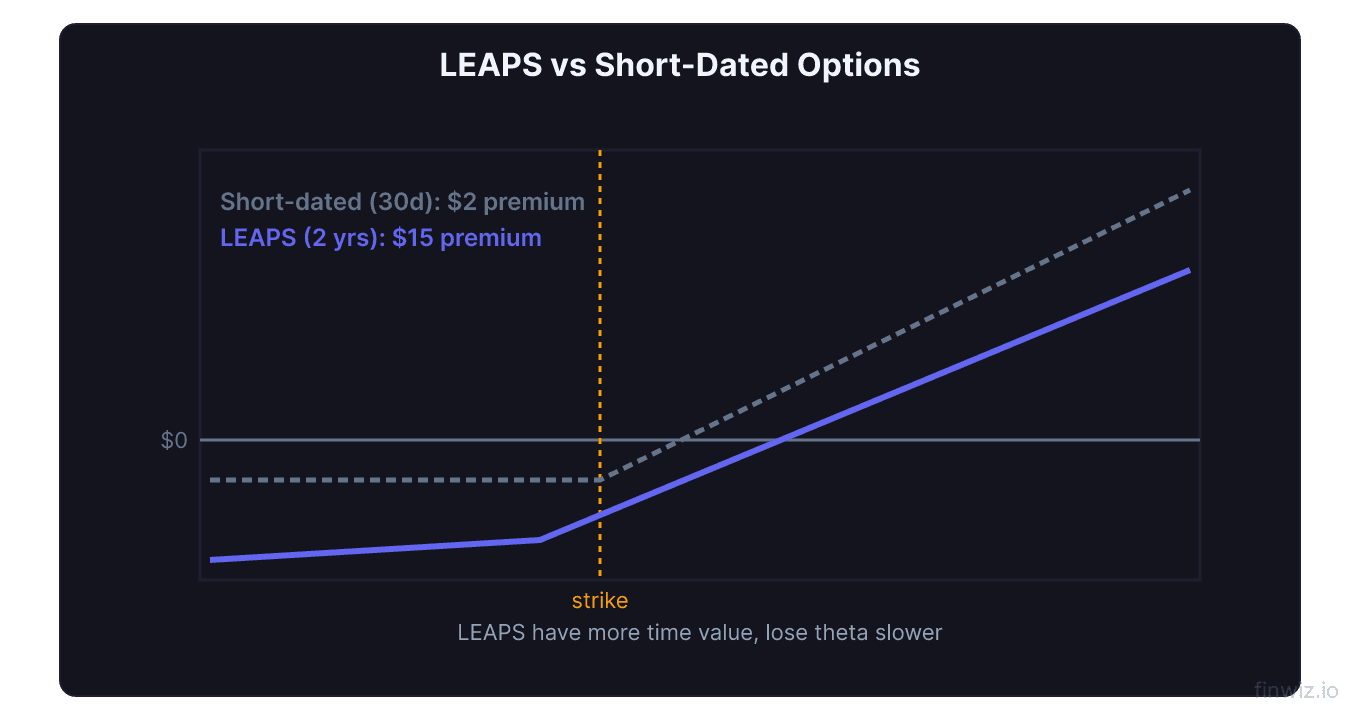
Reduced time decay is the primary advantage. Theta, the rate at which an option loses value each day, is not linear. It accelerates dramatically in the final 30-60 days before expiration. A LEAPS contract with 18 months remaining loses very little value each day compared to a monthly option.
Approximate Daily Theta: A $10.00 LEAPS option might lose $0.01-$0.02 per day, while a $2.00 monthly option could lose $0.05-$0.10 per dayMore time for your thesis. If you believe a stock will rise over the next year, buying a short-term call option requires the move to happen quickly. With LEAPS, you can be right on direction but imprecise on timing and still profit.
Lower capital requirement. Buying 100 shares of a $200 stock costs $20,000. A deep in-the-money LEAPS call on the same stock might cost $4,000-$5,000, freeing up capital for other investments or for diversification.
Built-in risk management. Your maximum loss is the premium paid for the LEAPS, no matter how far the stock falls. This creates a natural stop-loss without the risk of being stopped out by temporary volatility.
The Stock Replacement Strategy
The most popular use of LEAPS is as a stock replacement strategy. Instead of buying shares outright, you purchase a deep in-the-money LEAPS call that closely mimics the stock's price movement.
For an effective stock replacement, look for LEAPS calls with a delta of 0.80 or higher. This means the option will move roughly $0.80 for every $1.00 move in the stock. The deeper in-the-money you go, the higher the delta and the more closely the LEAPS tracks the stock.
Here is a comparison of buying stock versus a LEAPS stock replacement:
| Factor | Buy 100 Shares | LEAPS Call (0.80 Delta) |
|---|---|---|
| Stock price | $150 | $150 |
| Capital required | $15,000 | ~$3,500 |
| Upside participation | 100% | ~80% (at entry) |
| Downside risk | Full ($15,000) | Limited ($3,500) |
| Dividends | Yes | No |
| Time limit | None | 1-2 years |
| Leverage | 1x | ~4.3x |
Pro Tip
How to Select the Right LEAPS Contract
Choosing the right LEAPS requires balancing several factors. The strike price, expiration date, and underlying selection all impact your trade's probability of success.
Strike price selection depends on your strategy. For stock replacement, go deep in-the-money with delta above 0.80. For speculative bullish bets with less capital, at-the-money or slightly out-of-the-money LEAPS provide more leverage but lower probability of profit.
Expiration selection matters enormously. Always choose the longest available expiration unless there is a specific reason not to. The marginal cost of additional time decreases as you go further out, meaning you get more days per dollar spent.
Underlying selection should focus on stocks you would be comfortable owning for years. LEAPS work best on high-quality companies with strong fundamentals. Avoid using LEAPS on highly speculative or volatile small-cap stocks where the premium may be excessive relative to the potential return.
Implied volatility affects LEAPS pricing significantly. When IV is elevated, LEAPS are expensive. If possible, buy LEAPS when implied volatility is below its historical average for that stock. This gives you the potential for a volatility tailwind if IV expands later.
LEAPS Strategies Beyond Stock Replacement
While stock replacement is the most common application, LEAPS enable several other powerful strategies.
Poor man's covered call. Instead of buying 100 shares and selling covered calls, you buy a deep in-the-money LEAPS call and sell short-term calls against it. This is also known as a diagonal spread. The LEAPS serves as your "stock" position at a fraction of the cost.
| Component | Traditional Covered Call | Poor Man's Covered Call |
|---|---|---|
| Long position | 100 shares ($15,000) | LEAPS call ($3,500) |
| Short position | Monthly OTM call | Monthly OTM call |
| Capital at risk | Much higher | Much lower |
| Return on capital | Lower % | Higher % |
| Dividend income | Yes | No |
LEAPS puts for portfolio protection. Buying long-dated put options on your portfolio or an index ETF provides insurance against market crashes. The cost per day is lower than short-term puts, and you avoid the hassle of constantly rolling short-term protection.
LEAPS bull call spread. Buy an in-the-money LEAPS call and sell an out-of-the-money LEAPS call at a higher strike. This reduces your net cost while capping your upside. The debit spread structure works well for investors with a moderately bullish outlook over a long time horizon.
Married LEAPS put. If you own shares and want long-term downside protection, buy a LEAPS put. This establishes a floor on your losses while allowing unlimited upside. It is essentially a long-term insurance policy on your stock position.
Managing LEAPS Positions Over Time
LEAPS require different management techniques than short-term options. The extended time frame means you will need to monitor and adjust positions over many months.
Rolling forward is the most important management technique. As your LEAPS approaches the 6-9 month mark, theta decay begins to accelerate. To maintain the time advantage, sell your current LEAPS and buy a new one with a longer expiration. This "roll" keeps you in the position while resetting the theta clock.
Roll Cost = New LEAPS Premium - Current LEAPS ValueIf the stock has moved in your favor, the roll may cost very little because your existing LEAPS has gained intrinsic value. If the stock has moved against you, the roll will be more expensive.
Adjusting strike prices can be done during a roll. If the stock has appreciated significantly, you can roll to a higher strike that is still in-the-money, potentially extracting some profit while maintaining the position. If the stock has declined, rolling to a lower strike increases your delta but costs more premium.
Taking partial profits is wise when the stock makes a significant move. You might sell half your LEAPS position to lock in gains and let the remaining contracts ride. This is particularly smart when you have achieved 50% or more of your expected profit well before expiration.
Monitoring implied volatility throughout the life of the trade is important. If IV spikes (perhaps due to market fear or an upcoming event), your LEAPS will gain value beyond any stock price change. This can present an opportunity to close at a profit even if the stock has not moved as much as expected.
Risks and Drawbacks of LEAPS
Despite their advantages, LEAPS carry risks that investors must understand before trading them.
Premium decay is real. While theta is slow on LEAPS, it is not zero. Over 18 months, a LEAPS option can lose significant value to time decay, especially if the stock moves sideways. You need the stock to move enough to overcome this cost.
No dividends. LEAPS call holders do not receive dividends. If you are replacing a dividend-paying stock with a LEAPS call, factor in the lost dividend income. On high-yield stocks, this opportunity cost can be substantial.
Wider bid-ask spreads. LEAPS tend to have lower trading volume than near-term options, resulting in wider spreads. This means you lose more to the spread when entering and exiting. Use limit orders and be patient for fills.
Opportunity cost of premium. The premium paid for LEAPS is capital that could be invested elsewhere. If the stock barely moves over the life of the option, you would have been better off simply buying shares or investing in something else.
Volatility risk (vega). LEAPS have high vega, meaning they are very sensitive to changes in implied volatility. A significant drop in IV can cause your LEAPS to lose value even if the stock price is unchanged. This is particularly dangerous if you buy LEAPS when IV is elevated.
Tax Considerations for LEAPS
LEAPS can offer favorable tax treatment compared to short-term options, though the rules are specific.
If you hold a LEAPS option for more than 12 months before selling, the gain qualifies for long-term capital gains tax rates, which are lower than short-term rates for most investors. This is a significant advantage over trading short-term options, which almost always generate short-term capital gains.
However, if you exercise a LEAPS call and buy the stock, the holding period for the stock starts on the exercise date, not when you purchased the LEAPS. To get long-term capital gains on the stock itself, you would need to hold the shares for an additional 12 months after exercise.
Pro Tip
Frequently Asked Questions
How much do LEAPS cost compared to regular options?
LEAPS cost significantly more than short-term options because of their extended time value. A 2-year LEAPS call might cost 2-4 times more than a 3-month option at the same strike. However, the cost per day of time value is actually lower. For stock replacement, deep ITM LEAPS consist mostly of intrinsic value with a relatively small time value component.
Can I sell LEAPS before they expire?
Absolutely. You can sell a LEAPS contract at any time before expiration, just like any other option. Most LEAPS traders close their positions well before expiration rather than exercising. Selling preserves any remaining time value, whereas exercising forfeits it.
Are LEAPS available on all stocks?
No. LEAPS are generally available only on larger, more liquid stocks and major ETFs. Smaller companies, low-volume stocks, and newer IPOs may not have LEAPS listed. Check your broker's options chain and filter for expirations beyond 9 months to see what is available.
What delta should I target for LEAPS?
For stock replacement, target a delta of 0.80 or higher, which usually means going 15-20% in-the-money. For speculative positions where you want more leverage, a delta of 0.50-0.70 (at-the-money to slightly ITM) provides more upside percentage gain but lower probability of profit.
How do LEAPS perform in a flat or declining market?
LEAPS calls will lose value in flat or declining markets due to time decay and directional loss. This is the primary risk. If you expect a flat market, LEAPS are not the right strategy. If you are bearish, LEAPS puts would be appropriate. For neutral views, consider strategies like calendar spreads instead.
Disclaimer
This is educational content, not financial advice. Trading involves risk, and you should consult a qualified financial advisor before making any investment decisions. Past performance does not guarantee future results.
Related Articles
12 chapters covering charts, indicators, risk management & more. Plus weekly trading insights.