
Diagonal Spreads: Combining Time & Direction
⚡ Key Takeaways
- A diagonal spread uses different strike prices AND different expiration dates, combining elements of vertical and calendar spreads
- The most popular diagonal is the
- s covered call
What Is a Diagonal Spread?
A diagonal spread is an options strategy that combines a vertical spread (different strikes) with a calendar spread (different expirations) into a single position. You buy one option at one strike and expiration while selling another option at a different strike and different expiration.
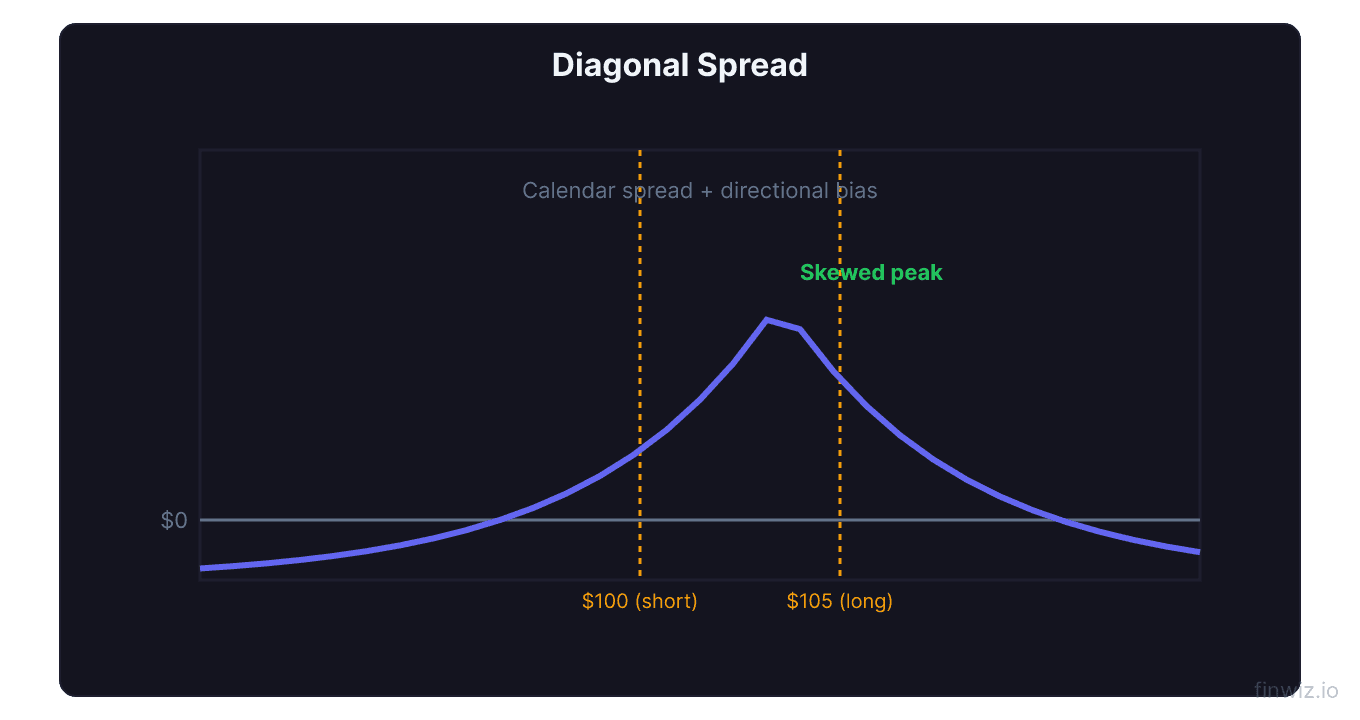
The name "diagonal" comes from how the position looks on an options chain. Vertical spreads move up and down the strike column. Calendar spreads move horizontally across the expiration row. Diagonals move diagonally across both dimensions simultaneously.
Diagonal spreads are versatile. Depending on the strikes and expirations chosen, they can be constructed as bullish, bearish, or neutral strategies. The most popular application is the poor man's covered call (PMCC), which replicates a covered call position using LEAPS options instead of stock, dramatically reducing capital requirements.
The dual nature of diagonals means they benefit from both directional movement (from the vertical component) and differential time decay (from the calendar component). This two-pronged approach gives diagonals flexibility that single-dimension spreads cannot match.
The Poor Man's Covered Call (PMCC)
The poor man's covered call is by far the most popular diagonal spread. It mimics a covered call position at a fraction of the capital.
Construction:
- Buy 1 deep ITM call with a long-dated expiration (6+ months, ideally LEAPS)
- Sell 1 OTM call with a near-term expiration (30-45 days)
For example, stock XYZ is trading at $100:
| Leg | Strike | Expiration | Delta | Premium |
|---|---|---|---|---|
| Long LEAPS call | $80 | 12 months | 0.85 | $23.00 |
| Short monthly call | $105 | 30 days | 0.25 | $1.50 |
| Net debit | $21.50 |
Compare this to a traditional covered call:
| Approach | Capital Required | Monthly Income | Return on Capital |
|---|---|---|---|
| Traditional covered call | $10,000 (100 shares) | $150 (1.5%) | 1.5%/month |
| Poor man's covered call | $2,150 (LEAPS) | $150 (7.0%) | 7.0%/month |
The PMCC achieves the same dollar income ($150/month) on roughly one-fifth the capital. This dramatically improves your percentage return, though the risk profiles differ.
Pro Tip
Constructing Bullish Diagonal Spreads
Beyond the PMCC, there are other bullish diagonal configurations for different market views.
Moderately bullish diagonal call spread:
- Buy 1 ATM or slightly ITM call with 60-90 day expiration
- Sell 1 OTM call with 30 day expiration at a higher strike
This structure costs less than the PMCC because you are not buying a deep ITM LEAPS. The trade-off is lower delta on the long leg and more sensitivity to adverse stock movement.
| Configuration | Long Call | Short Call | Bias | Capital |
|---|---|---|---|---|
| PMCC | Deep ITM, 12mo | OTM, 30 days | Strong bullish | High |
| Moderate diagonal | ATM, 60 days | OTM, 30 days | Moderate bullish | Medium |
| Aggressive diagonal | OTM, 60 days | Further OTM, 30 days | Speculative bullish | Low |
For the moderate bullish diagonal with XYZ at $100:
| Leg | Strike | Expiration | Premium |
|---|---|---|---|
| Long call | $100 | 60 days | $5.50 |
| Short call | $105 | 30 days | $1.50 |
| Net debit | $4.00 |
After the front month expires, if the stock is between $100 and $105, the short call expires worthless and you still hold a 30-day $100 call. You can then sell another short-term call, repeating the process.
Constructing Bearish Diagonal Spreads
Bearish diagonals work the same way but use put options to profit from declining stock prices.
Bearish diagonal put spread:
- Buy 1 deep ITM put with longer expiration
- Sell 1 OTM put with shorter expiration at a lower strike
This is the put-side equivalent of the PMCC, sometimes called the poor man's covered put. It profits when the stock declines or stays in a range.
For example, XYZ trading at $100:
| Leg | Strike | Expiration | Premium |
|---|---|---|---|
| Long put | $120 | 6 months | $22.00 |
| Short put | $95 | 30 days | $1.25 |
| Net debit | $20.75 |
The short put generates income as it decays. If the stock stays above $95, the short put expires worthless and you sell another. If the stock drops, your long $120 put gains value from both delta and the stock decline.
Bearish diagonals are less common than bullish ones because the stock market has a long-term upward bias, but they are useful for hedging portfolios or expressing bearish views on specific overvalued stocks.
How Greeks Impact Diagonal Spreads
Diagonals have a complex Greek profile because of the two different expirations. Understanding these dynamics is essential for managing the position.
Delta: The net delta of a diagonal is determined by the difference between the long and short option deltas. A PMCC with a 0.85 delta long call and a -0.25 delta short call has a net delta of approximately +0.60. This means the position gains $0.60 for every $1 the stock rises.
Theta: This is where diagonals shine. The short near-term option decays faster than the long longer-term option. Your net theta is positive, meaning you earn money each day from time decay. The theta advantage is similar to a calendar spread but with an added directional component.
Vega: Diagonals have positive net vega because the longer-dated option has higher vega than the shorter-dated one. Rising implied volatility helps the position; falling IV hurts it.
Gamma: The short near-term option has higher gamma than the long longer-term option, giving the diagonal negative gamma. This means large, sudden stock moves hurt the position more than gradual moves.
| Greek | Impact | Management Implication |
|---|---|---|
| Delta | Positive (bullish diagonal) | Stock must not collapse |
| Theta | Positive | Time is your friend |
| Vega | Positive | Avoid entering when IV is high |
| Gamma | Negative | Large moves hurt |
Managing Diagonal Spreads Over Time
Diagonals require more active management than simple vertical spreads because the short option expires while the long option continues.
At short option expiration, you have three choices:
1. Roll the short option forward. If the stock is near or below the short strike, buy back the expiring short option (if it has any remaining value) and sell the next month's option at the same or different strike. This collects additional credit and continues the income cycle.
2. Close the entire diagonal. If you have reached your profit target or the thesis has changed, close both legs and take your profit or loss.
3. Keep the long option alone. If your directional view has strengthened, let the short option expire and hold the long option for further gains. This converts the diagonal into a straight directional trade.
Rolling the short strike:
| Scenario | Rolling Action | Effect |
|---|---|---|
| Stock below short strike | Roll same strike, next month | Collect full premium |
| Stock at short strike | Roll up and out | Collect credit, raise ceiling |
| Stock above short strike | Roll up and out | May require small debit |
Total Return = Sum of All Short Option Premiums + Change in Long Option Value - Initial DebitPro Tip
Risk Scenarios and How to Handle Them
Understanding the specific risk scenarios for diagonals helps you react quickly when things go wrong.
Risk 1: Stock drops sharply. Your long call loses value and the short call expires worthless. You still own the long call, which has time value remaining. If the stock has dropped significantly but you remain bullish, sell another short-term call at a lower strike to generate income while waiting for recovery.
Risk 2: Stock surges above the short strike. The short call goes in-the-money. If you hold until expiration, the short call may be assigned, requiring you to deliver 100 shares. Since you own a call (not stock), you would exercise your long call to fulfill the obligation. The result is a gain equal to the difference between strikes minus the net debit, plus any premiums collected.
Risk 3: Implied volatility collapses. Both options lose extrinsic value, but the long option loses more (higher vega). The spread narrows and you lose money. This is most dangerous if IV was elevated when you entered. Avoid entering diagonals when IV rank is above 50%.
Risk 4: Early assignment on short call. If the short call is assigned before expiration (most likely near ex-dividend dates), you are obligated to sell 100 shares. You would exercise your long call to obtain the shares. The net result is the same as if both options expired ITM. Early assignment is an inconvenience but not a disaster.
Diagonal Spreads vs Calendar Spreads
Diagonals and calendar spreads are closely related. Understanding the differences helps you choose the right strategy.
| Feature | Calendar Spread | Diagonal Spread |
|---|---|---|
| Strikes | Same | Different |
| Directional bias | Neutral | Directional |
| Theta benefit | Yes | Yes |
| Vega sensitivity | High | Moderate |
| Profit zone | Narrow, centered | Wider, directional |
| Flexibility | Less | More |
| Complexity | Moderate | Higher |
Calendars are better for pure volatility plays where you expect the stock to pin at a specific price. Diagonals are better when you have a directional view but also want to collect income from time decay. The diagonal's different strikes give it a wider profit zone and a directional tilt.
Frequently Asked Questions
How much capital do I need for a poor man's covered call?
The capital requirement equals the cost of the deep ITM LEAPS call. For a $100 stock, a deep ITM LEAPS call (e.g., $80 strike, 12-month expiration) might cost $2,200-$2,500. This is roughly 20-25% of the capital needed for a traditional covered call ($10,000 for 100 shares). The exact cost depends on the stock's IV and how deep in-the-money you go.
Can I lose more than my initial debit on a diagonal spread?
In most configurations, the maximum loss is the net debit paid. However, there is a special risk if the extrinsic value of your long LEAPS exceeds the distance between the strikes. In that case, if the stock surges well past the short strike, the loss on the short call can exceed the gain on the long call's intrinsic value because the remaining time value in the LEAPS is lost when you exercise. To avoid this, ensure the LEAPS extrinsic value is less than the strike width.
How often should I sell the short-term option?
Most PMCC traders sell new short-term calls every 30-45 days, coinciding with the monthly options cycle. Some use weeklies for more frequent income but this requires more active management. A good rhythm is selling a new call the day after the previous one expires or is closed.
What delta should the short call be?
For the short-term short call, target a delta between 0.20 and 0.30. This provides a 70-80% probability of expiring worthless while still collecting meaningful premium. Lower deltas (0.10-0.15) are safer but generate less income. Higher deltas (0.35-0.40) collect more premium but are more likely to be challenged.
Is the PMCC suitable for beginners?
The PMCC is an intermediate-level strategy. You should be comfortable with how options work, understand the Greeks, and have experience with basic strategies like covered calls and debit spreads before attempting diagonals. The multi-expiration structure and rolling decisions add complexity beyond simple vertical spreads.
Disclaimer
This is educational content, not financial advice. Trading involves risk, and you should consult a qualified financial advisor before making any investment decisions. Past performance does not guarantee future results.
Related Articles
12 chapters covering charts, indicators, risk management & more. Plus weekly trading insights.