
How Do Options Work? The Mechanics Behind Every Contract
⚡ Key Takeaways
- Options are contracts that give you the right (but not obligation) to buy or sell an asset at a specific price before a specific date
- Call options give the right to buy; put options give the right to sell
- Every options contract controls 100 shares of the underlying stock
- The premium is the price you pay to purchase an option, and it consists of intrinsic value plus time value
- Options expire on specific dates — if not exercised or sold before expiration, they become worthless
What Are Options Contracts?
An options contract is a financial agreement between two parties that gives the buyer the right, but not the obligation, to buy or sell an underlying asset at a predetermined price within a specific time frame. The buyer pays a premium for this right, while the seller receives the premium and takes on the obligation.
Think of options like insurance policies. When you buy car insurance, you pay a premium for the right to file a claim if something happens. You hope you never need it, but the protection is there. Similarly, options buyers pay a premium for the right to buy or sell stock at a guaranteed price.
Options are traded on options exchanges just like stocks. The major exchanges include the CBOE (Chicago Board Options Exchange), NYSE Arca, and NASDAQ Options Market. You can buy and sell options through any standard brokerage account that has options trading enabled.
Every options contract represents 100 shares of the underlying stock. This is a critical detail that beginners often overlook. When you see an option quoted at $2.00, the actual cost is $200 ($2.00 x 100 shares). This multiplier effect is what gives options their leverage.
Calls vs Puts: The Two Types of Options
There are only two types of options: calls and puts. Understanding the difference is the foundation of all options trading.
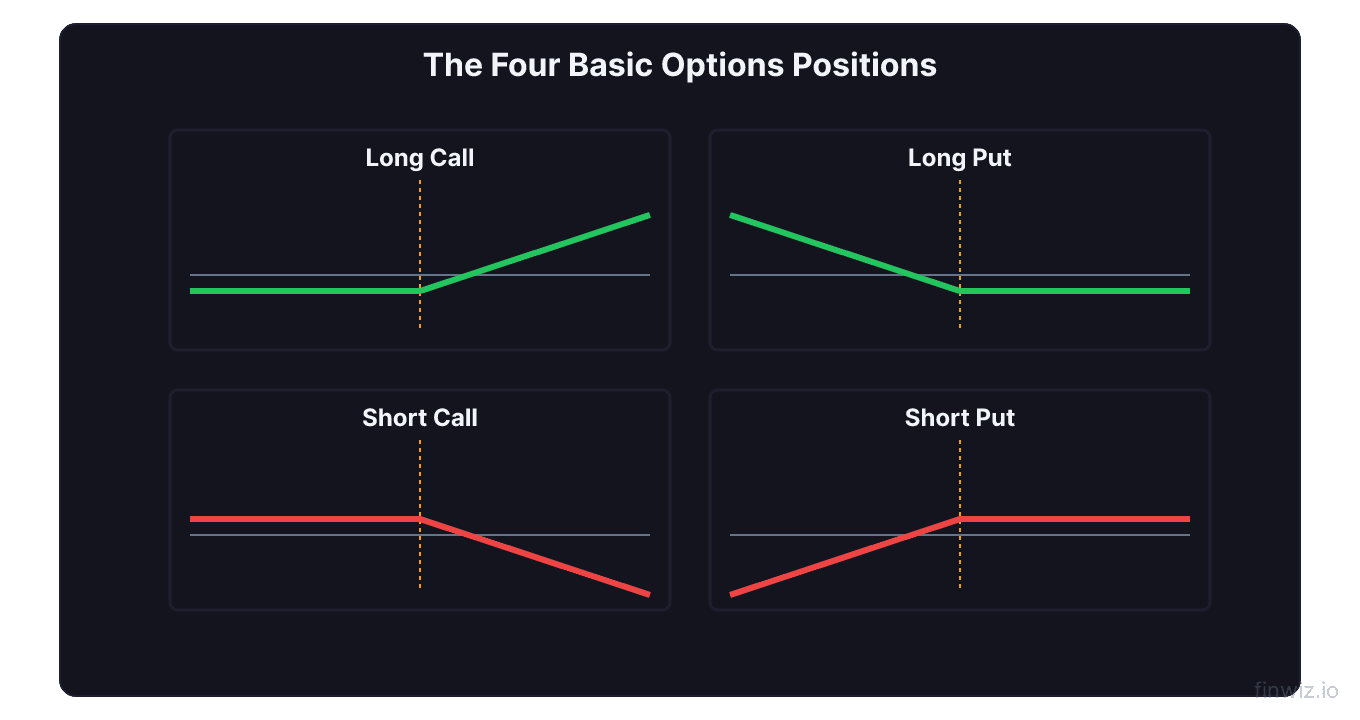
Call options give the holder the right to buy 100 shares of the underlying stock at the strike price before expiration. You buy calls when you are bullish and expect the stock to rise. If the stock goes up, the call increases in value and you can sell it for a profit or exercise it to buy shares at the lower strike price.
Put options give the holder the right to sell 100 shares of the underlying stock at the strike price before expiration. You buy puts when you are bearish and expect the stock to fall. If the stock drops, the put increases in value.
| Feature | Call Option | Put Option |
|---|---|---|
| Right to | Buy stock | Sell stock |
| Profitable when | Stock rises | Stock falls |
| Buyer is | Bullish | Bearish |
| Seller is | Neutral/bearish | Neutral/bullish |
| Max loss (buyer) | Premium paid | Premium paid |
| Max gain (buyer) | Unlimited | Strike price - premium |
For every buyer, there is a seller. The option seller (also called the writer) takes the opposite obligation. A call seller must sell shares at the strike price if the buyer exercises. A put seller must buy shares at the strike price if exercised.
Understanding the Premium
The premium is the price of the option. It is what you pay as a buyer and what you receive as a seller. The premium has two components: intrinsic value and extrinsic value (time value).
Intrinsic value is the amount by which an option is in-the-money. For a call option, intrinsic value equals the stock price minus the strike price (if positive). For a put, it is the strike price minus the stock price (if positive). An option that is out-of-the-money has zero intrinsic value.
Call Intrinsic Value = Stock Price - Strike Price (if positive, otherwise 0)Put Intrinsic Value = Strike Price - Stock Price (if positive, otherwise 0)Extrinsic value (time value) is the remaining premium beyond the intrinsic value. It represents the possibility that the option could become more valuable before expiration. Extrinsic value depends on time remaining, implied volatility, and how close the stock is to the strike price.
Extrinsic Value = Total Premium - Intrinsic ValueFor example, stock XYZ is at $105. The $100 call is trading at $7.00:
- Intrinsic value: $105 - $100 = $5.00
- Extrinsic value: $7.00 - $5.00 = $2.00
The $2.00 of extrinsic value is what you are paying for the time and possibility of further gains. This extrinsic value decays to zero by expiration.
Strike Prices and Moneyness
The strike price is the predetermined price at which the option holder can buy (call) or sell (put) the underlying stock. Each stock typically has options available at many different strike prices, usually spaced $1, $2.50, or $5 apart depending on the stock price.
Options are categorized by their relationship to the current stock price:
In-the-money (ITM): A call is ITM when the stock price is above the strike. A put is ITM when the stock price is below the strike. ITM options have intrinsic value.
At-the-money (ATM): The strike price is approximately equal to the current stock price. ATM options have no intrinsic value but typically have the highest extrinsic value.
Out-of-the-money (OTM): A call is OTM when the stock price is below the strike. A put is OTM when the stock price is above the strike. OTM options have zero intrinsic value — they are entirely extrinsic value.
| Stock at $100 | Call Moneyness | Put Moneyness |
|---|---|---|
| $90 strike | Deep ITM | Deep OTM |
| $95 strike | ITM | OTM |
| $100 strike | ATM | ATM |
| $105 strike | OTM | ITM |
| $110 strike | Deep OTM | Deep ITM |
Pro Tip
Expiration Dates and Time Decay
Every option has an expiration date, after which the contract ceases to exist. Options are available in various time frames:
- Weekly options: Expire every Friday (available on popular stocks and ETFs)
- Monthly options: Expire on the third Friday of each month
- Quarterly options: Expire on the last business day of each quarter
- LEAPS: Expire 1-3 years out (learn more about LEAPS)
As expiration approaches, the extrinsic value of an option decreases. This phenomenon is called time decay or theta decay. Time decay is the option buyer's enemy and the option seller's friend.
Time decay is not linear. It accelerates as expiration gets closer. An option loses roughly the same amount of time value in its last 30 days as it does in the previous 60 days combined. This is why most professional options traders prefer short time frames when selling and longer time frames when buying.
Approximate time value decay: An ATM option with 30 DTE might have $3.00 in time value. With 15 DTE, it might have $2.10. With 7 DTE, about $1.40. With 1 DTE, about $0.50.How Exercise and Assignment Work
Exercise is when the option buyer uses their right to buy (call) or sell (put) shares at the strike price. Assignment is when the option seller is obligated to fulfill the other side of that transaction.
Most options traders never exercise their options. Instead, they sell the option contract itself for a profit or loss before expiration. Selling the option is usually better because exercising forfeits any remaining time value.
American-style options can be exercised at any time before expiration. Most stock options are American-style. European-style options can only be exercised at expiration. Most index options (like SPX) are European-style.
Automatic exercise occurs at expiration. If an option is in-the-money by $0.01 or more at expiration, it is automatically exercised unless the holder instructs otherwise. This means:
- An expiring ITM call results in buying 100 shares at the strike price
- An expiring ITM put results in selling 100 shares at the strike price
If you do not have sufficient capital or shares in your account, this can create significant problems. Always close or manage positions before expiration to avoid unintended exercise.
The Options Greeks for Beginners
The Greeks are metrics that describe how an option's price changes in response to various factors. You do not need to memorize complex formulas, but understanding the basics helps you make better trading decisions.
Delta measures how much the option price changes for a $1 move in the stock. A call with 0.50 delta gains $0.50 when the stock rises $1. Puts have negative delta (e.g., -0.50). Delta also approximates the probability of the option expiring in-the-money.
Theta measures the daily time decay. A theta of -$0.05 means the option loses $0.05 per day just from the passage of time, all else being equal. Theta is negative for option buyers and positive for sellers.
Implied Volatility (IV) measures the market's expectation of future price movement. Higher IV means more expensive options. IV affects the vega of the option, which tells you how much the option price changes per 1-point change in IV.
| Greek | Measures | Buyer Impact | Seller Impact |
|---|---|---|---|
| Delta | Price sensitivity to stock | Positive (calls) | Negative (calls) |
| Theta | Time decay rate | Negative | Positive |
| Vega | IV sensitivity | Positive | Negative |
| Gamma | Rate of delta change | Positive | Negative |
Your First Options Trade: A Walkthrough
Let's walk through a complete example of buying a call option from start to finish.
The setup: You believe stock ABC, currently trading at $50, will rise to $55 within the next month.
Step 1: Choose the option. You look at the options chain and select the $52 call expiring in 35 days, priced at $1.50 ($150 per contract).
Step 2: Place the order. You buy 1 contract of the ABC $52 call for $1.50. Total cost: $150. This is your maximum possible loss.
Step 3: The stock moves. Over the next two weeks, ABC rises to $55. Your $52 call is now worth $4.00 ($3.00 intrinsic value + $1.00 time value).
Step 4: Close the position. You sell the call for $4.00 ($400 per contract).
Result: You paid $150 and received $400. Profit = $250, a 167% return. If you had bought 100 shares at $50 instead, your profit would be $500, but you would have risked $5,000 instead of $150. The option provided leverage — greater percentage returns on less capital.
What if you were wrong? If ABC dropped to $48 and stayed there, the $52 call would expire worthless. You lose the entire $150 premium. With stock ownership, you would only be down $200 but have $4,800 of capital still at risk.
Common Beginner Mistakes to Avoid
Learning from others' mistakes can save you significant money. Here are the most frequent errors new options traders make.
Buying only cheap OTM options. The $0.20 option seems like a bargain, but it has a very low probability of profit. It is cheap for a reason. Most OTM options expire worthless. Focus on probability of profit, not the option price.
Ignoring time decay. Holding options too long without a move in your favor lets theta erode your investment. Have a time-based exit plan for every trade.
Risking too much on one trade. Options can go to zero. Never put more than 3-5% of your account into a single options trade. Diversify across multiple positions.
Not understanding the Greeks. At minimum, know the delta and theta of every position. These tell you how the option will behave as the stock moves and time passes.
Trading illiquid options. Wide bid-ask spreads on illiquid options eat into your profits. Stick to options with high open interest and tight spreads.
Holding through expiration. Beginners often let options expire when they should close them early. Close losing positions to preserve capital and close winners to lock in gains. Do not wait until expiration day.
Frequently Asked Questions
How much money do I need to start trading options?
You can start with as little as $500-$1,000, though $2,000-$5,000 gives you more flexibility. Basic strategies like buying calls and puts require only the premium. More advanced strategies like selling options or spreads may require more capital or margin.
Are options riskier than stocks?
Options can be riskier because they can expire worthless (100% loss of investment), but they also limit your maximum loss to the premium paid. Stocks cannot go to zero overnight (usually), but they can decline significantly with no time limit on recovery. The risk depends on how you use options, not the instrument itself.
What is the difference between options and futures?
Options give you the right to buy or sell, while futures give you the obligation. Options buyers can walk away and lose only the premium. Futures participants must fulfill the contract or close it before expiration. Futures also use margin and can result in losses exceeding your initial deposit.
Can I sell options I don't own?
Yes, this is called writing or selling to open. You collect premium from the buyer and take on the obligation. Selling naked options (without owning the underlying stock or a protective option) carries significant risk and requires margin. Selling options is an important strategy but requires experience and proper risk management.
What happens if I forget about an expiring option?
If your option is in-the-money by $0.01 or more at expiration, it will be automatically exercised. This could result in purchasing or selling 100 shares per contract, which may require significant capital. Always manage positions before expiration. Set calendar reminders for all expiration dates.
Disclaimer
This is educational content, not financial advice. Trading involves risk, and you should consult a qualified financial advisor before making any investment decisions. Past performance does not guarantee future results.
Related Articles
12 chapters covering charts, indicators, risk management & more. Plus weekly trading insights.