
The Wheel Strategy: Selling Puts & Covered Calls for Income
⚡ Key Takeaways
- The wheel strategy is a systematic income approach: sell cash-secured puts, get assigned, then sell covered calls, and repeat
- You must be willing to own the underlying stock at the put strike price you sell
- Income comes from collecting premium on both puts and calls throughout the cycle
- The strategy works best on quality stocks you want to own at a lower price
- Capital requirements are significant since you need cash to cover potential stock purchase
What Is the Wheel Strategy?
The wheel strategy is a systematic options income strategy that cycles between two core positions: selling cash-secured puts and selling covered calls. It earns premium at every stage of the cycle, generating consistent income while acquiring and disposing of stock positions at favorable prices.
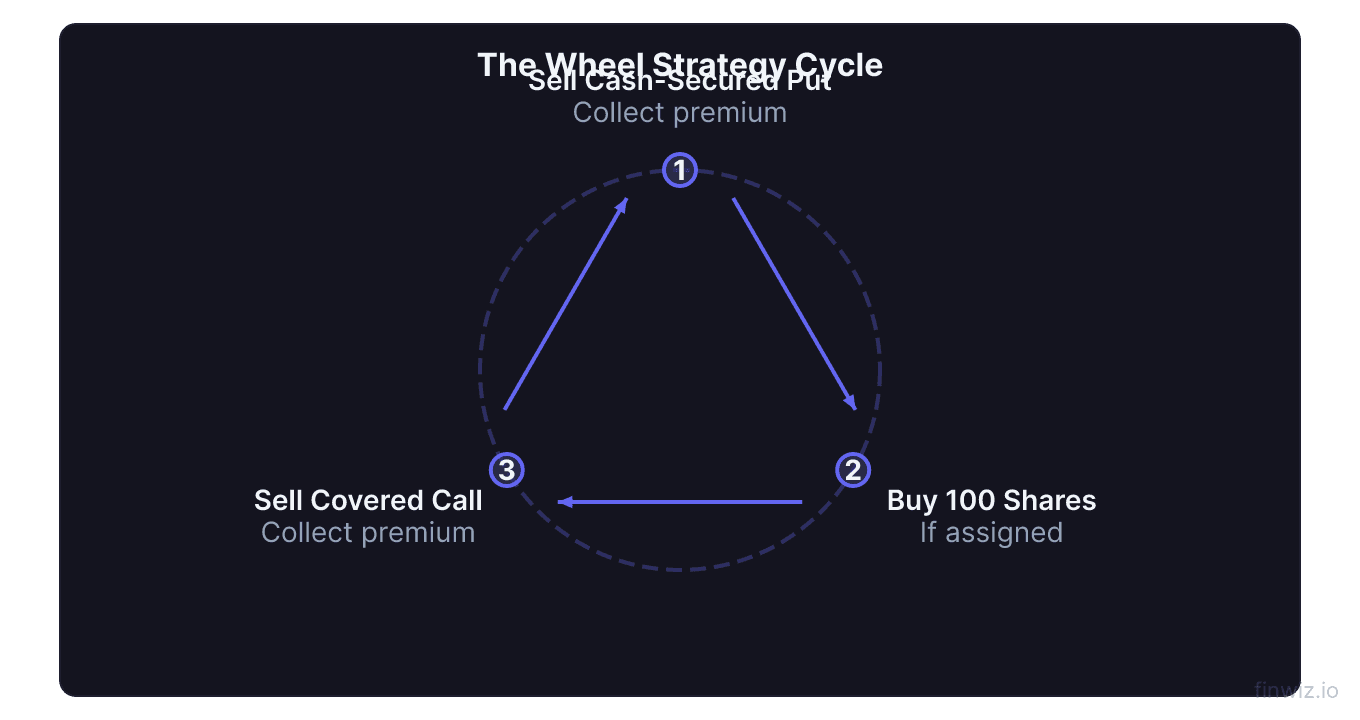
The strategy gets its name from the circular nature of the process. You sell puts, potentially get assigned shares, sell calls on those shares, potentially have them called away, and then start the cycle again. The wheel keeps turning, and you collect premium at each step.
This approach is popular among income-focused investors who want to outperform buy-and-hold on stocks they are already interested in owning. Rather than simply buying shares at the market price, the wheel lets you get paid to wait for a lower entry price, and then get paid again while holding the stock.
The wheel strategy requires substantial capital because you must have enough cash to purchase 100 shares if assigned on your put. For a $100 stock, that means $10,000 per contract. This makes it more suited to well-capitalized accounts.
Phase 1: Selling Cash-Secured Puts
The wheel begins by selling cash-secured puts on a stock you want to own. A cash-secured put means you have sufficient cash in your account to buy 100 shares at the strike price if assigned.
How to execute Phase 1:
- Choose a stock you are willing to own at a lower price
- Sell a put option at a strike below the current price (typically 5-10% out-of-the-money)
- Choose an expiration of 30-45 days for optimal theta decay
- Keep enough cash in your account to cover assignment
For example, XYZ is trading at $50 and you want to own it at $45 or below:
| Detail | Value |
|---|---|
| Stock price | $50.00 |
| Put strike sold | $45 |
| Premium received | $1.25 |
| Expiration | 35 days |
| Cash required | $4,500 |
| Effective buy price if assigned | $43.75 ($45 - $1.25) |
Effective Purchase Price = Put Strike - Premium Received = $45 - $1.25 = $43.75Two outcomes are possible:
Outcome A: Stock stays above $45. The put expires worthless. You keep the $125 premium as pure profit. Return to Phase 1 and sell another put.
Outcome B: Stock drops below $45. You are assigned 100 shares at $45. Your effective cost basis is $43.75 after accounting for the premium received. Move to Phase 2.
Pro Tip
Phase 2: Selling Covered Calls
Once you own 100 shares (through assignment on your put), you immediately begin selling covered calls against those shares. This generates additional income while you hold the stock.
How to execute Phase 2:
- Sell a call option at a strike above your cost basis (ideally above your effective purchase price)
- Choose an expiration of 30-45 days
- If the stock stays below the call strike, the call expires worthless and you sell another
Continuing the example, you now own 100 shares at an effective cost of $43.75:
| Detail | Value |
|---|---|
| Shares owned at | $43.75 effective cost |
| Current price | $44.00 |
| Call strike sold | $47 |
| Premium received | $1.00 |
| Expiration | 30 days |
Two outcomes are possible:
Outcome A: Stock stays below $47. The call expires worthless. You keep the $100 premium. Sell another covered call. Your cost basis effectively drops to $42.75.
Outcome B: Stock rises above $47. Your shares are called away at $47. You sell 100 shares at $47, having bought them at an effective cost of $43.75 (or lower if you sold multiple rounds of calls). Move back to Phase 1.
Total Profit if Called Away = (Call Strike - Effective Cost Basis) + All Premiums CollectedThe Complete Wheel Cycle
Let's trace a full wheel cycle to see how the profits accumulate:
| Step | Action | Premium | Running Total |
|---|---|---|---|
| 1 | Sell $45 put (expires worthless) | +$1.25 | $1.25 |
| 2 | Sell $45 put again (assigned at $45) | +$1.10 | $2.35 |
| 3 | Sell $47 call on shares (expires worthless) | +$1.00 | $3.35 |
| 4 | Sell $48 call on shares (called away at $48) | +$0.75 | $4.10 |
Total premium collected: $4.10 per share ($410 per contract)
Stock profit: Bought at $45, sold at $48 = $3.00 per share ($300)
Total profit for the cycle: $710 on $4,500 capital = 15.8% return
This cycle might take 4-6 months, translating to an annualized return of 30-45%. Results vary, but the wheel consistently generates returns above buy-and-hold when executed on suitable stocks.
Selecting the Right Stocks for the Wheel
Not every stock is appropriate for the wheel strategy. The ideal wheel candidate has specific characteristics.
Stocks you want to own. This is the most important criterion. You will potentially hold these shares for weeks or months. Choose companies with strong fundamentals, consistent earnings, and long-term growth potential. Think of the wheel as a way to get paid to buy stocks you already want.
Moderate implied volatility. Stocks with higher IV generate more premium, but extremely volatile stocks carry higher risk of large drawdowns. Look for IV rank between 30-60% for the best balance of premium and safety.
Liquid options markets. The stock should have tight bid-ask spreads and high open interest in the options chains. This ensures you get fair prices entering and exiting positions.
Price range that fits your capital. Since each contract requires cash to cover 100 shares, the stock price determines your capital requirement. A $50 stock requires $5,000 per contract. A $200 stock requires $20,000.
| Good Wheel Candidates | Poor Wheel Candidates |
|---|---|
| Large-cap blue chips | High-growth unprofitable tech |
| Dividend payers | Biotech/pharma with binary events |
| Major ETFs (SPY, QQQ, IWM) | Meme stocks |
| Moderate IV (30-60%) | Extremely high or low IV |
| Liquid options chains | Illiquid options |
Managing Drawdowns and Difficult Assignments
The biggest challenge with the wheel strategy occurs when a stock drops significantly after you are assigned. This is the risk that makes the wheel less profitable than it appears in theory.
When assigned on a declining stock, you face a dilemma. If the stock has fallen well below your cost basis, selling covered calls at strikes above your cost basis may generate very little premium because those calls are deep out-of-the-money.
Strategy for managing drawdowns:
Option 1: Sell calls below your cost basis. Accept a potential loss on the shares but collect meaningful premium. This is appropriate when you believe the stock will stay depressed for a while.
Option 2: Sell aggressive short-term calls. Use weekly options to collect small premiums frequently. Over time, this chips away at your cost basis.
Option 3: Wait and sell at higher strikes. If the stock is significantly below your cost basis, wait for a partial recovery before selling calls. This preserves your ability to recoup the loss if the stock bounces.
Option 4: Close the position at a loss. If the thesis has fundamentally changed, sell the shares and take the loss. The premium collected from puts and calls offsets some of the loss.
Adjusted Cost Basis = Purchase Price - Total Premiums Collected = $45 - $2.35 = $42.65Pro Tip
The Wheel Strategy vs Buy and Hold
Comparing the wheel to simple buy-and-hold helps you understand when each approach wins.
The wheel outperforms in:
- Sideways markets where the stock trades in a range
- Slightly bullish markets where the stock drifts higher slowly
- High volatility environments where premiums are rich
Buy-and-hold outperforms in:
- Strong bull markets where the stock rises sharply (your calls cap upside)
- Dividend-heavy stocks where the yield is a major return component
- Tax-advantaged situations where long-term capital gains treatment matters
The wheel's primary weakness is that covered calls cap your upside. If you sell a $47 call and the stock surges to $60, you miss out on $13 of gains. This opportunity cost can be substantial in strong bull markets.
However, the wheel's premium income provides a cushion in flat and down markets that buy-and-hold lacks. The break-even analysis often favors the wheel over a complete market cycle that includes both up and down periods.
Tax Implications of the Wheel
The wheel generates short-term capital gains at every stage, which has tax implications you should understand.
Put premiums received are short-term gains if the put expires worthless. If you are assigned, the premium reduces your cost basis in the stock.
Call premiums received are short-term gains if the call expires worthless. If your shares are called away, the premium is added to the sale proceeds.
Stock gains are typically short-term because you usually hold shares for less than one year in the wheel cycle.
Since all income is taxed at ordinary income rates (which can be as high as 37% federally), the wheel is most tax-efficient in tax-advantaged accounts like IRAs. In taxable accounts, the tax drag can reduce returns by 20-35% depending on your bracket.
Advanced Wheel Modifications
Experienced wheel traders often modify the basic strategy for better results.
The double-dip wheel. Sell puts at two different strikes simultaneously to increase premium and diversify your entry points. For example, sell one $45 put and one $43 put instead of two $45 puts.
Adding LEAPS protection. Buy a long-dated LEAPS put far out-of-the-money as catastrophic insurance. This limits your downside if the stock crashes, though it reduces overall returns.
Using weeklies for covered calls. Instead of monthly calls, sell weekly covered calls to capture theta more aggressively. This requires more active management but can generate 20-30% more premium annually.
Scaling into and out of positions. Instead of trading one contract at a time, sell puts at different strikes and expirations. This smooths out your entry price and reduces the impact of any single assignment.
Frequently Asked Questions
How much capital do I need for the wheel strategy?
You need enough cash to buy 100 shares at the put strike price. For a $50 stock, that is $5,000 per contract. Most traders recommend a minimum account size of $25,000-$50,000 to run the wheel effectively on multiple positions, which provides diversification and avoids concentrating too much in one stock.
What return can I realistically expect from the wheel?
Conservative wheel traders targeting quality stocks typically generate 15-30% annualized returns including both premium income and stock appreciation. Returns vary based on market conditions, stock selection, and management skill. In sideways markets, the wheel can produce even higher returns relative to buy-and-hold.
What happens if the stock crashes after I'm assigned?
This is the primary risk. If the stock drops sharply, you own shares at a loss. Your options are to sell covered calls at lower strikes to generate income, hold and wait for recovery, or sell at a loss. The premiums collected from puts and calls cushion the loss but do not eliminate it. This is why choosing quality stocks you want to own is essential.
Can I run the wheel in an IRA?
Yes, and it is often recommended. IRAs eliminate the tax drag from short-term capital gains. You can sell cash-secured puts and covered calls in most IRA accounts. However, you cannot sell naked options in an IRA, so the wheel's cash-secured and covered structure is ideal.
How does the wheel compare to dividend investing?
Both generate income, but through different mechanisms. Dividends provide predictable, passive income with no effort. The wheel generates higher income but requires active management. Dividend stocks also offer long-term capital gains tax treatment on qualified dividends, while wheel premiums are taxed as short-term gains in taxable accounts.
Disclaimer
This is educational content, not financial advice. Trading involves risk, and you should consult a qualified financial advisor before making any investment decisions. Past performance does not guarantee future results.
Related Articles
12 chapters covering charts, indicators, risk management & more. Plus weekly trading insights.