
Butterfly Spread: Low-Cost Options Strategy for Range-Bound Markets
⚡ Key Takeaways
- A butterfly spread combines a bull spread and bear spread using three strike prices for a low-cost, defined-risk trade
- Maximum profit occurs when the underlying lands exactly at the center strike at expiration
- Butterfly spreads are ideal for range-bound markets where you expect low volatility
- The maximum loss is limited to the net premium paid to enter the trade
- You can construct butterflies with calls, puts, or a combination (iron butterfly)
What Is a Butterfly Spread?
A butterfly spread is an advanced options strategy that combines elements of both a bull spread and a bear spread into a single, low-cost position. It uses three different strike prices with the same expiration date, creating a structure that profits most when the underlying asset stays near the middle strike at expiration.
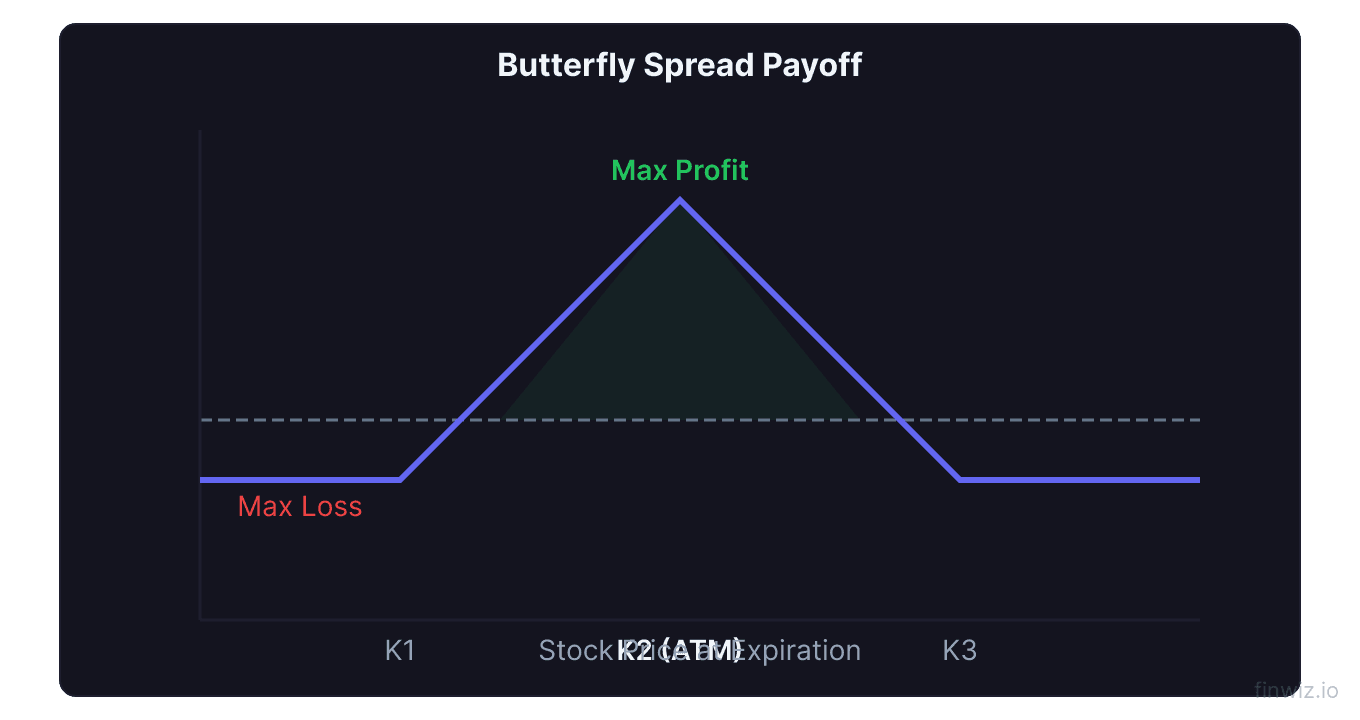
The name comes from the shape of the profit and loss diagram, which resembles a butterfly's wings. The body of the butterfly sits at the center strike where maximum profit occurs, while the wings extend outward to define the breakeven points and maximum loss zones.
Butterfly spreads are considered neutral strategies because they are designed for markets expected to trade within a narrow range. Traders deploy them when they believe a stock will stay relatively flat, making them the opposite of strategies like straddles that profit from large moves.
How to Construct a Long Call Butterfly
The most common form is the long call butterfly, which involves three legs placed simultaneously. Here is the exact construction:
- Buy 1 call at the lower strike (in-the-money)
- Sell 2 calls at the middle strike (at-the-money)
- Buy 1 call at the upper strike (out-of-the-money)
The strikes must be equidistant from one another. For example, if you choose strikes of $95, $100, and $105, the distance between each is $5.
Net Debit = (Lower Call Premium + Upper Call Premium) - (2 x Middle Call Premium)Because the two short calls at the middle strike generate premium that partially offsets the cost of the two long calls, the net debit is typically very small. This is one of the most attractive features of the butterfly: low capital outlay with defined risk.
Consider a practical example. Stock XYZ is trading at $100. You construct a butterfly with 30 days to expiration:
| Leg | Strike | Action | Premium |
|---|---|---|---|
| Lower call | $95 | Buy 1 | $6.50 |
| Middle calls | $100 | Sell 2 | $3.50 each ($7.00 total) |
| Upper call | $105 | Buy 1 | $1.50 |
Net Debit = ($6.50 + $1.50) - $7.00 = $1.00 per share ($100 per contract)Maximum Profit, Maximum Loss, and Breakeven Points
Understanding the risk/reward profile of the butterfly spread is essential before placing the trade. The math is straightforward once you know the structure.
Maximum profit occurs when the underlying price is exactly at the center strike at expiration. In that scenario, the lower call is fully in-the-money, the two short middle calls and the upper call all expire worthless or at-the-money.
Max Profit = (Middle Strike - Lower Strike) - Net Debit PaidUsing our example: Max Profit = ($100 - $95) - $1.00 = $4.00 per share, or $400 per contract.
Maximum loss is simply the net debit paid to enter the trade. In our example, that is $1.00 per share or $100 per contract. This loss occurs if the stock moves decisively above the upper strike or below the lower strike.
The breakeven points are calculated as:
Lower Breakeven = Lower Strike + Net Debit = $95 + $1.00 = $96.00Upper Breakeven = Upper Strike - Net Debit = $105 - $1.00 = $104.00This gives a profit zone between $96 and $104, an $8 range where the trade makes money. The risk-to-reward ratio of risking $1 to potentially make $4 is an impressive 4:1.
Long Put Butterfly
You can also construct a butterfly using put options instead of calls. The long put butterfly works as follows:
- Buy 1 put at the upper strike
- Sell 2 puts at the middle strike
- Buy 1 put at the lower strike
The profit and loss profile is identical to the long call butterfly when using the same strikes and expiration. The choice between calls and puts often comes down to liquidity and pricing efficiency. Sometimes one side offers a slightly better fill than the other due to skew or open interest.
Pro Tip
The Iron Butterfly Variation
The iron butterfly is a popular variation that uses both calls and puts. It is constructed as a combination of a bull put spread and a bear call spread:
- Sell 1 put at the middle strike
- Buy 1 put at a lower strike
- Sell 1 call at the middle strike
- Buy 1 call at an upper strike
Unlike the standard butterfly which is entered for a debit, the iron butterfly is entered for a net credit. Your maximum profit is the credit received, and it occurs when the underlying expires exactly at the middle strike.
| Feature | Long Butterfly | Iron Butterfly |
|---|---|---|
| Entry | Net debit | Net credit |
| Max profit | Strike width - debit | Credit received |
| Max loss | Net debit | Strike width - credit |
| Best for | Low IV environments | Higher IV environments |
When to Use a Butterfly Spread
Butterflies work best in specific market conditions. Understanding when to deploy this strategy is just as important as knowing how to construct it.
Range-bound markets are the primary environment. If you believe a stock will consolidate around a certain price, the butterfly lets you profit from that thesis with minimal capital at risk.
Pre-earnings plays can work if you believe the stock will not move much after the announcement. However, this is risky because earnings often produce significant moves. Many traders prefer to place the butterfly after earnings when volatility has already collapsed.
Low implied volatility environments favor buying butterflies because the options are cheaper to purchase. When IV is high, consider the iron butterfly instead since you collect more premium as a net seller.
Time horizon matters significantly. Butterflies with very long durations behave more like directional trades and less like pinning bets. The classic butterfly works best with 2 to 4 weeks until expiration, when theta decay accelerates on the short options.
Managing and Adjusting Butterfly Spreads
Once you have entered a butterfly, active management can significantly improve your results. Here are the key management techniques.
Take profits early. Most experienced traders do not hold butterflies to expiration hoping for the perfect pin. A common rule is to close the trade when it reaches 50% to 75% of maximum profit. Since pinning at the exact strike is unlikely, capturing a partial win is smart.
Roll the center strike. If the underlying moves away from your center strike, you can close the current butterfly and open a new one centered at the current price. This is called rolling and essentially resets the trade.
Widen or narrow the wings. Wider wings give you a larger profit zone but cost more. Narrower wings are cheaper but require more precise price action. You can adjust wing width based on the stock's expected trading range.
Time-based exits. If the trade is not working with a week left and the stock is outside the profit zone, consider closing for a small loss rather than hoping for a last-minute reversal.
Pro Tip
Butterfly Spreads vs Other Range-Bound Strategies
The butterfly is not the only strategy for sideways markets. Here is how it compares to alternatives:
| Strategy | Cost | Max Profit | Risk | Complexity |
|---|---|---|---|---|
| Butterfly | Very low | High ratio | Limited to debit | Moderate |
| Iron Condor | Credit received | Credit received | Defined | Moderate |
| Short Straddle | Credit received | Credit received | Unlimited | Low |
| Calendar Spread | Moderate debit | Moderate | Limited to debit | Moderate |
The butterfly has the best risk-to-reward ratio among these strategies but requires the most precise directional forecast. Iron condors offer a wider profit zone but lower reward. Short straddles collect the most premium but carry unlimited risk.
Common Mistakes with Butterfly Spreads
Beginners frequently make several errors when trading butterflies. Avoid these pitfalls to improve your results.
Choosing illiquid options is the most common mistake. Wide bid-ask spreads can eat into your edge significantly. Always trade butterflies on highly liquid underlyings like SPY, QQQ, AAPL, or major indices.
Ignoring commissions can turn a winning trade into a loser. With four legs (or three unique strikes), round-trip commissions add up. Use a broker with competitive multi-leg pricing.
Holding to expiration exposes you to pin risk. If the stock closes right at your short strike, you may face unexpected assignment. Close the trade before the last day to avoid this.
Trading butterflies in trending markets is a recipe for losses. This is a range-bound strategy. If the market is trending strongly, use directional strategies like debit spreads instead.
Frequently Asked Questions
What is the ideal market condition for a butterfly spread?
The ideal condition is a range-bound market with relatively low implied volatility. You want the underlying asset to stay near the center strike through expiration. Sideways price action with declining volatility creates the best environment for butterfly profits.
Can I lose more than my initial investment on a butterfly spread?
No. The maximum loss on a long butterfly spread is the net debit paid to enter the trade. This is one of the strategy's most appealing features: clearly defined, limited risk with no possibility of catastrophic loss.
Should I use calls or puts for my butterfly?
Both produce essentially the same profit and loss profile at the same strikes. Check the pricing of both before entering and choose whichever offers the lower net debit. Also consider liquidity; sometimes one side has tighter bid-ask spreads.
How wide should I make the wings of my butterfly?
Wing width depends on your confidence in the underlying staying near the center strike. Narrower wings (e.g., $2.50 apart) cost less but have a tighter profit zone. Wider wings ($5 or $10 apart) cost more but provide a larger range for profitability. Match wing width to the stock's expected trading range.
When should I close a butterfly spread?
Consider closing when the trade reaches 50-75% of maximum profit or when the underlying moves decisively outside your profit zone with significant time remaining. Do not hold to the final day of expiration to avoid pin risk and assignment complications.
Disclaimer
This is educational content, not financial advice. Trading involves risk, and you should consult a qualified financial advisor before making any investment decisions. Past performance does not guarantee future results.
Related Articles
12 chapters covering charts, indicators, risk management & more. Plus weekly trading insights.