
Poor Man's Covered Call: Using LEAPS Instead of Stock
⚡ Key Takeaways
- A poor man's covered call (PMCC) replaces stock ownership with a deep ITM LEAPS call to reduce capital requirements
- The LEAPS call should have a delta of 0.75 or higher to closely mimic stock ownership
- You sell short-term OTM calls against the LEAPS to generate recurring income
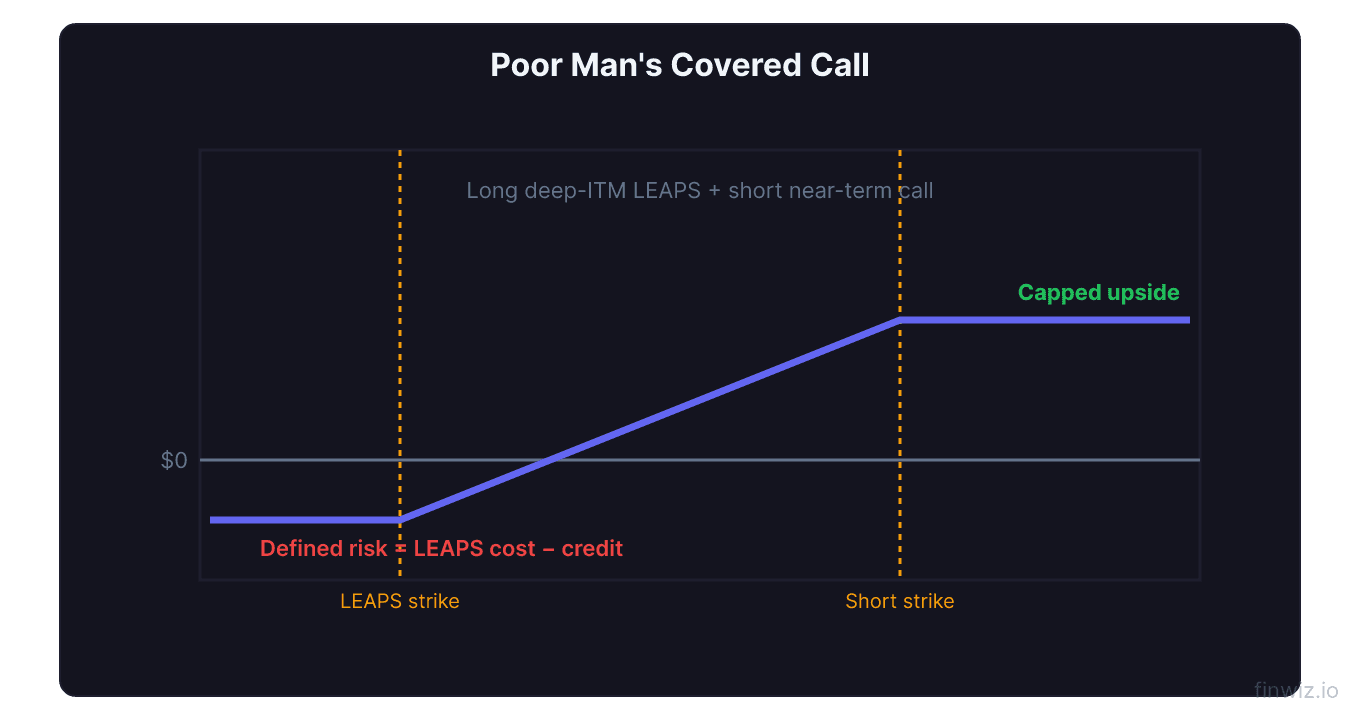
- Maximum loss is limited to the net debit paid for the LEAPS minus total premiums collected
- The strategy requires less than half the capital of a traditional covered call position
What Is a Poor Man's Covered Call?
The poor man's covered call (PMCC) is a capital-efficient alternative to the traditional covered call strategy. Instead of buying 100 shares of stock and selling calls against them, you buy a deep in-the-money LEAPS call option as a stock substitute and sell short-term calls against it.
The name comes from the reduced capital requirement. Buying 100 shares of AAPL at $190 costs $19,000. A deep ITM LEAPS call on AAPL might cost $4,000-$5,000. You control the same upside exposure for roughly 25% of the capital, freeing the rest for other positions.
Technically, this is a diagonal spread — a long option at one strike and expiration paired with a short option at a different strike and expiration. The diagonal spread framework applies to the mechanics, but the PMCC specifically uses a deep ITM long leg and an OTM short leg to simulate covered call behavior.
Building the Position
The PMCC has two legs:
Leg 1: Buy a deep ITM LEAPS call. Choose an expiration at least 6-12 months out, ideally longer. Select a strike with a delta of 0.75 to 0.85. This ensures the LEAPS moves almost dollar-for-dollar with the stock.
Leg 2: Sell a short-term OTM call. Choose an expiration 30-45 days out. Select a strike above the current stock price — typically at a delta of 0.20 to 0.30 — to give the stock room to appreciate.
Example on MSFT trading at $420:
| Leg | Details | Cost/Credit |
|---|---|---|
| Buy LEAPS | $370 call, 12 months out, delta 0.80 | $58.00 ($5,800) |
| Sell short call | $435 call, 30 DTE, delta 0.25 | $4.50 ($450) |
| Net debit | $53.50 ($5,350) |
Compare this to buying 100 shares of MSFT at $420 ($42,000) and selling the same $435 call. The PMCC achieves a similar income stream for 87% less capital.
Capital Reduction = 1 − (LEAPS Cost ÷ Stock Cost) × 100In this case: 1 − ($5,800 ÷ $42,000) = 86% capital reduction.
Selecting the LEAPS Call
The LEAPS selection determines whether your PMCC behaves like a covered call or a speculative bet. Get this wrong and the strategy falls apart.
Delta of 0.75+. This is non-negotiable. A LEAPS with lower delta does not track the stock closely enough. When the stock rises, a low-delta LEAPS gains less than a high-delta one, reducing the effectiveness of the stock substitution.
Minimum 6 months to expiration. Shorter-dated options lose too much value to theta. LEAPS options with 12-18 months are ideal because theta decay is minimal on long-dated options, preserving your capital base.
Minimal extrinsic value. Deep ITM LEAPS have most of their value in intrinsic value. The extrinsic portion is what you pay for the leverage privilege. Less extrinsic value means less time decay on your long leg.
Check options moneyness to confirm your LEAPS is deep enough in the money. A good rule of thumb: the strike should be 10-15% below the current stock price for the LEAPS to have sufficient delta.
Pro Tip
Selling Short-Term Calls Against the LEAPS
Once you own the LEAPS, you sell short-term calls monthly to generate income. This is identical to how covered call sellers operate, but your LEAPS is the collateral instead of shares.
Strike selection for the short call:
- Delta 0.20-0.30 — Standard approach. Roughly 70-80% probability the short call expires worthless. You keep the premium and sell again next month.
- Delta 0.10-0.15 — Conservative. Less premium but a higher win rate and more room for the stock to appreciate.
- Delta 0.35-0.45 — Aggressive. More premium but a higher chance the stock rises above the short strike, potentially capping your profit.
Key rule: The short call strike should be above your LEAPS breakeven.
LEAPS Breakeven = LEAPS Strike + LEAPS Premium PaidFor our MSFT example: $370 + $58.00 = $428.00. If you sell the $435 short call and MSFT rallies past $435, you still profit because $435 is above your $428 breakeven. If you sold a $425 call (below breakeven) and got assigned, you could actually lose money on the overall position despite the stock rising.
Managing the Position
When the short call expires worthless: Sell another short-term call for the next cycle. This is the best outcome — you collected premium and maintained your LEAPS position.
When the stock approaches the short strike: You have three choices. Let it get called away (close both legs for a profit), roll the short call up and out to a higher strike and later expiration, or buy back the short call and wait for a pullback before selling another.
When the stock drops significantly: Your LEAPS loses value, but the short call expires worthless or can be bought back cheaply. The concern is a sustained decline that erodes your LEAPS value. If the stock drops 15-20% and your thesis changes, consider closing the entire position rather than continuing to sell calls against a depreciating LEAPS.
Adjusting the LEAPS: If your LEAPS has less than 90 days to expiration, it is time to roll it to a new LEAPS further out. Do not let the long leg approach expiration — the time decay accelerates and you lose the capital efficiency advantage.
Risk and Reward Profile
Maximum profit on a single cycle occurs if the stock closes at the short call strike at expiration. You capture the full premium from the short call plus the appreciation of the LEAPS up to that price.
Max Profit (Single Cycle) = (Short Strike − LEAPS Strike − LEAPS Premium + Short Call Premium) × 100Maximum loss occurs if the stock drops to zero. Your loss is the LEAPS premium paid minus all short call premiums collected. In practice, you would close the position long before this point.
Ongoing income compounds over multiple cycles. If you sell calls 10-12 times per year and collect $300-$500 each time, that is $3,000-$6,000 in annual income on a $5,800 capital base — a potential 50-100% annualized return on the short call income alone.
| Metric | PMCC (MSFT Example) | Traditional Covered Call |
|---|---|---|
| Capital required | $5,350 | $41,550 |
| Monthly income | ~$450 | ~$450 |
| Annualized yield on capital | ~100% | ~13% |
| Max loss | $5,350 | $41,550 |
| Dividend income | None | Yes |
Pro Tip
Frequently Asked Questions
What happens if my short call is assigned on a PMCC?
If the short call is assigned, you must deliver 100 shares. Since you do not own shares, your broker will exercise your LEAPS to obtain them (or you can exercise it yourself). You buy at the LEAPS strike and sell at the short call strike. As long as the short call strike is above your LEAPS breakeven, the assignment results in a profit. If it is below your breakeven, you take a loss on the overall position.
Can I use the PMCC in a retirement account?
Yes. Most brokers allow PMCC positions (defined-risk diagonal spreads) in IRA accounts. Since your risk is limited to the LEAPS premium, there is no margin requirement. This makes the PMCC an excellent way to generate covered call style income in a retirement account without the large capital requirement of owning 100 shares.
How do I choose which stocks to run a PMCC on?
Focus on stocks with strong long-term uptrends, high liquidity, and low or no dividends. Stocks like AAPL, MSFT, GOOGL, and AMZN are popular PMCC candidates. Avoid highly volatile names where a large drop could wipe out the LEAPS value, and avoid dividend-paying stocks where the lack of dividend income is a meaningful disadvantage versus owning shares outright.
12 chapters covering charts, indicators, risk management & more. Plus weekly trading insights.